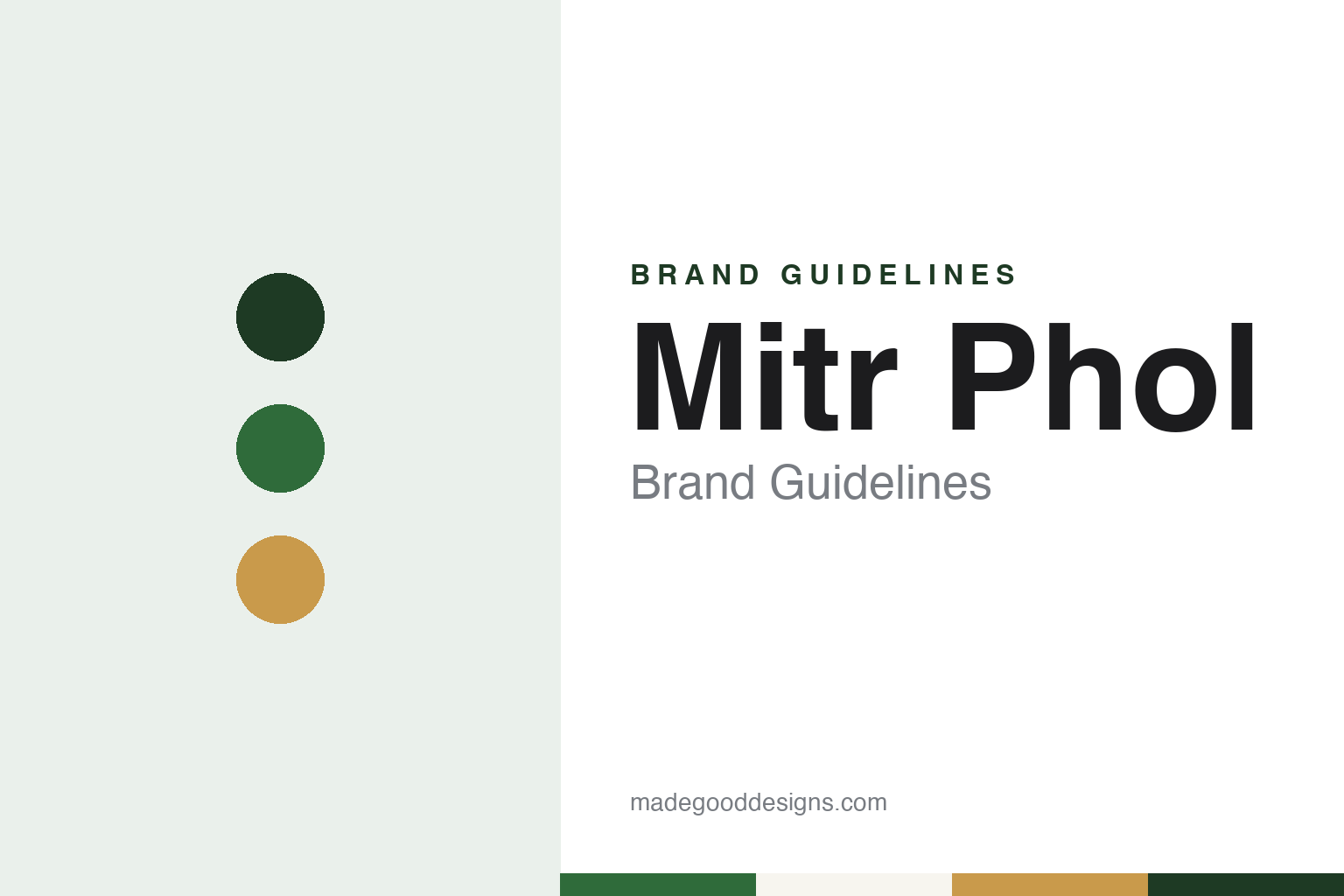
Mitr Phol Brand Guidelines
A 1946 Ratchaburi syrup business that became a sugar group.
Aa
Two constants: a cane green, deep field and raw sugar palette and a rounded sans register. Abstract homage — not a Mitr Phol product or mark; no pack, logo or label is reproduced.
Ban Pong, 1946
From cane syrup to a group of mills.
Mitr Phol began in 1946 as a small family business in Ban Pong district, Ratchaburi province, west of Bangkok. According to Thai and English Wikipedia, it first made condensed cane syrup and sold it to sugar mills; in 1956 it began to produce sugar of its own. English Wikipedia describes the group as privately owned, mainly by the Vongkusolkit family. The Nation named Isara Vongkusolkit as chairman of Mitr Phol Group in 2018, and the Bangkok Post named Buntoeng Vongkusolkit as chairman in 2023.
Growth came through new mills across Thailand’s cane-growing provinces. Thai Wikipedia dates the Mitr Phu Khieo mill in Chaiyaphum province to 1983; the Dan Chang mill in Suphan Buri province to 1990, the same year the group started making particle board; the Phu Wiang mill in Khon Kaen to 1995; and the Kalasin mill, at Kuchinarai, to 1997, together with a cane and sugar research company. English Wikipedia lists seven Thai mills today, from Suphan Buri and Sing Buri in the centre to Loei and Amnat Charoen in the north-east, and gives their combined capacity as 130,500 tonnes of cane a day.
The group went abroad in 1993, when it began investing in sugar in Guangxi, in southern China; Thai Wikipedia says it now has seven mills there, and English Wikipedia names East Asia Sugar as its joint venture. In 2006 it set up Mitr Lao Sugar in Savannakhet province, Laos. Australia followed. The Sydney Morning Herald reported in November 2011 that Mitr Phol had bought a fifth of MSF Sugar in 2010, had raised its holding to 22 per cent by July 2011, and was seen as the likely bidder for the rest; Thai Wikipedia dates the group’s move into Queensland to 2012. MSF Sugar’s own website now describes the company as part of the Thai Mitr Phol Group, with its head office at Gordonvale, south of Cairns, and four mills at Gordonvale, South Johnstone, the Atherton Tablelands and Maryborough.
Colour
Sugar, then everything the cane leaves behind.
Sugar is where the Mitr Phol name is most visible to shoppers. English Wikipedia lists a retail range sold under the name that includes refined, brown, coconut and rock sugars, syrups and icing sugar, and the group’s Thai-language website groups its products under four headings: Mitr Phol sugar, molasses, fertiliser and wood-substitute materials. The same site presents separate businesses for cane development, sugar, energy, wood substitutes, research and overseas operations.
Energy grew out of the mills. Thai Wikipedia says the group opened its first biomass power plant at Dan Chang in 2002, followed by a second at Phu Khieo, and its first ethanol plant, run by Mitr Phol Bio-Fuel, at Phu Khieo in 2005. More ethanol plants followed at Kuchinarai in 2006, at Mae Sot in Tak province in 2007 as a joint venture with Padaeng Industry and Thai Oil, and at Dan Chang in 2009. English Wikipedia explains the logic: molasses left over from sugar-making is the feedstock for ethanol that is blended into petrol as gasohol, while Mitr Phol Bio-Power runs power plants beside the mills that burn bagasse, the fibre left after the cane is crushed. Thai Wikipedia adds a bagasse power plant at Funan in China in 2010, which it calls the first of its kind there, and one in Laos in 2011.
The same fibre feeds the group’s board business. English Wikipedia says the subsidiary Panel Plus makes particle board and medium-density fibreboard from bagasse and rubber-wood chips at plants in Chaiyaphum and Songkhla provinces, and also produces melamine-faced panels.
Research and farming practice are a large part of how the group describes itself. Thai Wikipedia dates a second innovation and research centre, at Thailand Science Park in Pathum Thani, to 2014. The Nation reported in January 2017 that the group had developed a smart-farming programme called Mitr Phol Modern Farm, using GPS-guided machinery, controlled truck traffic and a leaf cover left on the soil instead of burning cane leaves, and was passing those methods on to smaller growers.
Typography
Cane, mills and the by-product economy.
Sugar and ethanol producers sit between the farm and the factory, and their identities usually show both sides. Many use green, blue or gold in their wordmarks and colour systems, and their websites and reports lean on photographs of the raw material: rows of cane in Brazil or India, beet harvests and clamps in northern Europe, and the mills, boilers and storage silos that turn a crop into sugar, alcohol and power.
Most of these companies sell more to industry than to shoppers, so the consumer face is often a separate brand. A packaged sugar name on a supermarket shelf can be older than the group that owns it, and the same group may also make bioethanol for fuel, alcohol for drinks and cosmetics, animal feed from beet pulp, and electricity from bagasse, the fibre left after cane is crushed. Tereos, for example, sells sugar in France under the Béghin Say name, while Raízen sells fuel in Brazil under a licensed Shell brand.
Ownership shapes the language. Cooperatives such as Tereos speak to and for their grower members, and talk about fields, harvests and the farmers who supply the mills; listed companies and family groups address investors, and joint ventures often carry the names of their parents. Their websites tend to follow a familiar pattern, with pages on products, sustainability and the communities around their mills.
Much of what can be checked about these companies sits in their annual and sustainability reports, stock-exchange filings and regional business press. This guide sets out who founded each producer, who owns it, where it operates and what it says about its brands, and marks clearly what rests on the company’s own word.
Aa
A rounded sans with a Thai companion. (Specimen set in Prompt, a sans STAND-IN; NOT the Mitr Phol logo.)
Mitr Phol
A family name on mills in four countries.
The group’s record abroad includes a long land dispute in Cambodia. Families in Oddar Meanchey province, in the country’s north-west, were evicted in 2008 and 2009 from land granted as a concession for a sugar plantation, the Thomson Reuters Foundation reported in the Bangkok Post in August 2020. Mitr Phol said it had received the concessions in line with Cambodian law, and that it had withdrawn from the project in 2014 and recommended that the land be returned to the communities. A lawsuit was filed in a Thai court in 2018, and at the end of July 2020 the Bangkok South Civil Court allowed it to go ahead as a class action; the report described it as the first class action brought in a Thai court by plaintiffs from another country against a Thai company operating abroad. According to Inclusive Development International, an advocacy group that supported the plaintiffs, the two sides reached a resolution through court-led mediation in February 2025, the company made an undisclosed payment to the communities in May, and the court dismissed the case on 14 May 2025.
Scale is usually described by others. In 2018 The Nation described Mitr Phol as the fifth-largest sugar producer in the world, and the 2020 Thomson Reuters Foundation report called it Asia’s largest. Certification is part of the group’s public story too: The Nation reported in 2017 that Mitr Phol had won a Bonsucro sustainability award in 2015 and that in 2016 it became the first company in Thailand, and the second in Asia, to be certified by Bonsucro, the sugar-cane standard body.
For a design guide, Mitr Phol shows how one family name can sit on a supermarket sugar pack, an ethanol plant and a board factory at once, and how a group that grew mill by mill presents itself through cane fields, farming programmes and by-products. Compare Wilmar, another Asian agribusiness group with sugar mills in Queensland, and Dhampur Sugar Mills, an Indian maker that also turned molasses into ethanol. For this guide we use cane green, a deep field green and a raw-sugar gold with a sans, an unofficial interpretation; no product or logo is reproduced.
Explore & save
Keep Mitr Phol’s identity on hand — save it to a board in the Made Good inspiration library.
Mitr Phol identity set
Pin the Mitr Phol cane green, deep field and raw sugar palette and the rounded sans register to your own board.