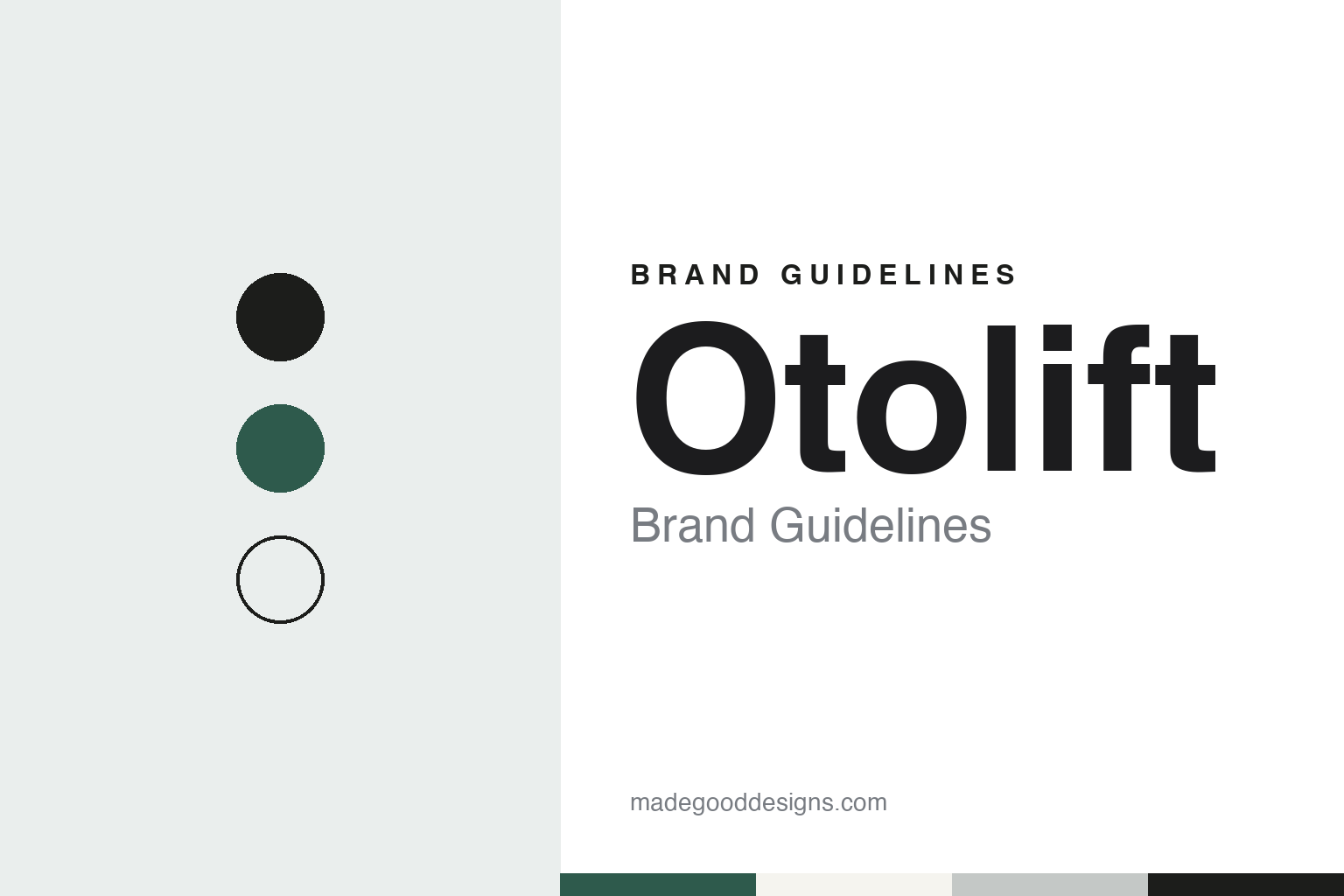
Otolift Brand Guidelines
An 1891 Ammerstol smithy turned royal stairlift maker.
Aa
Two constants: a polder green, rail silver and smithy black palette and a geometric sans register. Abstract homage — not an Otolift product or mark; no stairlift, logo or crown is reproduced.
Otto Ooms’s smithy
Stoves, horseshoes and salmon boats on the Lek.
Otolift began as a blacksmith’s shop. The company says Otto Ooms opened it in 1891 in Ammerstol, a South Holland village on the river Lek, making stoves for salmon fishermen and horseshoes for the horses that pulled the salmon barges. Dutch Wikipedia gives the same founding year and names the early business after its founder, as Otto Ooms B.V.
From 1898, the company says, Otto Ooms also built and repaired salmon boats in his father’s shipyard, and the Ooms family were for many years among the larger boatbuilders in Ammerstol. Dutch Wikipedia says that when salmon fishing on the Lek stopped in 1921, orders fell, and in the years that followed the business turned to forge work for the building trade and to steel tank trucks. The sources used for this guide do not say how the company operated during the occupation of 1940–1945.
The company dates the next turn to 1950, when Jan Otto Ooms took over the smithy from his father and built and adapted tank trucks for the petroleum trade, each made to the customer’s order. When that demand eased, the company says, he moved the firm into lifting: a balance lift that worked with counterweights, then a platform lift, and in the late 1960s its own first stairlift. Dutch Wikipedia dates the first stairlifts made by the firm to 1970, says they were mostly installed in homes for older people, and says the balance lift was developed with the Dutch research organisation TNO. It also says a second trade name, Otolift, came into use at this time, and that the Otolift brand name was registered in 1989.
In 1980 the business moved to a new production hall in the nearby village of Bergambacht, where Dutch Wikipedia places its head office and a production hall today. The company says Otto and Alex Ooms, the children of Jan Otto, took over the business at that point and began making home lifts, and that the Dutch market followed quickly.
Colour
Rails, modules and a Red Dot.
Otolift’s products are stairlifts, and the company names them by rail and staircase. It says cuts to municipal housing-adaptation budgets in the 1990s, together with a growing focus on sustainability, led it to develop a reusable stairlift in 1995, built around what it calls the Flexi-Rail. Dutch Wikipedia dates the funding change to 1994, when the budget for home adaptations passed from the national ministry to the municipalities, and says that from then on stairlifts no longer went to waste after use but could be fitted again. It adds that CNC lathes, robots and lasers let the company produce at lower cost.
The Flexi-Rail was refined into the Otolift Two, a compact chair on two slim tubes for the outer curve of a staircase, in 2002, and the Otolift Parallel, for straight stairs, followed in 2007, the company says. Around 2010 came the Otolift One, which can be fitted on the inner or the outer side of a staircase. The company says the Otolift One won a Red Dot Design Award in 2011, and Dutch Wikipedia also records the award for the firm’s inner-rail stairlift of that period.
At the Rehacare trade fair in Düsseldorf in 2016 the company introduced the Otolift Modul-Air, built from modules to shorten delivery times. The Otolift Line, for straight indoor or outdoor staircases, was updated in 2019, and the Modul-Air Smart followed in 2023 with a small display in the armrest that shows the status of the lift. The company says the Modul-Air Smart can be fitted on stairs as narrow as seventy centimetres and that the chair of the Line folds to 31 centimetres deep. It names the standard NEN-EN 81-40 for both models, and ISO 9001 and ISO 14001 for the Line.
The company also describes its own working methods: an app that measures a staircase digitally and sends the data to its drawing office for a made-to-measure rail, an augmented-reality app that previews the lift on the customer’s stairs, and a production line that uses collaborative robots and RFID tracking.
Typography
How lift makers present themselves.
Home-lift and stairlift makers sell machines that end up in private hallways and living rooms, and two Swedish makers, Aritco and Cibes, present them that way. Aritco names its range around the home, with the HomeLift, HomeLift Compact and HomeLift Access, and credits the Swedish designer Alexander Lervik for several models; Cibes Lift Group says its customers choose from colour, material and function options picked by local design teams.
Naming often begins as engineering shorthand. Cibes still uses letter-and-number models such as the A5000, launched in 1992, and groups its lifts as A-lifts, with their own shaft walls, and B-lifts, which the company traces to a screw-and-nut design of the early 1970s. Aritco moved from numbered models, from the Aritco 7000 of 1995 to the Aritco 9000 cabin lift of 2013, to the named HomeLift and PublicLift lines from 2016 onwards.
Both companies describe selling largely through partners. Cibes Lift Group says it works through more than 270 certified distributors as well as its own offices in 20 countries; Aritco says it sells in 60 countries through more than 170 distributors, and that it set up a global network of installation and service partners in 2014. Cibes has also bought local lift companies and kept several of their names, such as Kalea, Aesy Liften and Apex Lifts.
Corporate pages fill in the rest: who owns the company and where the lifts are made. Cibes names its factories in Gävle, Jiaxing and the United States and a components unit in Gdańsk, and its owner, the investment company Nalka, lists it as a holding. Aritco describes its factory in Veddesta, outside Stockholm, and its place in Innovalift, a business area of Investment AB Latour. This guide sets out what can be checked for each brand, and marks what rests on the company’s own word.
Aa
A geometric sans for a crowned, functional name. (Specimen set in Outfit, a sans STAND-IN; NOT the Otolift logo.)
Royal Otolift Stairlifts
A crown, a Meditek deal and NPM Capital.
In 2016 Otolift received the Dutch royal designation, the predicate Koninklijk, which Dutch Wikipedia also records. The company says it has traded since then as Royal Otolift Stairlifts and that a crown was added to its logo; its corporate site carries the line “Innovation since 1891.”
The company made its first acquisition in 2018, buying the English stairlift brand Meditek, which it describes as previously one of the larger stairlift suppliers in England. Ownership changed in 2022. The Dutch competition authority ACM decided on 2 September 2022 that NPM Investments 28, a subsidiary of the investment company NPM Capital, could take over Otolift Beheer. Its decision describes Otolift Beheer as a producer and supplier of stairlifts whose largest markets are in the European Union and the United Kingdom, and which also offers service and maintenance subscriptions and stairlift rental. The 2022 annual report of SHV, the parent of NPM Capital, says NPM acquired a majority stake in Otolift in October 2022.
The company calls itself the largest stairlift supplier in the Netherlands. It says it develops and makes its stairlifts in its own factory, sells through subsidiaries in Belgium, France, Italy, Spain and the United Kingdom, and exports to more than 45 other countries. Dutch Wikipedia adds a second production site in Slovakia and dates the opening of offices in Milan in 2009, Paris in 2010, Newcastle in 2012 and Belgium and Spain in 2016. The consumer websites run country by country, beside a separate corporate site for dealers and suppliers.
For a design guide, Otolift shows how a nineteenth-century smithy can stand behind a modern product range: short, descriptive model names such as Line, Parallel and Modul-Air Smart, a royal name with a crown, and the founding year of 1891 kept beside it. Compare Stannah and Handicare, two other stairlift makers. For this guide we use polder green, rail silver and smithy black with a geometric sans, an unofficial interpretation; no product or logo is reproduced.
Explore & save
Keep Otolift’s identity on hand — save it to a board in the Made Good inspiration library.
Otolift identity set
Pin the polder green, rail silver and smithy black palette and the geometric sans register to your own board.