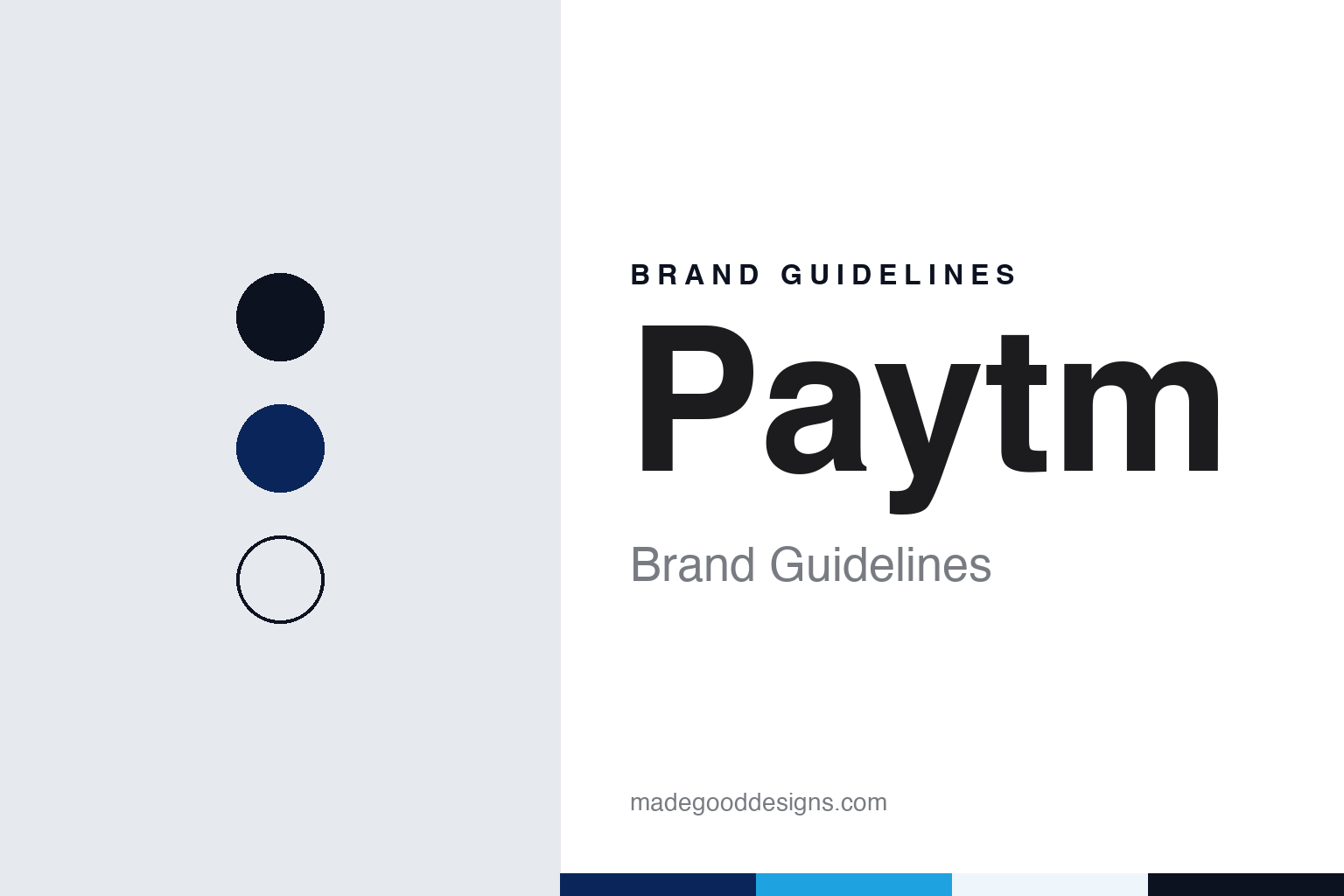
Paytm Brand Guidelines
One97’s pay-through-mobile brand, from recharges to the Soundbox.
Aa
Two constants: a deep navy, clear sky and cloud white palette and a soft geometric sans register. Abstract homage — not a Paytm product or mark; no app screen, QR code, device or logo is reproduced.
One97 and a recharge site
Pay Through Mobile, from 2010.
Paytm is the consumer brand of One97 Communications, an Indian company that, the Free Press Journal reported on the day of its stock-market debut, was founded in 2000 and began in mobile value-added services. Its founder is Vijay Shekhar Sharma, who led the company as founder and chief executive when it listed. Before Paytm, according to a 2026 explainer in Jagran Josh, One97 supplied services such as ringtones, cricket scores and alerts to telecom operators.
Paytm itself arrived in 2010 as a service for recharging prepaid mobile phones. The name, the same explainer says, stands for “Pay Through Mobile,” and the service grew from recharges into a mobile wallet. The Free Press Journal listed what it had become by 2021: payments, credit, insurance, merchant services, wealth management and e-commerce. Jagran Josh ties its fastest growth to India’s 2016 withdrawal of its 500- and 1,000-rupee notes, when shopkeepers and auto-rickshaw drivers turned to digital payment, and points to the spoken “Paytm Karo” heard at checkouts as the brand’s familiar sound.
One97 Communications listed on the Indian stock exchanges on 18 November 2021, and Paytm remains a brand of that listed company. Its app works within India’s Unified Payments Interface, or UPI, the real-time payment network overseen by the National Payments Corporation of India (NPCI), where users pay by scanning a merchant’s QR code or entering a UPI handle.
Colour
QR codes and a box that speaks.
Much of Paytm’s physical presence sits at the shop counter. The company says it was the first to launch audio confirmations of payments, through the Paytm Soundbox, a small device that announces each payment received. In September 2023, in a release carried by CXOToday, One97 introduced the Card Soundbox, which added tap-to-pay for Visa, Mastercard, American Express and RuPay cards and showed each payment on an LCD screen as well as announcing it. The company said the device spoke in 11 languages, chosen by the merchant in the Paytm for Business app, and followed earlier Pocket and Music versions. At the Global Fintech Fest in 2025 Paytm launched an AI Soundbox with an assistant in 11 local languages, the Free Press Journal reported.
The brand has also begun to divide. The same paper reported in October 2026 that Paytm had unveiled Paytm Intelligence, or Pi, an enterprise AI service for banks, lenders and insurers in India and the UAE, at the Global Fintech Fest in September 2026. Its agents work across sales, customer service and operations, and at its core is a financial-services AI model that the company had been developing for about two years, the paper said. The founder had said a year earlier that he wanted AI products to carry a brand of their own, because the Paytm name is so closely tied to payments, the paper said.
Paytm’s UPI handles changed in 2024. On 14 March 2024 NPCI approved One97 as a third-party application provider in UPI’s multi-bank model, and from 17 April 2024 users with @paytm handles were asked to move to new handles with four partner banks, Axis Bank, HDFC Bank, State Bank of India and Yes Bank, News18 reported, citing the company. The same report cited NPCI data putting Paytm’s share of UPI at 9% in March 2024, down from 11% in February.
Typography
How Asian e-wallets present themselves.
Asian e-wallets and payment apps tend to present themselves first through a small square: the app icon. Bright blues, greens, pinks, purples and oranges are common choices, often with a single letter or a short word set in a rounded sans, because the icon has to be found quickly on a crowded phone screen and read at the size of a fingertip. The same colour usually carries through to buttons, cards and the bar at the top of the home screen.
The QR code is the other recurring image. Many wallets grew up around scanning a printed code at a shop counter, and national standards such as QRIS in Indonesia and QR Ph in the Philippines mean one code can often be read by several apps. Marketing pages show phones held over codes, stickers on stall fronts and receipts on screen, so the payment itself becomes part of the identity.
Names and taglines often lean on the local language and on everyday speech. Product families frequently share a prefix or a letter, so that savings, credit, insurance and investment features read as parts of one app. Promotions bring their own visual layer: cashback badges, countdown timers, vouchers and, for some brands, mascots or illustrated characters that soften a financial product.
Behind the consumer screens sit two other audiences. Websites usually divide into pages on transfers, bills, mobile top-ups, micro-loans and pay-later credit for users, and pages on QR acceptance, payouts and point-of-sale tools for merchants. A third layer of newsroom, regulatory and investor pages has grown as several of these companies have joined stock exchanges, and those pages tend to use a quieter version of the same palette.
Aa
A soft, rounded geometric sans. (Specimen set in Nunito Sans, a sans STAND-IN; NOT the Paytm logo.)
Paytm
A payments bank wound up in 2026.
The group’s banking arm has a separate history. Paytm Payments Bank Ltd (PPBL), an associate of Paytm, was directed by the Reserve Bank of India (RBI) to stop onboarding new customers from 11 March 2022. In a press release dated 31 January 2024, the RBI cited “persistent non-compliances and continued material supervisory concerns” found in audit reports and directed that, after 29 February 2024, the bank take no further deposits, credits or top-ups in customer accounts, wallets, FASTags and similar cards, while customers could still withdraw their balances; the nodal accounts of One97 Communications and Paytm Payments Services were to be closed. Further restrictions followed on 16 February 2024, The Hindu reported.
The RBI then cancelled PPBL’s banking licence with effect from the close of business on 24 April 2026, saying the bank’s affairs had been conducted in a manner detrimental to the interests of its depositors. The Delhi High Court ordered the bank wound up in orders of 8 and 22 July 2026 and an official liquidator was appointed, Zee Business reported, citing an RBI press release of 28 July. On 7 October 2026 the RBI said PPBL had been excluded from the Second Schedule to the RBI Act of 1934, the list of scheduled banks, The Hindu reported. Paytm’s UPI service had already moved to partner banks in 2024.
For a design guide, Paytm shows a name built from a plain description of the service, carried into shops by a counter device that announces each payment out loud. Compare Razorpay, the Indian payments company, and PhonePe, another Indian UPI app. For this guide we use a deep navy, a clear sky blue and a cloud white with a soft geometric sans, an unofficial interpretation; no product or logo is reproduced.
Explore & save
Keep Paytm’s identity on hand — save it to a board in the Made Good inspiration library.
Paytm identity set
Save the deep navy, clear sky and cloud white palette and the soft geometric sans register to your own board.