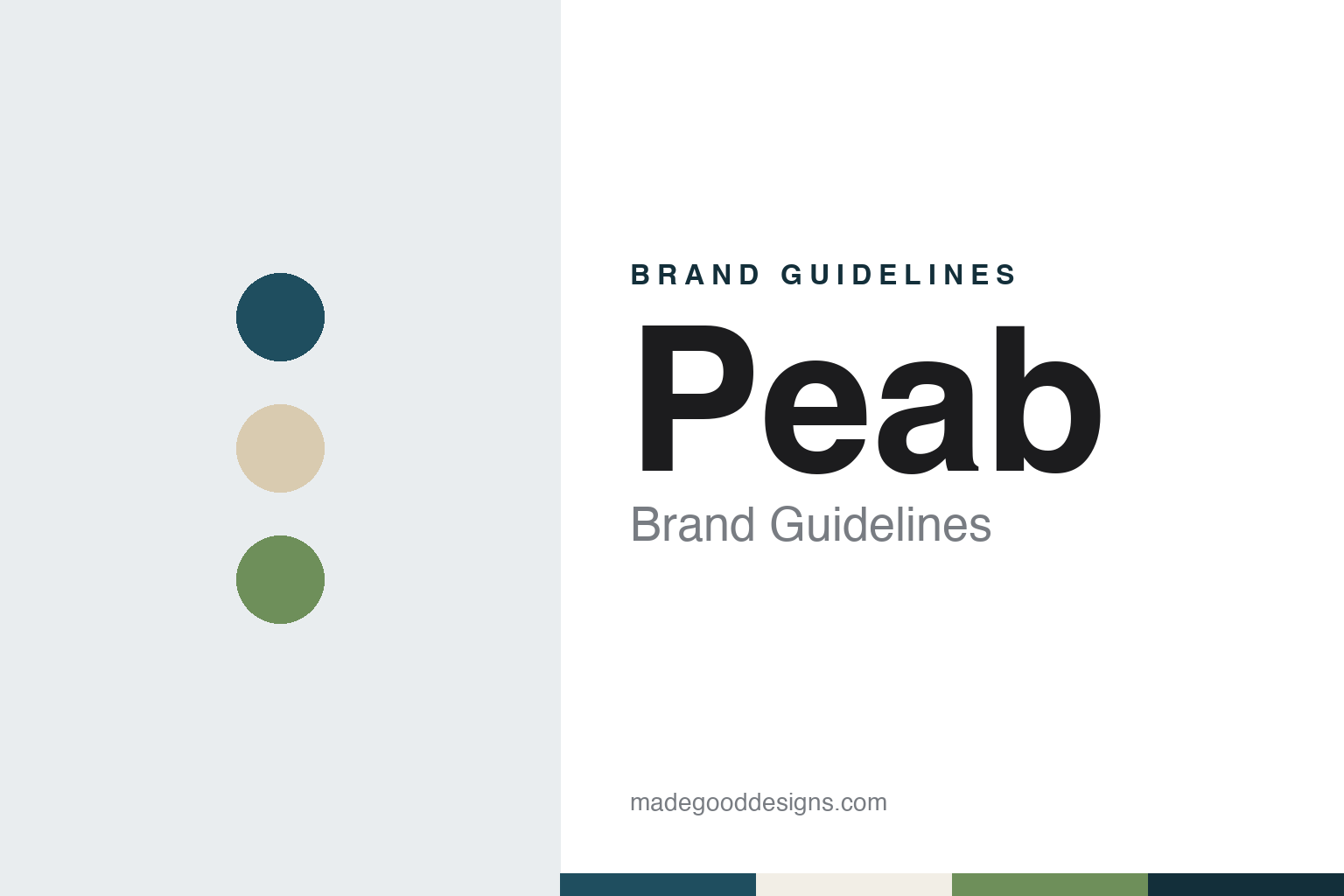
Peab Brand Guidelines
From a tractor in Skåne to a Nordic builder.
Aa
Two constants: a teal, sand and field-green palette of our own and a plain grotesque register. Abstract homage — not a Peab asset; no logo, sign or site hoarding is reproduced.
Two brothers and a tractor
Refuse rounds that turned into a building firm.
Peab began in 1959 on a farm in north-west Skåne, the southernmost province of Sweden. Aftonbladet, in a 2023 profile of the founders, tells how the local municipality asked the farmer Paulsson to empty refuse bins and latrines in the village of Grevie, because he owned the only tractor in the district. His sons took on the work: Mats Paulsson was 14 and Erik Paulsson 16. English Wikipedia describes the early business the same way, as refuse collection and disposal for farmers, and Peab’s own history page sums up the start as “two very young brothers” and “a tractor.”
The work grew quickly. According to Aftonbladet, the brothers took over a machine station, the kind of contractor that hires out machinery and labour to farmers, and one of their large customers was the food company Findus, which needed loads of peas moved from the fields to its freezing plant in Bjuv at harvest time. They bought a smallholding in Förslöv, on the Bjäre peninsula, that came with a gravel pit; the gravel went into road maintenance, and the site became their headquarters. Peab’s head office is still in Förslöv today.
Building began with a setback. While the brothers were putting up a new machine workshop, the building firm they had hired went bankrupt, so they took over its estate and finished the job themselves, Aftonbladet reported, at a time when thousands of small houses were going up across Skåne. Swedish Wikipedia dates the change of course to the late 1960s: the business, first called Paulssons Entreprenad AB, became a limited company in 1967, took on larger contracts and began construction work in 1970. The name Peab comes from those initials; English Wikipedia expands it as Paulsson Entreprenad AktieBolag.
Through the 1970s and 1980s the company grew by buying builders across southern Sweden, English Wikipedia says. In the mid-1970s the brothers also bought the Lindvallen ski village in Sälen, a holding that later grew into the separate company Skistar, Aftonbladet recorded.
Colour
A national builder, then a Nordic one.
National reach came in the early 1990s. Swedish Wikipedia records that Peab merged in 1991 with Hallströms & Nisses, a builder English Wikipedia places in Stockholm and northern Sweden, traded for a time from 1992 under the name Tre Byggare, and took the Peab name again in 1993, when it also took over large parts of BPA, the trade-union movement’s construction company. English Wikipedia dates the move abroad to 1994, when Peab bought Fagbygg in Norway, and to 1999 for Finland, with the purchase of Rakennus Oy Leo Heinänen; Seicon and Vasa Betong followed in 2003. In 2003 the group also spun off its property portfolio as a separate company, Brinova, which was distributed to shareholders, Swedish Wikipedia says.
Today Peab works in four business areas, as both Wikipedia editions describe them: Construction, covering new building, renovation and building services; Civil Engineering, from roads and bridges to the running and upkeep of streets; Industry, which supplies asphalt, concrete, foundation work, transport and crane services, and much of it to Peab’s own sites; and Project Development, which buys, develops and sells housing and commercial property. The company presents itself on peab.com as “the Nordic Community Builder,” with national sites for Sweden, Norway, Finland and Denmark, and lists its core values as “down-to-earth, developing, personal and reliable.”
Its large projects include sport and retail buildings. Swedish Wikipedia lists the national football arena in Solna, opened as Friends Arena in 2012 and now called Strawberry Arena; the neighbouring Mall of Scandinavia of 2015; Tele2 Arena in Johanneshov, Stockholm, of 2013; the stadium in Malmö of 2009; Victoria Tower in Kista of 2011; and the widening of the E6 motorway through Bohuslän in 2011–2012. Aftonbladet adds the MAX IV research facility in Lund and the extension of the Liljevalchs art gallery in Stockholm.
Typography
How construction groups present themselves.
Large construction groups present themselves less through products than through places. Their identities usually rest on a strong wordmark, often in a blue, a red or an orange, used across hoardings, site vehicles, workwear and reports, with the group name repeated in the names of its subsidiaries. Eiffage, for example, runs its business lines as Eiffage Construction, Eiffage Route, Eiffage Métal and so on, while Bouygues keeps separate names such as Colas alongside Bouygues Construction.
Photography does much of the work. Group websites tend to alternate pictures of active sites — cranes, tunnel-boring machines, road crews — with finished bridges, stadiums, towers and rail lines, and they organise their pages by activity: infrastructure, buildings, concessions such as motorways and airports, and energy works. Named landmark projects serve as the main proof of capability, from the Channel Tunnel to the Millau Viaduct.
Commitments are presented in a structured way. Groups describe their environmental and social aims through named programmes, plans and reports rather than slogans; Eiffage, for instance, publishes a climate report and a biodiversity action plan alongside its universal registration document. Values pages, codes of ethics and statements on site safety appear as standard sections, written in the language of programmes and targets.
Two other audiences shape these identities. Careers pages address the large numbers of engineers, site managers and trades staff the groups recruit each year, and many groups promote employee shareholding as part of their story. Investors and lenders read the annual and sustainability reports, where the identity system is often applied most completely, in charts, maps and project photographs. This guide sets out what can be checked about each group: who founded it, how it was formed, who owns it, and which projects dated sources connect to its name.
Aa
A plain grotesque for a plain-spoken builder. (Specimen set in Archivo, a sans STAND-IN; NOT the Peab logo.)
Peab
A family-controlled company on the stock exchange.
Peab is listed on Nasdaq Stockholm, but it remains a family company in its control. Swedish Wikipedia says the Paulsson brothers and their families own just over half of it. English Wikipedia records that Mats Paulsson stepped down as chief executive in 2011 to become vice chairman, and that in 2014 Erik Paulsson and his family sold their Peab shares to Mats Paulsson and his family; Aftonbladet describes the same handover as agreed between the brothers many years in advance. Peab’s history page, written for its sixtieth anniversary in 2019, credits its growth to “talented, committed people” and gives the campaign line “sixty years of community building.”
The company has also faced the courts as part of an industry case. In April 2003, Hallands Nyheter reported, the Swedish Competition Authority, Konkurrensverket, filed a suit at the Stockholm district court over the coordination of asphalt bids for road and municipal work, naming Skanska, NCC, Peab and the production arm of the national road agency. Swedish Wikipedia records that the authority won its case in 2009, after six years of investigation and proceedings, and that NCC, Skanska, Peab and several smaller firms were fined in what became known as the asphalt cartel.
For a design guide, Peab shows how a large contractor can keep the voice of a local firm: a short name built from initials, a head office still in the village where the gravel pit was, and a self-description that talks about communities rather than size. Compare Skanska, another southern Swedish builder that grew into a Nordic group, and NCC, its rival from the Stockholm side. For this guide we use a deep teal, gravel sand and a field green with a sans, an unofficial interpretation; no product or logo is reproduced.
Explore & save
Keep Peab’s identity on hand — save it to a board in the Made Good inspiration library.
Peab identity set
Pin the Peab teal, sand and field-green palette and the plain grotesque register to your own board.