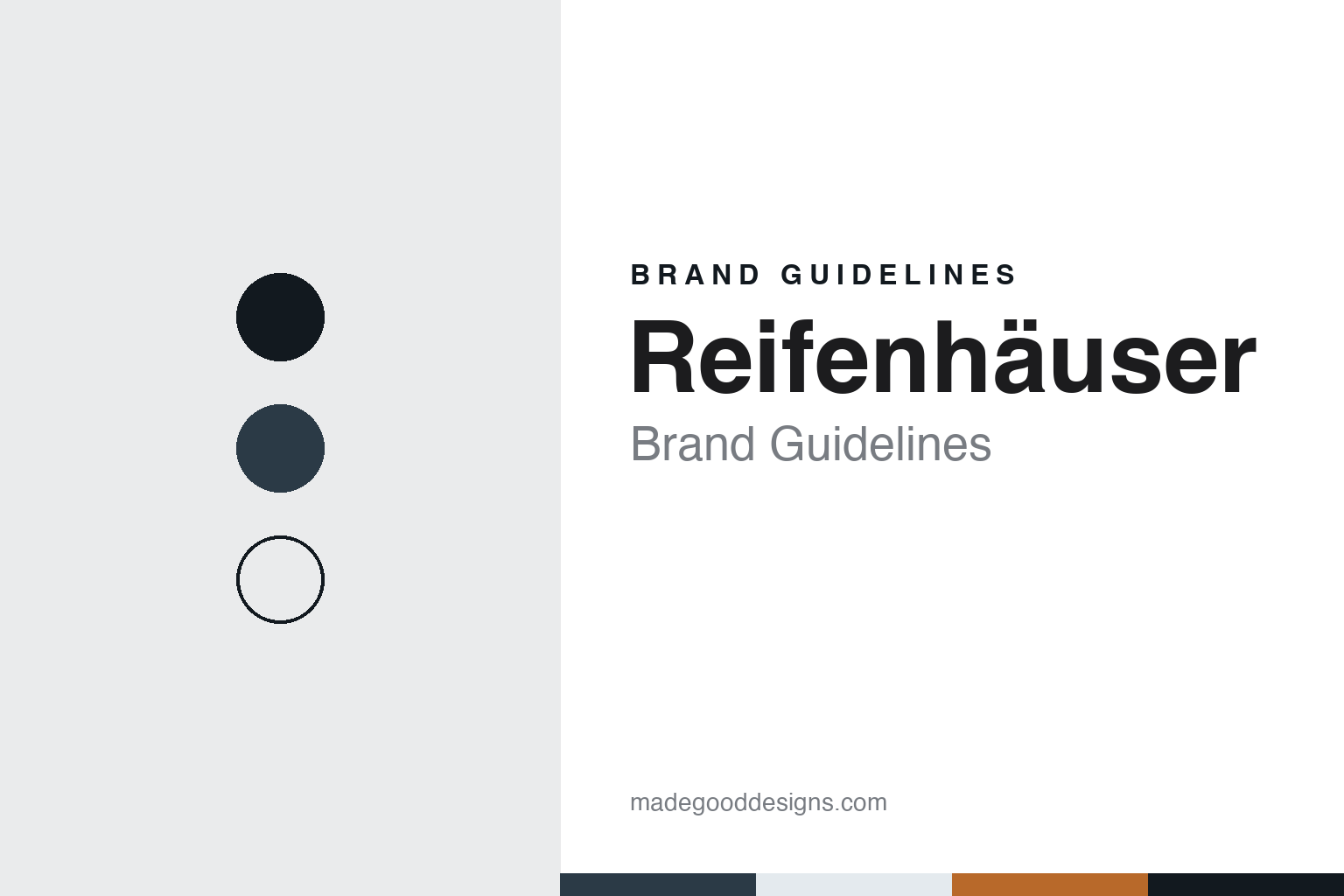
Reifenhäuser Brand Guidelines
The Troisdorf forge that became the Extrusioneers.
Aa
Two constants: a steel, film-haze and amber palette and an engineering sans register. Abstract homage — not a Reifenhäuser product or mark; no machine, logo or nameplate is reproduced.
The forge
A wagon smith, two sons and a prototype in 1948.
Reifenhäuser began in 1911 as a forge. The company says Anton Reifenhäuser, a master hoof and wagon smith from the Westerwald, set up a forge and blacksmith’s shop in the growing industrial town of Troisdorf. German Wikipedia says the business remained a metalworking shop until the Second World War. In 1938, the company says, his wife Elisabeth and their sons Hans and Fritz took over the management of a firm with 20 employees.
The turn came after the war. German Wikipedia says the sons started building screw presses, and both it and the company date the first Reifenhäuser extruder for plastics processing to 1948. The US Plastics Hall of Fame, in its profile of Hans Reifenhäuser, says the brothers developed “their father’s forge” in the 1950s into a major machine maker for the plastics industry. The company adds that by the 1950s “Reifenhäuser” had become the common name for an extruder in Great Britain.
Growth needed room. In 1957 the company bought 110,000 square metres of building land with a rail siding in Troisdorf-Sieglar, and German Wikipedia says production began there in 1959, a year after the firm became a limited partnership with 35 agencies abroad. A new administration building at Sieglar opened in 1974, and the company has stayed in the town ever since. In 1960 it added injection units for injection moulding machines, and in 1962 four employees left to set up a production facility in Brazil, the company says.
Two moves of the 1970s still shape the group. Reiloy was founded in 1971 as a specialist in wear-resistant screws and barrels. In 1973 Reifenhäuser acquired a licence to make spunbonded nonwoven, and after twelve years of development it launched its first spunbond line in 1985. The company moved that business into Reifenhäuser Reicofil in 2005. Hans Reifenhäuser received the Federal Cross of Merit, First Class, in 1984 for his services to the plastics industry, the company says.
Colour
Third generation, fourth generation and Kiefel Extrusion.
The family has handed the company on twice more. Klaus and Ulrich Reifenhäuser joined the management in 1992. In 2004 the group was brought under a family holding, Reifenhäuser GmbH & Co. KG Maschinenfabrik, and plasticker reported in November 2008 that their brother Bernd Reifenhäuser had become a managing director of the holding that month, after years as chairman of its advisory board. The company says it has been 100 percent family-owned since 1911.
Blown film then grew by acquisition. In August 2009 Brückner and Reifenhäuser announced that Kiefel Extrusion, the blown film line maker in Worms, would pass to Reifenhäuser, retroactive to 1 January that year, plasticker reported; the business became Reifenhäuser Kiefel Extrusion. Plastics Machinery & Manufacturing reported in April 2015 that it had been renamed Reifenhäuser Blown Film, which the company presented as a sign of full integration. In 2022, the company says, its blown film units in Worms, Troisdorf and Bergheim were merged under that one name.
Other purchases followed. The company says it took over its long-standing spinneret supplier Enka Tecnica in 2015; German Wikipedia adds Plamex of Kelberg in 2019 and a majority of Kdesign, a maker of cooling rings and measuring systems, in 2021.
The group now reports four business units: Blown Film, Cast Sheet Coating, Reicofil and Extrusion Systems. It says more than 1,500 people work for it worldwide; its own history page gives 1,750 for 2023. On where things are made, the website promises “quality made in Germany,” and German Wikipedia’s 2023 list places the units at Troisdorf, with Enka Tecnica at Kabelsketal and Heinsberg and Kdesign at Königswinter.
The latest handover is recent. Plastics Machinery & Manufacturing reported in April 2024 that Jan Karnath had become the first of the fourth generation to join the business, as its first chief digital officer. plasticker reported on 12 January 2026 that Ulrich Reifenhäuser had stepped back from operational management after four decades and would move to the advisory board, with Bernd Reifenhäuser staying on as CEO and Karnath now on the management board.
Typography
Towers, barrels and trade fairs.
Machinery for plastics film, sheet and recycling is sold to plant owners and engineers, and its makers build their image on the machines themselves. The tallest of them is the blown-film tower, where a shining bubble of film rises several storeys before it is flattened and wound. Wide cast lines and winders offer the same kind of picture lying down: long, level and glossy, with the finished roll as the closing shot.
Close-ups supply the colour. Extruder barrels, guards and control cabinets are often finished in brand colours, which makes the livery of the line one of the few visual assets a maker fully owns. Thermoforming makers favour the end of the line, with formed trays stacking up as they leave the machine. Makers of bottles and preforms show rows of finished shapes.
Recycling has added its own set of pictures. Pellets in glass jars, shown before and after processing, turn an industrial step into something that can sit on a table at a trade stand. Bales of used film do the opposite job, showing the raw material as it arrives. Both images need careful handling, because they suggest a result that the words around them should state plainly and with a source.
The category’s main stages are its trade fairs, among them K in Düsseldorf, NPE in the United States, Plastpol in Poland and Fakuma in Germany. Stands there often feature running machinery. For a designer, this is a field where the identity has to work on a steel guard, a touch screen and a technical data sheet as well as on a web page. This guide sets out what can be checked about each maker and leaves the rest out.
Aa
An engineering sans for a company that signs itself the Extrusioneers. (Specimen set in IBM Plex Sans, a sans STAND-IN; NOT the Reifenhäuser logo.)
Reifenhäuser
A coined word and a two-click screen.
The brand’s signature is a coined word. The company calls its staff the Extrusioneers, and uses the line “Engineers. Pioneers. Extrusioneers” on its website, turning the name of a technical process into a name for the people who work on it. On the same site it calls itself a world market leader in its sector.
The written side of the brand was formalised in 2019, when the company says it defined a purpose: “For a better daily life. For generations to come. With our family spirit. Pioneering the future. Enabling our customers.” Its history page also quotes Hans Reifenhäuser from 1986 on know-how, which he said “does not reside in a few heads.” That page runs decade by decade from the smithy to the present, and sets each period against the news of its time.
The newest brand work is digital. In 2020 Reifenhäuser launched R-Cycle, a cross-company project that Plastics Machinery & Manufacturing described in 2024 as a digital product passport for packaging. At K 2025 in Düsseldorf it presented the Everex flat film line, the Evo Gen3 blown film line and Reifenhäuser NEXT, which the company calls a new brand for digitalisation and learning products. Plastech reported in October 2025 that the company also showed a shared machine interface for its blown film, flat film and nonwoven lines, and that the interface received a German Design Award distinction during the fair. The company says operators can reach any setting in at most two clicks, and Plastech mentions a colour concept in the interface.
For a design guide, Reifenhäuser shows how a family name that, by the company’s account, once stood for a machine can be carried by a coined word for its people. Compare Kiefel, whose name the blown film unit carried until 2015, and Windmöller & Hölscher, another German family company in film extrusion. For this guide we use steel, a pale film haze and amber with a sans, an unofficial interpretation; no product or logo is reproduced.
Explore & save
Keep Reifenhäuser’s identity on hand — save it to a board in the Made Good inspiration library.
Reifenhäuser identity set
Pin the Reifenhäuser steel, film haze and amber palette and the engineering sans register to your own board.