Starlinger Brand Guidelines
The 1835 Austrian firm behind woven plastic sacks and recoSTAR.
Aa
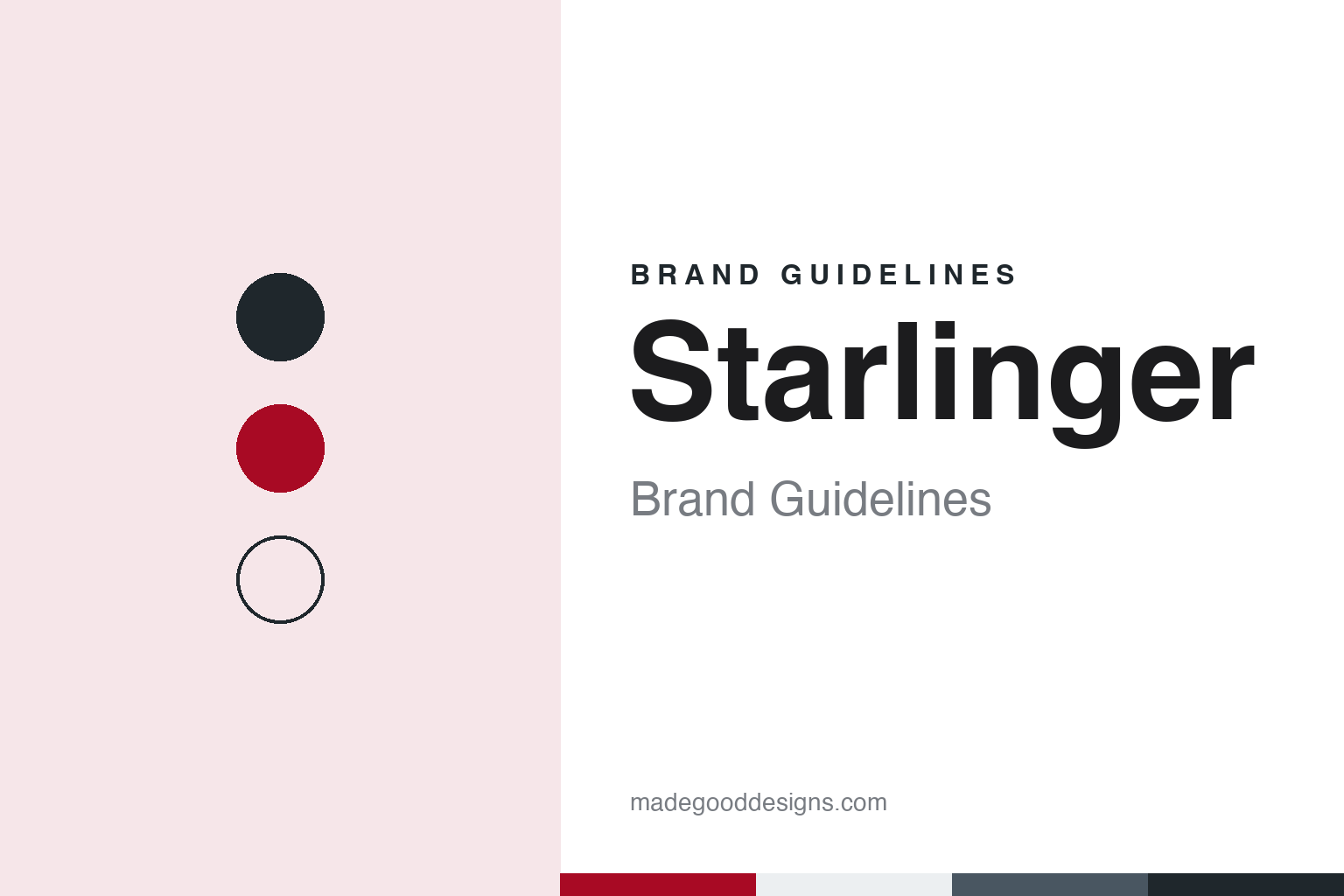
Two constants: a Starlinger red and slate palette and an Engineering sans register. Abstract homage — not a Starlinger product or mark; no machine, logo or nameplate is reproduced.
Franz Laubek
A steam-engine firm that changed its work three times.
Starlinger’s history starts under another name. The company says its beginnings go back to 1835 and a firm called Franz Laubek, which made stationary steam engines and drive elements; Textile World gave the same date and name in September 2010, when the company marked 175 years. The company says the firm was registered as Franz Laubek’s Successors in 1895 and turned to textile machinery in 1897 under the management of Franz Starlinger, building machines for passementerie: fringes, trims and braiding. Textile World dates Franz Starlinger’s management differently, from the 1920s to the 1940s. The name itself came later. The firm was registered as Starlinger & Co. in 1913, the company says.
In 1920 production changed again, to specialised winding machines for the weaving industry, and in 1955 the company developed winders for man-made fibres. In 1959 Franz X. Starlinger-Huemer took over ownership and management, with Erna Starlinger-Huemer as commercial director. In 1968 the first assembly hall went up at Weissenbach an der Triesting, on the grounds of a former cement works, and the company began industrial production of its own circular looms for polypropylene tapes. New tape winders, sack conversion lines, printing machines and baling presses followed, with tape extrusion lines bought in from outside, and together they covered the production of woven plastic sacks.
Exports came next. At the first Austrian machinery exhibition in Beijing in 1973, the company says, it showed the circular loom, and sold 30 complete sack plants to China over the following 10 to 12 years. In 1990 it bought a licence for tape extrusion lines and went on to develop its own technology; it says it delivered its 1,000th starEX tape line in 2022. The Austrian business magazine trend reported in April 2025 that exports usually account for 99 percent of the company’s business, and that Austria itself barely figures as a market.
Colour
Looms, sacks and recycling lines.
Starlinger describes itself as the world’s leading supplier of machinery for woven plastic packaging, plastics recycling and refinement, and trend called it the world market leader in woven-sack lines in 2025. The packaging side runs from tape extrusion lines, winders and circular looms through coating and printing to sack conversion. trend reported that the resulting sacks are used mainly outside Europe, for bulk goods, animal feed and vegetables.
Its best-known product name is AD*STAR, a block bottom valve sack of woven polypropylene and a registered Starlinger trademark, made on ad*starKON conversion lines. The company says these bags are produced only on its machinery, and it defends that position. In February 2026 it announced that a Chinese court of first instance had found in its favour on the core points of a patent case it brought in 2024 against two Chinese machine makers. Starlinger said at the time that the decisions were not yet in force.
Recycling is the second business. The company says it founded the Starlinger recycling technology unit in 2000, and Textile World dated its recycling lines to 2000 and its PET reprocessing lines to 2005. A separate division, viscotec, works on the refinement of recycled material. It moved into a new production site and technical centre at St. Martin in Upper Austria in 2012, and the recycling unit moved into new headquarters at Weissenbach in 2017. The company’s 2026 news pages describe recoSTAR PET bottle-to-bottle lines at recyclers in India and Pakistan. In 2019 it presented a concept it calls “Circular Packaging” for big bags at the K trade fair in Düsseldorf.
Across all this runs a naming habit that is plain on the page: AD*STAR, IC*STAR, PP*STAR and recoSTAR all carry the same syllable, some with an asterisk in the middle, and the tape line is starEX.
Typography
Machinery makers and their halls.
Machinery for plastics film, sheet and recycling is sold to plant owners and engineers, and its makers build their image on the machines themselves. The tallest of them is the blown-film tower, where a shining bubble of film rises several storeys before it is flattened and wound. Wide cast lines and winders offer the same kind of picture lying down: long, level and glossy, with the finished roll as the closing shot.
Close-ups supply the colour. Extruder barrels, guards and control cabinets are often finished in brand colours, which makes the livery of the line one of the few visual assets a maker fully owns. Thermoforming makers favour the end of the line, with formed trays stacking up as they leave the machine. Makers of bottles and preforms show rows of finished shapes.
Recycling has added its own set of pictures. Pellets in glass jars, shown before and after processing, turn an industrial step into something that can sit on a table at a trade stand. Bales of used film do the opposite job, showing the raw material as it arrives. Both images need careful handling, because they suggest a result that the words around them should state plainly and with a source.
The category’s main stages are its trade fairs, among them K in Düsseldorf, NPE in the United States, Plastpol in Poland and Fakuma in Germany. Stands there often feature running machinery. For a designer, this is a field where the identity has to work on a steel guard, a touch screen and a technical data sheet as well as on a web page. This guide sets out what can be checked about each maker and leaves the rest out.
Aa
A plain engineering sans. (Specimen set in Inter Tight, a sans STAND-IN; NOT the Starlinger logo.)
Starlinger
A family group that grew by buying specialists.
The company calls Starlinger Group a family-owned group of globally active machinery manufacturers, and trend and German Wikipedia both describe it as family-owned. German Wikipedia names the Starlinger-Huemer family as owner and gives Vienna as the seat of the Austrian parent company. Angelika Huemer, CEO and managing partner, took over in 2002, in what the company calls a change of generations.
The group has grown through purchases. Textile World listed MAPLAN in 1991, SML in 1995 and Georg Sahm in 2002. Georg Sahm GmbH & Co. KG of Eschwege, a winder maker, remains in the group. In 2018 Starlinger bought Barmag Spinnzwirn of Chemnitz from Oerlikon; TextileTechnology reported that ownership passed on 1 October that year and that the business became STC Spinnzwirn GmbH. In November 2024, plasticker reported, Starlinger took over the woven packaging division of Windmöller & Hölscher, with its Vienna subsidiary W&H Machinery GmbH.
STC Spinnzwirn has since run into difficulty. On 1 June 2026 the news agency dpa, carried by the Süddeutsche Zeitung, reported that STC Spinnzwirn had applied to the Chemnitz district court to open insolvency proceedings, citing weak orders. It said the company employed about 140 people and that business was continuing during the provisional proceedings. Starlinger’s own history says STC Extrusion GmbH was founded in Chemnitz in 2026, as a centre for artificial turf and technical monofilaments. Proceedings opened on 1 August 2026, and the insolvency news service INDat reported on 15 September that Starlinger, already a shareholder, would buy selected assets, with a new company of about 40 staff carrying on the monofilament, extrusion and service business from 1 November; most of the remaining staff were to move to a transfer company.
Production is spread across several countries. trend reported in 2025 that Starlinger builds in Lower and Upper Austria, in Germany, at an associated site in Hungary and at Taicang in China, and that a first plant in India was on the way to make sack lines, while PET recycling machines would still ship from Europe. The company says that plant, STP Machinery in Ahmedabad, began operating in 2025. Its base in the United States, at Fountain Inn in South Carolina, is a branch, trend said, with no production planned. The company says it twice won the Austrian Export Award, in 2007 and, German Wikipedia says, in 2012, and that the group employed around 1,200 people in fiscal 2023/24.
The export reach once produced an odd headline. trend, citing the Guardian, reported in April 2025 that the company’s name had appeared on freight papers linked to the uninhabited Heard and McDonald Islands; Huemer told Die Presse the company had no site or address there and suggested codes had been confused.
For a design guide, Starlinger shows how one syllable can tie a long range of machines and sacks to a family name. Compare Windmöller & Hölscher, which sold Starlinger its woven packaging business, and EREMA, another Austrian maker of plastics recycling machinery. For this guide we use a deep red and slate with a sans, an unofficial interpretation; no product or logo is reproduced.
Explore & save
Keep Starlinger’s identity on hand — save it to a board in the Made Good inspiration library.
Starlinger identity set
Pin the Starlinger red and slate palette and the Engineering sans register to your own board.