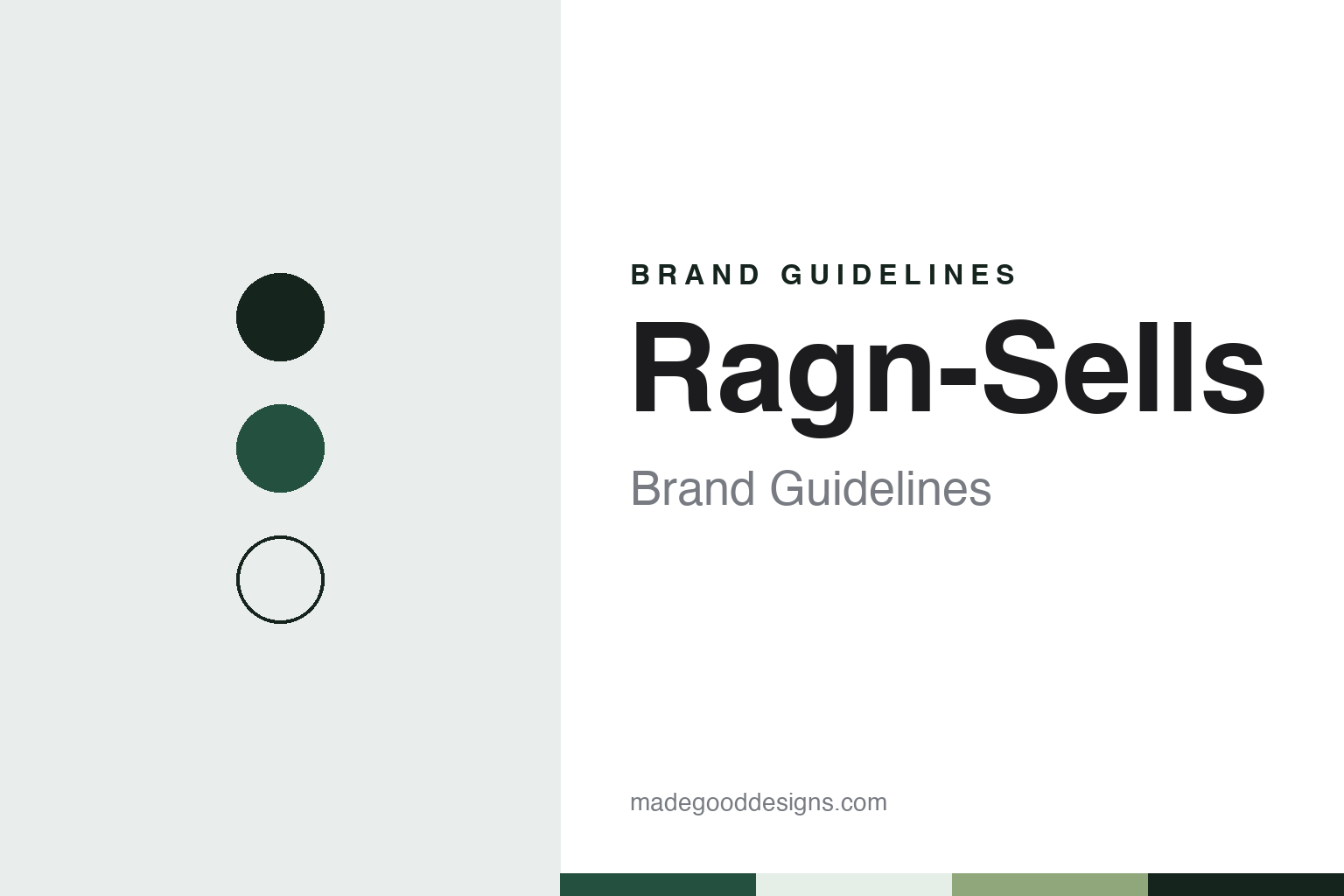
Ragn-Sells Brand Guidelines
An 1881 Stockholm haulier, a Sollentuna farm and a family name on every truck.
Aa
Two constants: a Ragn-Sells spruce green and birch white palette and a Plain grotesque sans register. Abstract homage — not a Ragn-Sells vehicle, container or mark; no logo or livery is reproduced.
Sellbergs häståkeri
From horse haulage to refuse collection.
Ragn-Sells traces its history to 1881, when Amandus Zakarias Leonard Sellberg started Sellbergs häståkeri, a horse-haulage business on Odengatan in Stockholm, according to the company’s own history page and Swedish Wikipedia. Haulage, not waste, was the trade for its first decades. The company’s history links the family to Väderholmens gård, a farm in Sollentuna, north of the city; that farm is still the group’s head office.
Waste arrived with the next generation. In 1928, the company says, Sellberg’s son Ragnar Sellberg was selling potatoes and milk from the farm in Stockholm and began taking the city’s refuse back with him to handle at Väderholmens gård; the company describes the farm as Sweden’s first recycling station. Swedish Wikipedia puts it slightly differently: in 1928 Ragnar Sellberg began collecting refuse from villa owners in Sollentuna, alongside the haulage business in Stockholm.
In 1933 Ragnar Sellberg became managing director of AZ Sellbergs Åkeri AB. At that time, the company says, it kept about a hundred horses, which were gradually replaced by motor vehicles. Waste handling was still the smaller part of a firm that was mainly a haulier, Swedish Wikipedia notes.
The split into a dedicated waste business came in the 1960s. Swedish Wikipedia dates the founding of AB Norrtrim, a company working only in refuse collection, to 1966, and the group itself now says it has been “involved in waste management, environmental services and recycling” since that year. The company’s history page adds that AZ Sellbergs Åkeri was sold after a change of generations in the 1960s. In 1968 both companies took the name Ragn-Sells AB, with Ragnar Sellberg as managing director until 1973, when he became chairman, according to Swedish Wikipedia.
Colour
Three business areas and an innovation company.
Ragn-Sells describes itself as a privately held, family-owned group, now in its third generation of family leadership, which collects, treats and recycles waste and residual products from businesses, organisations and households. The company says Erik Sellberg became group chief executive in 2008 and that the holding company Ragn-Sellsföretagen AB was formed in 2010; he is now chairman of the board, and a company article of May 2026 describes him and his daughter Linnéa Sellberg as the third and fourth generations of the owner family.
The group organises its work in three business areas: Recycling, Treatment (hazardous waste) and New Value Chains. Its own group facts for 2025 list operations in Sweden, Norway, Denmark, Estonia and Germany, 115 sites, 2,709 employees and 5.38 million tonnes of material treated, figures it says come from its annual report and sustainability report for that year.
Much of the group’s newer work runs through EasyMining, which Ragn-Sells calls its innovation company. In January 2023 the Swedish clean-tech company C-Green announced a cooperation agreement with Ragn-Sells, which it described as one of Sweden’s largest sludge handlers, aiming to establish eight to ten C-Green biorefineries at Ragn-Sells facilities over the following years. C-Green’s process uses hydrothermal carbonisation to turn sewage sludge into hydrochar, which can be used as a biofuel. The first plant was planned for Häradsudden, outside Norrköping, and the ash from the treated sludge was to be processed with Ash2Phos, a phosphorus-recovery process that C-Green’s release credits to EasyMining.
Smaller projects appear in the company’s own articles. In May 2026 it said its Stockholm team had begun recycling paper towels into new paper towels, and that it was working with the energy company St1 to turn used cooking oil into HVO, a renewable diesel. The group also supports the Ragnar Sellberg Foundation, which it describes as an independent body that funds research and the spread of knowledge in waste management.
Typography
Design and documentation.
Waste and recycling companies rarely sell a product people choose off a shelf. Their identity is carried instead by the things the public sees every week: collection vehicles, bins, depots and, increasingly, large plants on the edge of town. Some of those marks have long histories. English Wikipedia records that the London firm Cory gave its colliers a black funnel with a white band and a black diamond, flew a red house flag with a cream diamond, and later painted its road haulage vehicles white with the same black lozenge.
On their own websites, the companies in this guide arrange themselves around services rather than products: collection, recycling and energy recovery, each with its own page. Viridor’s site leads with energy from waste, decarbonisation and what it calls Circular Solutions; Cory’s explains, step by step, how a black bag travels from a riverside transfer station by barge to its Riverside plant at Belvedere, and how ash from the process becomes aggregate. Those pages describe the work as the companies describe it, and this guide treats them that way.
Photography does much of the branding. Plants, barges, tugs, sorting halls and depots appear far more often than logos, and new facilities are announced with architects’ impressions long before they open; the trade weekly letsrecycle.com illustrated its 2022 report on Cory’s second Belvedere plant with one.
The other constant is the dated report. Viridor published its ESG report for the 2026 financial year in October 2026, and Cory published its 2025 annual and sustainability reports in June 2026, each with tonnages, electricity generated and progress on new plants. This guide uses such figures only as the companies or a dated source give them, and sets out what can be checked about each firm: who founded it, who owns it and how it presents its work.
Aa
A plain grotesque sans — a family surname turned into a company name. (Specimen set in Work Sans, a sans STAND-IN; NOT the Ragn-Sells logo.)
Ragn-Sells
Ragnar plus Sellberg.
The name is the brand’s clearest story. Swedish Wikipedia explains that the “Ragn” in Ragn-Sells comes from Ragnar Sellberg, and the second half is a shortened form of the family surname, so the company name joins a first name and a surname with a hyphen. The same encyclopedia records the Swedish slogan “En del av kretsloppet”, roughly “part of the cycle.” Erik Sellberg put the link between family and name directly in the company’s May 2026 article: “we are literally putting our name on this.”
The company states its vision in one sentence: it wants to be “living proof that caring for the earth and business go hand in hand.” It lists four cornerstones for how it works — simplicity, drive, accountability and a holistic view — and its Swedish history page carries the heading “pioneers in recycling since 1928,” dating its recycling story to Ragnar Sellberg’s farm rather than to the haulage firm of 1881. Both dates appear in its material: 1881 as the year it was established, 1928 as the start of its recycling work.
Place is part of the identity too. The company points out that its head office sits at Väderholmens gård in Sollentuna, the farm where its waste business began, rather than in a city-centre office. That continuity — one family, one farm, one surname-based name since 1968 — is the thread that runs through its own telling.
For a design guide, Ragn-Sells shows how a family surname, a single farm and a long timeline can carry an industrial brand. Compare L&T, the Finnish environmental-services group, and Veolia, the French environmental-services group. For this guide we use a spruce green, a moss and a birch white with a sans, an unofficial interpretation; no product or logo is reproduced.
Explore & save
Keep Ragn-Sells’s identity on hand — save it to a board in the Made Good inspiration library.
Ragn-Sells identity set
Pin the Ragn-Sells spruce green and birch white palette and the Plain grotesque sans register to your own board.