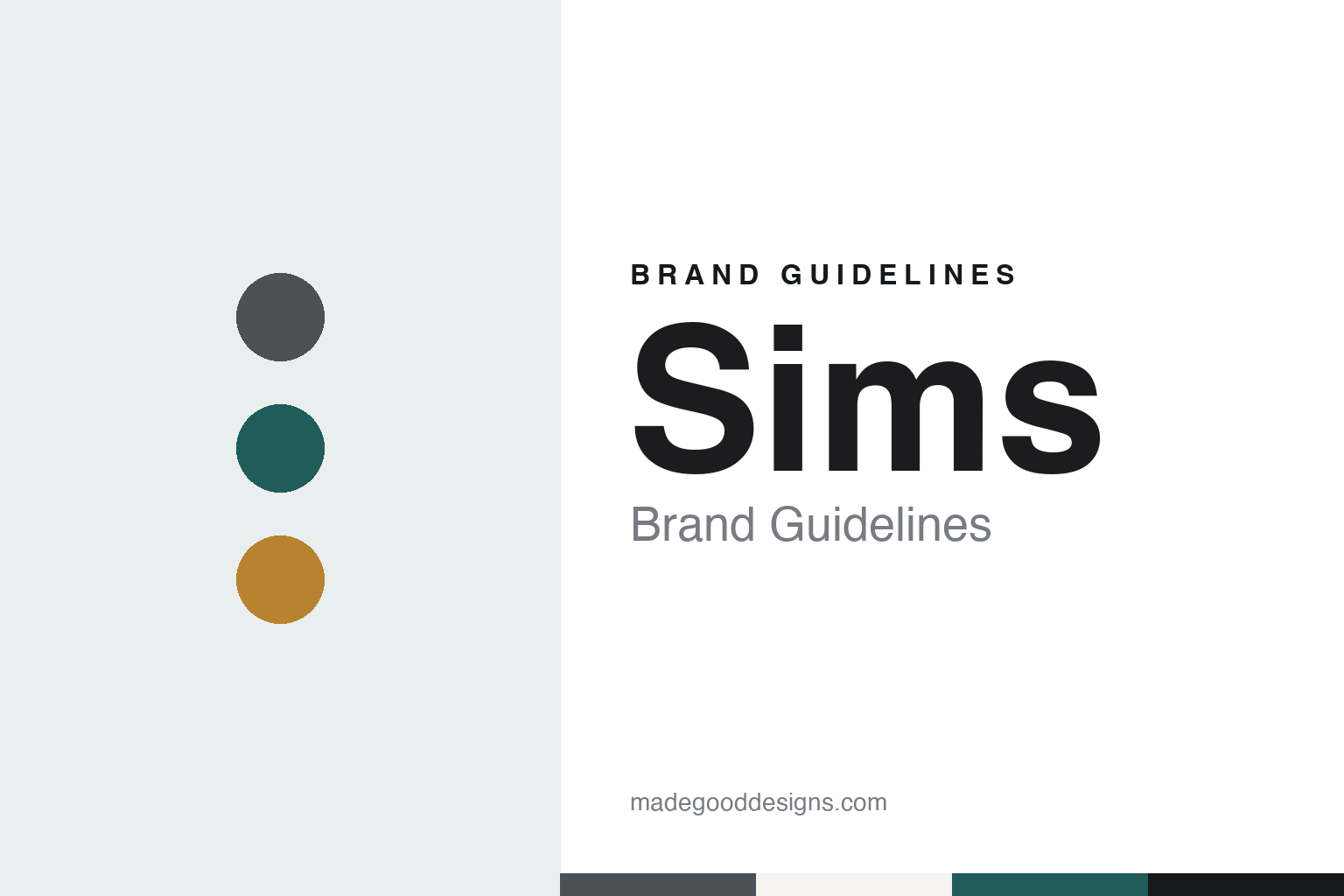
Sims Brand Guidelines
A 1917 Sydney scrap yard that kept its founder’s name through a century of mergers.
Aa
Two constants: a steel grey, teal and ochre palette and an industrial sans register. Abstract homage — not a Sims asset or mark; no logo, vehicle or site is reproduced.
Albert G. Sims
One scrap yard in Sydney.
Sims began as a scrap yard. English Wikipedia says the business was established in Sydney in 1917 by Albert Sims, a dealer in recycled metals, and the company’s own history page tells the same story: “a single scrap metal yard in Sydney, Australia.” The business was incorporated as Albert G. Sims Limited in 1928 and renamed Simsmetal Limited in November 1968, Wikipedia says.
The next two decades were a run of mergers and new owners. In November 1970 Sims merged with Consolidated Metal Products to form Sims Consolidated, a company listed on the Australian stock exchange. In May 1979 the mining group Peko-Wallsend bought it and took it off the market. When North Limited bought Peko-Wallsend in 1988, Sims came with it; North sold the business in 1989 to Elders Resources NZFP, and in 1990 Carter Holt Harvey took over Elders and sold its non-forestry businesses, Sims among them. Renamed Simsmetal once more in 1990, the company returned to the Australian Securities Exchange in November 1991, according to Wikipedia.
Growth abroad had already begun by then. Sims entered the American scrap market in February 1988 by buying LMC Corporation in California. In August 1992 it combined its New Zealand business with the ferrous recycling operations of Pacific Steel, a Fletcher Building company, in a joint venture named Sims Pacific Metals. Britain followed in stages: a 51 per cent stake in Sims Bird in February 1995, the remaining shares in May 1998, and the purchase of Philip Services (Europe) in April 2000, which Wikipedia says greatly enlarged its presence in the British market.
Colour
Simsmetal, Sims Group, Sims Metal Management.
The name kept changing as the company grew. Simsmetal became Sims Group Limited in November 2002. In October 2005 it merged with recycling businesses of the privately owned Hugo Neu Corporation, which Wikipedia says gave Sims a large presence in southern California, New York and New Jersey. In September 2007 Sims put its southern California business into a joint venture with Adams Steel, called SA Recycling, which Wikipedia says runs more than 150 facilities in 15 states. In March 2008 it bought Metal Management Inc., a scrap recycler with locations in 17 US states, and in November 2008 shareholders approved a new name, Sims Metal Management Limited.
The work itself is industrial. Wikipedia describes the metals business buying ferrous metal from dealers, auto wreckers, demolition firms and manufacturers, then sorting, shredding, cutting, baling or breaking it for resale to steel mills and foundries; non-ferrous metal comes from production offcuts, power and telecoms providers and dealers. The electronics division, named there as Sims Recycling Solutions, takes in end-of-life and redundant electrical equipment for refurbishment, parts recovery, resale and recycling, and in Europe works within the WEEE Directive. In New York, Wikipedia says, a 20-year recycling contract with the city’s Department of Sanitation began in January 2009, and in December 2013 Sims opened a recycling facility at the South Brooklyn Marine Terminal in Sunset Park. Wikipedia says the 11-acre site was built between 2010 and 2013, with recycled glass aggregate blended with rock from the city’s tunnelling projects to raise parts of the site by four feet.
In 2020 the parent company became Sims Limited, “a name that better reflects the breadth of our businesses,” the company says, covering Sims Metal and Sims Lifecycle Services. It now describes Sims Metal as recovering and processing ferrous and non-ferrous metals into recycled raw materials, and Sims Lifecycle Services as helping large organisations recover value from their IT assets and dispose of them; its home page frames the group around metal recycling and “the circularity of digital infrastructure.” In November 2026 the company named a new president of Sims Lifecycle Services, who joined from the data centre company Equinix.
Typography
How recyclers present themselves.
Waste and recycling companies rarely sell a product people choose off a shelf. Their identity is carried instead by the things the public sees every week: collection vehicles, bins, depots and, increasingly, large plants on the edge of town. Some of those marks have long histories. English Wikipedia records that the London firm Cory gave its colliers a black funnel with a white band and a black diamond, flew a red house flag with a cream diamond, and later painted its road haulage vehicles white with the same black lozenge.
On their own websites, the companies in this guide arrange themselves around services rather than products: collection, recycling and energy recovery, each with its own page. Viridor’s site leads with energy from waste, decarbonisation and what it calls Circular Solutions; Cory’s explains, step by step, how a black bag travels from a riverside transfer station by barge to its Riverside plant at Belvedere, and how ash from the process becomes aggregate. Those pages describe the work as the companies describe it, and this guide treats them that way.
Photography does much of the branding. Plants, barges, tugs, sorting halls and depots appear far more often than logos, and new facilities are announced with architects’ impressions long before they open; the trade weekly letsrecycle.com illustrated its 2022 report on Cory’s second Belvedere plant with one.
The other constant is the dated report. Viridor published its ESG report for the 2026 financial year in October 2026, and Cory published its 2025 annual and sustainability reports in June 2026, each with tonnages, electricity generated and progress on new plants. This guide uses such figures only as the companies or a dated source give them, and sets out what can be checked about each firm: who founded it, who owns it and how it presents its work.
Aa
An industrial sans for a family name. (Specimen set in Archivo, a sans STAND-IN; NOT the Sims logo.)
Sims
A smaller map and two divisions.
Sims has also narrowed its map. In August 2024 it agreed to sell its UK metals business, 28 facilities including three port sites and four shredders, to Unimetals, letsrecycle.com reported; Sims later said it had had no involvement in the business since the sale in October 2024, the same publication reported in 2025. After the sale, Sims said, its metals portfolio would consist of Australia and New Zealand, North America and its 50 per cent interest in the SA Recycling joint venture, and it described the sale as the end of a divestment programme that had begun in 2022.
By its own count, Sims Limited now has more than 4,200 employees at more than 300 locations in 13 countries. The company says it took in 6.4 million tonnes of material in its 2026 financial year, while Sims Lifecycle Services repurposed 16.8 million assets, and that it has been ranked in the Corporate Knights Global 100 sustainability index for 12 consecutive years. Its stated purpose is “Create a World Without Waste to Preserve Our Planet.”
The identity sits in that structure: one short surname carried across a parent company and two division names, with the electronics business on its own web address. For a design guide, Sims shows how a founder’s name can outlast a century of mergers, delistings and renamings, from Simsmetal and Sims Group to Sims Metal Management and Sims Limited, while the plain trade of buying and sorting scrap stays at the centre. Compare Cleanaway, another Australian waste and recycling name, and Veolia. For this guide we use a steel grey, a deep teal and an ochre with a sans, an unofficial interpretation; no product or logo is reproduced.
Explore & save
Keep Sims’s identity on hand — save it to a board in the Made Good inspiration library.
Sims identity set
Pin the Sims steel grey, teal and ochre palette and the industrial sans register to your own board.