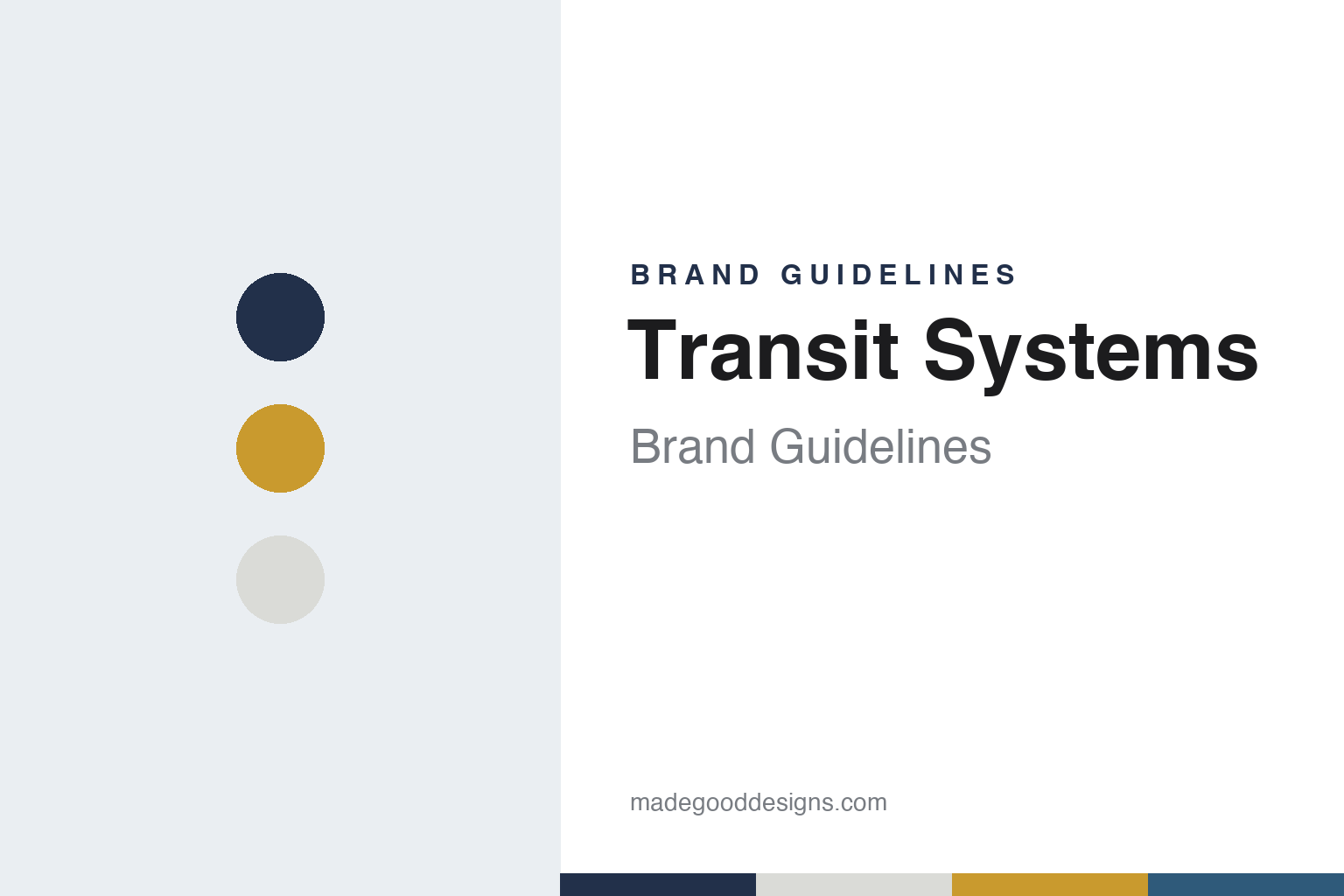
Transit Systems Brand Guidelines
A Perth contract operator that runs buses under other people’s names.
Aa
Two constants: a route deep blue, harbour blue and wattle palette and a geometric sans register. Abstract homage — not a Transit Systems asset; no vehicle, logo or livery is reproduced.
Swan Transit
Three bus men and a Perth tender.
Transit Systems was founded in 1995, when its founders won the tender to run buses in Midland, on the eastern edge of Perth. The company’s own timeline calls it the first bus contract tendered in Perth, and English Wikipedia says services began on 21 January 1996 under Swan Transit, the first business unit of the group, and the first time since 1962 that a private operator had run an urban service bus in Perth. The founders, Neil Smith, Graham Leishman and Lance Francis, already had a long record in the trade: in June 2013 the Brisbane Times reported that the three had moved from the New South Wales Central Coast in 1985 to run Bayside Buslines in the Redland area south-east of Brisbane, and English Wikipedia lists earlier operations including Peninsula Bus Lines and Sunliner Express.
Perth was the base for the first years. The company says it won the Canning and Southern River contracts in 1996, Kalamunda and Armadale South in 1998, the management of the new Circle Route in 1999 and the Claremont and Belmont contracts in 2002. English Wikipedia notes that Swan Transit’s Perth services all run under the Transperth name, the state network brand, and that in January 2015 it began ten-year contracts in Bunbury and Busselton under the TransBunbury and TransBusselton brands.
Adelaide followed in 2000, when Transit Systems began running the city’s East–West contract as Torrens Transit. The company says the North, South and Outer North East contracts it won in 2005 took its share of the Adelaide network to 73 per cent; English Wikipedia says those contracts passed to another operator in 2011 and returned in 2018, when Torrens Transit bought Light-City Buses. From July 2020 the Torrens Connect joint venture added Adelaide’s Glenelg tram line, English Wikipedia says.
Colour
Ferries, London and Singapore.
For a decade the company also ran boats. It bought the Bay Islands passenger ferry in Moreton Bay in 2005, added a vehicle ferry to North Stradbroke Island in 2007 and Stradbroke Ferries in 2011, and ran ferries to the gas plants on Curtis Island near Gladstone, its timeline says. In November 2015, English Wikipedia says, it sold the whole marine division to SeaLink Travel Group.
The bigger expansion was overseas. On 12 June 2013 the Brisbane Times reported that Transit Systems, then a private company owned by the Leishman, Smith and Francis families, had agreed to buy 20 London bus routes from First Group through a sister company, Tower Transit, taking on 1,500 staff and 403 red double-deck buses. In May 2015 The Straits Times reported that Tower Transit had won Singapore’s first government bus contract, beating seven other bidders, to run 26 services from a new depot at Bulim in Jurong from 2016, with the fleet growing to about 380 buses.
At home the contract map kept widening. Transit Systems began running Sydney’s Region 3, in the west of the city, in October 2013, and the Inner West’s Region 6 in July 2018, English Wikipedia says; it ran part of the Darwin network as Territory Transit from 2014 to 2022, bought the on-demand transport company Bridj in 2017 and entered Melbourne in April 2019 by buying Sita Buslines, renamed Transit Systems Victoria in November 2020.
In October 2019 SeaLink announced it would buy the rest of the business, and the sale was completed in January 2020, according to English Wikipedia; Transit Systems’ chief executive became SeaLink’s chief executive. In November 2021 SeaLink renamed itself Kelsian Group, an anagram of its old name. Kelsian sold its remaining share of its London bus joint venture with RATP Dev in 2023, English Wikipedia says.
Typography
Design and documentation.
Bus and coach operators present themselves first on the street. The vehicle carries the name, the colours and often a local or route brand, and liveries change gradually as buses are repainted or replaced. A group name can sit in the background while local names do the visible work: English Wikipedia says First’s purple, white and lilac “Olympia” livery reinstated local branding on its buses from 2012, after a decade in which the vehicles simply carried the First name.
Network maps, timetables and route names carry the identity onto stops, stations and screens, and who owns them depends on the contract. In London, operators such as Metroline tender for routes and run them as contractors under Transport for London, with fare revenue going to TfL, English Wikipedia says. Elsewhere an operator may run its own commercial network, its own coach brand or a franchise for a regional authority, such as the Bee Network services that Metroline Manchester began running for Transport for Greater Manchester in January 2025.
Ticketing has moved onto phones, and operators describe their apps in their own terms. FirstGroup says about 80% of First Bus ticket transactions are now digital and that its app and platform account for 35% of ticket revenue. ComfortDelGro brought taxi booking, ride-hailing and its driverless shuttle in Punggol under the Zig name and app, Marketing-Interactive reported in September 2026.
Depots and fleets are part of the picture too: FirstGroup counts around 70 depots for First Bus, and ComfortDelGro gives a bus fleet of more than 8,000 across three countries. The guides in this series set out each operator’s name, its history of mergers, sales and contracts, and the liveries and marks that dated sources document; fleet and depot counts appear only as a source gives them, and every palette and type specimen is an unofficial interpretation.
Aa
A geometric sans for a contract operator. (Specimen set in Manrope, a sans STAND-IN; NOT the Transit Systems logo.)
Behind the network brand
Swan, Torrens and the state colours.
Much of Transit Systems’ work is done under government network brands, such as Transperth in Western Australia and Adelaide Metro in South Australia, and under its own local operating names: Swan Transit in Perth, Torrens Transit in Adelaide and Territory Transit in the Northern Territory. Its website groups them by state alongside further businesses Kelsian has bought, including Horizons West and Go West in Western Australia, and Tower Transit in Singapore and the Channel Islands.
The company presents itself as an established partner to government. Its company page says that since 1995 it has grown into what it calls Australia’s largest bus operator, describes Transit Systems Group as a subsidiary of Kelsian Group, which it says operates in Australia, Singapore, the United States, the United Kingdom and the Channel Islands, and lists independent certification of its operations to international standards. The site’s footer credits the brand and website to the Australian agency Creature. Its news pages in 2026 describe the opening of Adelaide Metro’s first electric bus charging hub at the Morphettville depot, with 60 charging stations, and new Western Sydney routes launched with the New South Wales transport minister in July 2026; the company also says it opened training academies in Sydney in 2024 and Adelaide in 2025.
For a design guide, Transit Systems shows a contract operator whose own name sits behind state network brands such as Transperth and Adelaide Metro, with local names like Swan Transit and Torrens Transit in between. Compare Kinetic, another Australian group built on contracts and acquisitions, and Busways, a fellow Sydney contract operator. For this guide we use a route deep blue, a harbour blue and a wattle gold with a sans, an unofficial interpretation; no product or logo is reproduced.
Explore & save
Keep Transit Systems’s identity on hand — save it to a board in the Made Good inspiration library.
Transit Systems identity set
Pin the Transit Systems route deep blue, harbour blue and wattle palette and the geometric sans register to your own board.