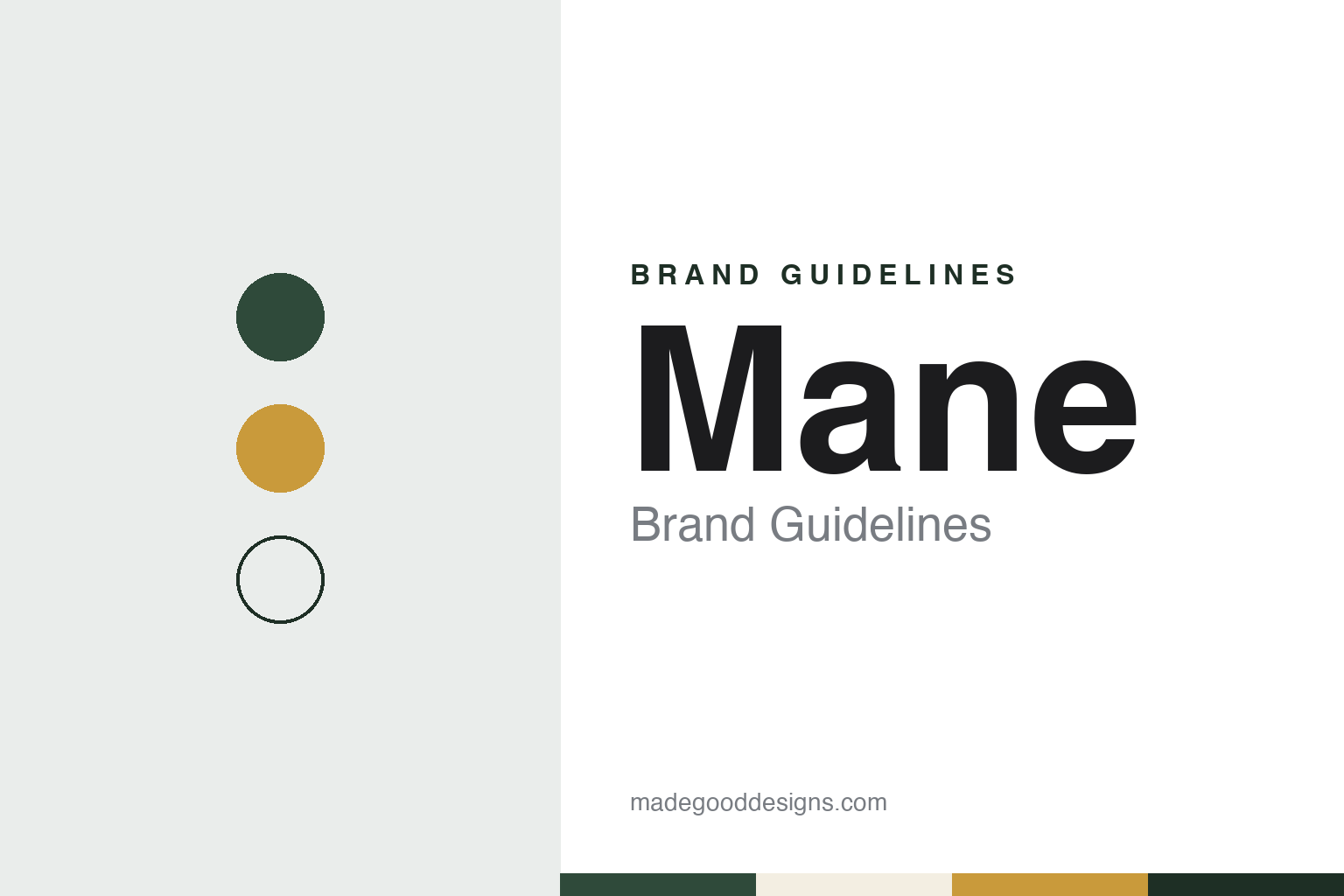
Mane Brand Guidelines
A family flavour and fragrance house in the hills above Grasse since 1871.
Aa
Two constants: a leaf green, amber and ivory palette and a geometric sans register. Abstract homage — not a Mane product or mark; no logo, label or packaging is reproduced.
V. Mane Fils
A grower and distiller near Grasse.
Mane traces its start to 1871, when Victor Mane, a grower and distiller of flowers, installed his first equipment for extracting perfume plants at Pont-du-Loup, near Grasse, French Wikipedia says. The company’s own timeline names the business founded that year V. Mane Fils, a name the group still uses. In its early decades it produced raw materials for perfumery from the plants and flowers of the region; WWD, describing the founding in 2025, wrote that Victor Mane distilled the flowers and plants he grew in the Grasse area into raw materials for scent.
The company’s timeline places its headquarters at Le Bar-sur-Loup from 1907 and lists the Brussels International Exhibition of 1910. Victor Mane’s sons Eugène and Gabriel Mane took over in 1916; French Wikipedia says they settled in the Notre-Dame quarter of Le Bar-sur-Loup and built up food flavours abroad, while the company’s timeline dates its steam-distillation workshops to 1930 and its Notre-Dame headquarters to 1940. The sources used for this guide do not say how V. Mane Fils operated during the occupation of 1940–1944.
The third generation widened the business. Maurice Mane followed his father Eugène into the company in 1959 and, French Wikipedia says, diversified into raw materials for food flavours, built a network of subsidiaries and added research and quality-control laboratories. The company’s timeline lists new companies in Japan and the United States in 1956, Brazil in 1963, Switzerland in 1969 and the United Kingdom in 1971, then Mexico, Germany, Spain, Indonesia and Chile between 1975 and 1990. The same timeline records an organic chemistry department in 1971 and a biotechnology department in 1987.
In 1995 Maurice Mane moved to the supervisory board and his son Jean Mane became president of the group, with his brother Michel Mane in charge of the Americas region, French Wikipedia says. WWD later dated Jean Mane’s time running the company to 1995–2024.
Colour
Flavours, fragrances and extraction.
Mane works in two main businesses, flavours and fragrances, and presents ingredients as a third line on its website. Its flavour pages are grouped into sweet, savoury, naturals and a flavourist school; its fragrance pages into fine fragrance, consumer goods, oral care and a perfumery school. The company says apprentice perfumers train at the MANE School of Perfumery for at least two years on a customised programme, and it calls the perfumers of its consumer-goods and fine-fragrance divisions “olfactory artists.”
The home site at Le Bar-sur-Loup covers more than twenty hectares in two parts, French Wikipedia says: Notre-Dame, where research, creation, the extraction of natural raw materials and the production of aroma molecules are grouped, and La Sarrée, where industrial production, logistics and quality services sit. The company’s timeline dates its La Sarrée headquarters to 1992.
Extraction is the thread the company returns to. Its timeline lists the Jungle Essence kit in 2000 and E-Pure Jungle Essence in 2020. Mane describes Jungle Essence as an extraction technology that captures the scent or taste of a material, from a fruit to a sweet, in a small sample that can later be reproduced at industrial scale, and says a production unit at its headquarters is dedicated to extraction with supercritical fluids. The timeline also lists the creation of Green Motion in 2011. In June 2026 the company announced an experimental garden at the “La Rose St Jean” site, run with a local farmer, to grow emblematic plants and new hybrids and to try out those extraction processes.
The group has grown abroad by founding companies and by buying them. Its timeline lists acquisitions and joint ventures in the United States, Italy, Poland, France and India in 1998, and new companies across Asia, Africa, Latin America and Eastern Europe through the 2000s and 2010s. On 2 September 2026 Mane announced that it was acquiring Cvista, a supplier of citrus oil fractions and natural essences based in Riverview, Florida, and said it would set up a global citrus and beverage centre of excellence there; completion of that deal was not stated at the time of writing.
Typography
Houses behind the label.
Flavour and fragrance houses sell to other companies, so their public identity is built for buyers, investors and future staff more than for shoppers. Their websites tend to divide the business into a few lines: flavours for food and drink, fragrances for fine perfumery and consumer goods, and ingredients sold in their own right. Mane groups its pages under flavours, fragrances and ingredients, for example, and Robertet adds natural raw materials and natural actives.
Creation is shown through people and places. Houses publish pages on their perfumers and flavourists, their training schools and their creation centres: Mane describes a perfumery school where apprentices train for at least two years, and Robertet lists a New York creation centre opened in 2006.
Natural materials are the other recurring story. Houses around Grasse lean on the region’s flower and plant heritage and on extraction methods: Robertet frames its sourcing as “Seed to Scent,” from the field to the finished creation, while Mane presents named extraction technologies and, in 2026, an experimental garden. Sourcing pages often pair those stories with certifications and supplier assessments, stated in the companies’ own words.
Ownership is part of the identity too. Some houses stress family control and independence; listed ones publish regulated announcements on shareholders and acquisitions. Robertet, listed in Paris since 1984, set out a change of shareholders in November 2024, and Mane’s change of chief executive in February 2025 kept the group in family hands, WWD reported. This guide sets out what can be checked about each house: who founded it, who owns it and what it says about where its materials come from.
Aa
A clean geometric sans for a family name set in capitals. (Specimen set in Jost, a sans STAND-IN; NOT the Mane logo.)
MANE
Five generations, one family name.
Mane remains a family company. In February 2025 WWD reported that Samantha Mane had been named chief executive, succeeding her father Jean Mane, who stayed on as chairman. She is the first woman to run the company and one of five members of the family’s fifth generation, the magazine said. WWD described Mane as the fifth-largest fragrance and flavours supplier worldwide, the largest in France, and the only major international player in the sector that remains independent and family-run. It reported that she joined the company in 2007, ran its Europe, Middle East and Africa region from 2016, and serves as vice president of Prodarom, the French union of fragrance-ingredient and composition makers.
WWD also gave the group’s scale in 2025: about 8,000 employees, 50 research and development centres and 29 production sites. It said Mane was the first fragrance and flavours company to sign the United Nations Global Compact, in 2003; the company’s timeline lists that signature and a celebration of its 150th anniversary in 2021. The company’s Who we are page lists certifications by country, among them ISO 9001, ISO 14001 and FSSC 22000, and memberships of the International Collaboration on Cosmetics Safety and the European Partnership for Alternative Approaches to Animal Testing.
On its website the company sets its name in capitals, MANE, and frames its identity around independence: its Who we are page says that independence lets it make bold choices and venture along new paths. The founding year, the family name and the village of Le Bar-sur-Loup run through its timeline, its anniversary pages and its leadership statements.
For a design guide, Mane shows how a family house can present a long timeline, named extraction technologies and a home site as its identity. Compare Robertet, the Grasse house founded in the same century, and Firmenich, the Geneva house now part of dsm-firmenich. For this guide we use a leaf green, a resin amber and a jasmine ivory with a geometric sans, an unofficial interpretation; no product or logo is reproduced.
Explore & save
Keep Mane’s identity on hand — save it to a board in the Made Good inspiration library.
Mane identity set
Pin the Mane leaf green, amber and ivory palette and the geometric sans register to your own board.