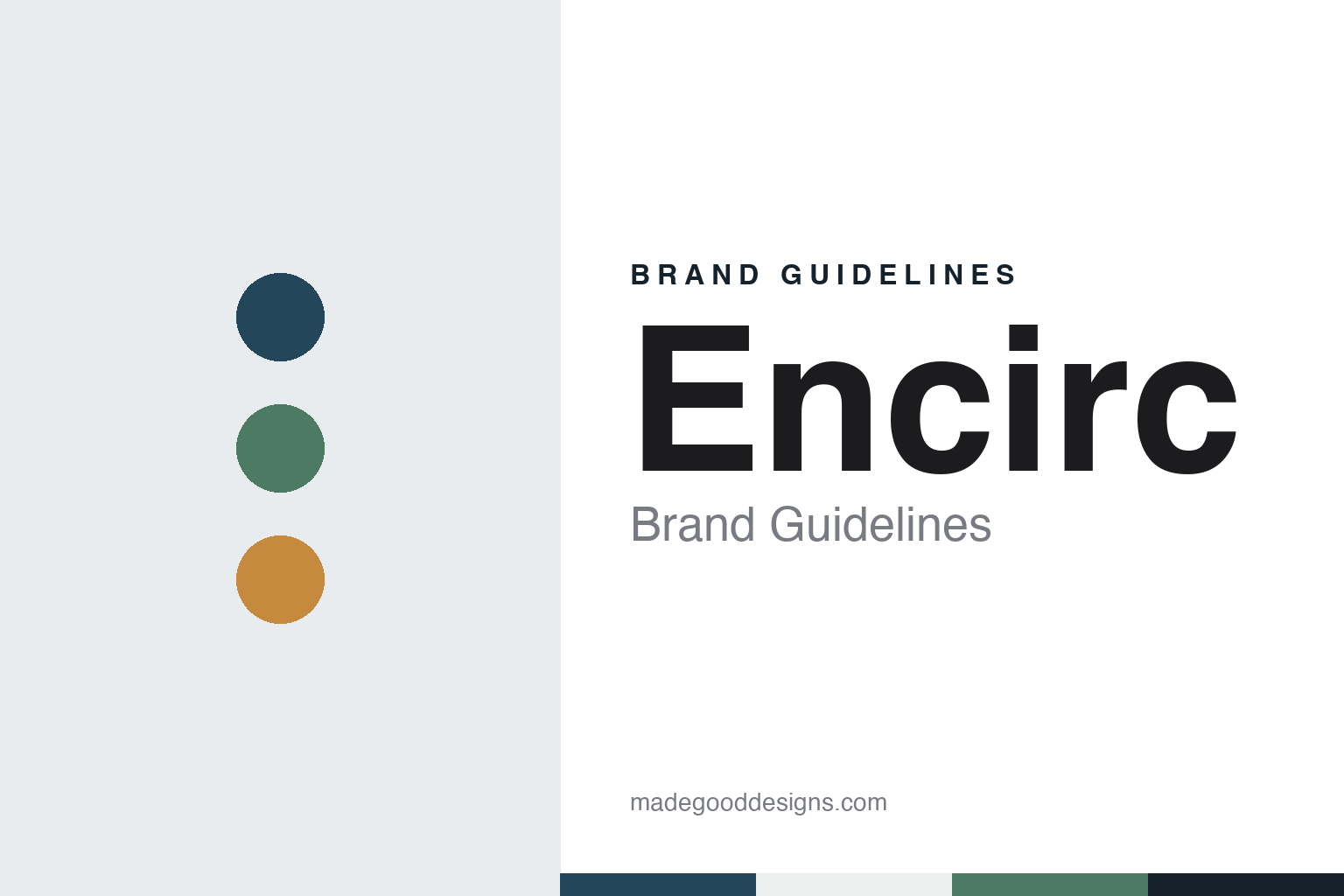
Encirc Brand Guidelines
The Quinn Glass plant that became Encirc, and then Vidrala UK & Ireland.
Aa
Two constants: a lough blue, cullet green and amber palette and a rounded industrial sans register. Abstract homage — not an Encirc or Vidrala product or mark; no bottle, logo or wordmark is reproduced.
Quinn Glass
A container-glass plant in County Fermanagh, 1998.
Encirc began as Quinn Glass, a container-glass plant at Derrylin in County Fermanagh, Northern Ireland. The company’s own timeline says work on the plant started in 1997 and that it opened in 1998, when Quinn Glass began making glass containers for the food and drink industry. English Wikipedia’s article on the Quinn group, now called Mannok, places the commissioning of the group’s first container-glass plant in the same year.
Quinn Glass was one arm of a wider Fermanagh business. English Wikipedia says the Quinn group was formed by its founder, Seán Quinn, in 1973, and grew from a small quarrying operation in Derrylin into a group with interests in cement, concrete products, container glass, radiators, plastics, insurance, hotels and property. The glass plant was built in Derrylin, the same village where the group had started.
The second site came in England. The company says work began in 2004 on a plant at Elton, Cheshire, which opened in 2005 and put glass-making, drinks filling, automated bonded storage and distribution on a single site. In the same timeline the company lists 2008 as the year it perfected what it calls 12-section quad-gob manufacturing, a forming method it describes as an industry first.
The wider group changed hands in the years that followed. In 2011 a receiver was appointed to the Quinn manufacturing businesses, and the lenders who took control renamed them Aventas, BBC News reported in January 2015; English Wikipedia adds that the group became Quinn Industrial Holdings in 2014 and Mannok in 2020. The glass business took its own new name in 2014: according to both the company and BBC News, Quinn Glass was rebranded Encirc that year.
Colour
Glass, filling and logistics as one service.
The company’s central idea is what it calls “360”. On its site it describes a chain that starts with wine and other drinks shipped in bulk to its sites by road, rail or sea, continues through glass manufacture, processing and bottling on automated high-speed lines, and ends with storage in an automated bonded warehouse and delivery of store-ready pallets to retailers. The company says that warehouse holds 250,000 pallets, and Glass International reported in October 2026 that customers have access to one of Europe’s largest bonded warehouses, in the company’s words.
Its glass pages set out the process in plain steps. A batch of silica sand, soda ash, limestone and recycled glass, known as cullet, is mixed and melted in a furnace; the molten glass is cut into gobs and formed by the press-and-blow or blow-and-blow method; the bottles are then annealed in a lehr, inspected and packed. Further ingredients, the company notes, change the colour of the glass. At Elton, finished bottles can go straight from the warehouse to the filling hall.
The model reached a third site in Bristol. The Grocer reported in November 2022 that Encirc had agreed to acquire The Park, the Bristol bottling and warehousing site run by Accolade Wines, with around 400 employees moving to Encirc and Accolade entering a ten-year bottling and distribution agreement, a deal agreed in November 2022. At that point, The Grocer said, Encirc listed its sites as Derrylin, Elton and Corsico in Italy. Today the company names Derrylin, Elton and Bristol as its three sites.
Scale is given in round numbers. The company says it employs almost 2,000 people and makes more than three billion glass containers a year; its October 2026 announcement gives around three billion containers and up to 500 million litres of drinks filled each year. It also runs a training programme, launched in 2014 as the Encirc Academy and later renamed the Vidrala Academy, according to its timeline.
Typography
Design and documentation.
Glass makers sell mainly to builders, carmakers and bottlers rather than to shoppers, and their brand pages are written for those buyers. The material does much of the visual work. Many of the large producers fill their websites and annual reports with photographs of their own float lines, furnaces and forming machines, shot and published the way each company chooses, next to close-ups of finished sheets, windscreens and bottles.
Product pages tend to follow the three big markets. Architectural ranges cover clear and tinted float glass, coated glass for solar control and insulation, laminated glass and mirrors, each usually with a range name and a technical data sheet. Automotive pages describe windscreens, side and roof glass, and glass with heating, acoustic layers or head-up-display areas. Container makers show bottles and jars by capacity, colour and finish, often with catalogue pages of standard shapes for wine, beer, spirits and food.
Colour belongs to the catalogue as much as to the logo. Flat-glass makers publish swatches for body tints and reflective coatings, and packaging makers name their glass colours, such as flint, amber and green, and show the same bottle shape in each. Corporate pages carry a second kind of identity: maps of plants, lists of countries, ownership histories and stock-market listings, which matter in an industry where many groups have grown by buying or merging with other glassworks.
The guides in this group read those public materials: founding records, owners, plants and product families, as the companies and independent sources describe them. The colours and type samples shown here are our own interpretation, not official brand assets, and no product or mark is reproduced.
Aa
A rounded industrial sans for a glass and logistics business. (Specimen set in Manrope, a sans STAND-IN; NOT the Encirc or Vidrala logo.)
Encirc
From Quinn Glass to Vidrala UK & Ireland.
Ownership moved to Spain in 2015. BBC News reported on 14 January 2015 that the Basque glass-container maker Vidrala had bought the former Quinn Glass business, including the plants at Derrylin and Elton and the filling operation at Elton; the BBC noted that Vidrala then had no manufacturing presence in the UK or Ireland. Encirc kept its own name inside the group for more than a decade, and its site footer still describes it as part of the Vidrala Group.
That arrangement ended in October 2026. In an announcement dated that month, and reported by Glass International on 27 October 2026, the company said Encirc had become Vidrala UK & Ireland, with its plants now operating as Vidrala Derrylin, Vidrala Elton and Vidrala Bristol. The company said the change honours nearly three decades of glassmaking since the first Quinn Glass plant opened in Derrylin in 1998, and it carried the purpose line “Great people, great place, great future” over to the renamed business. The encirc360.com site was still online in November 2026, carrying the announcement.
The Encirc name therefore belongs to a defined period: from the 2014 rename of Quinn Glass to the October 2026 move to the Vidrala name, a span of about twelve years in which the business went from a Fermanagh plant with an English sister site to three sites under a Spanish parent. Through that period the name stood for a service as much as a factory, with glass-making, filling and warehousing sold together.
For a design guide, Encirc shows how a supplier name can be built around a service idea and later folded into its parent’s brand. Compare Vidrala, its owner since 2015, and O-I Glass, another container-glass maker. For this guide we use a deep lough blue, a cullet green and an amber with a sans, an unofficial interpretation; no product or logo is reproduced.
Explore & save
Keep Encirc’s identity on hand — save it to a board in the Made Good inspiration library.
Encirc identity set
Keep the Encirc lough blue, cullet green & amber palette and the rounded industrial sans register for reference.