Homebox Brand Guidelines
A Paris self-storage idea of 1996, grown into a family-group franchise network.
Aa
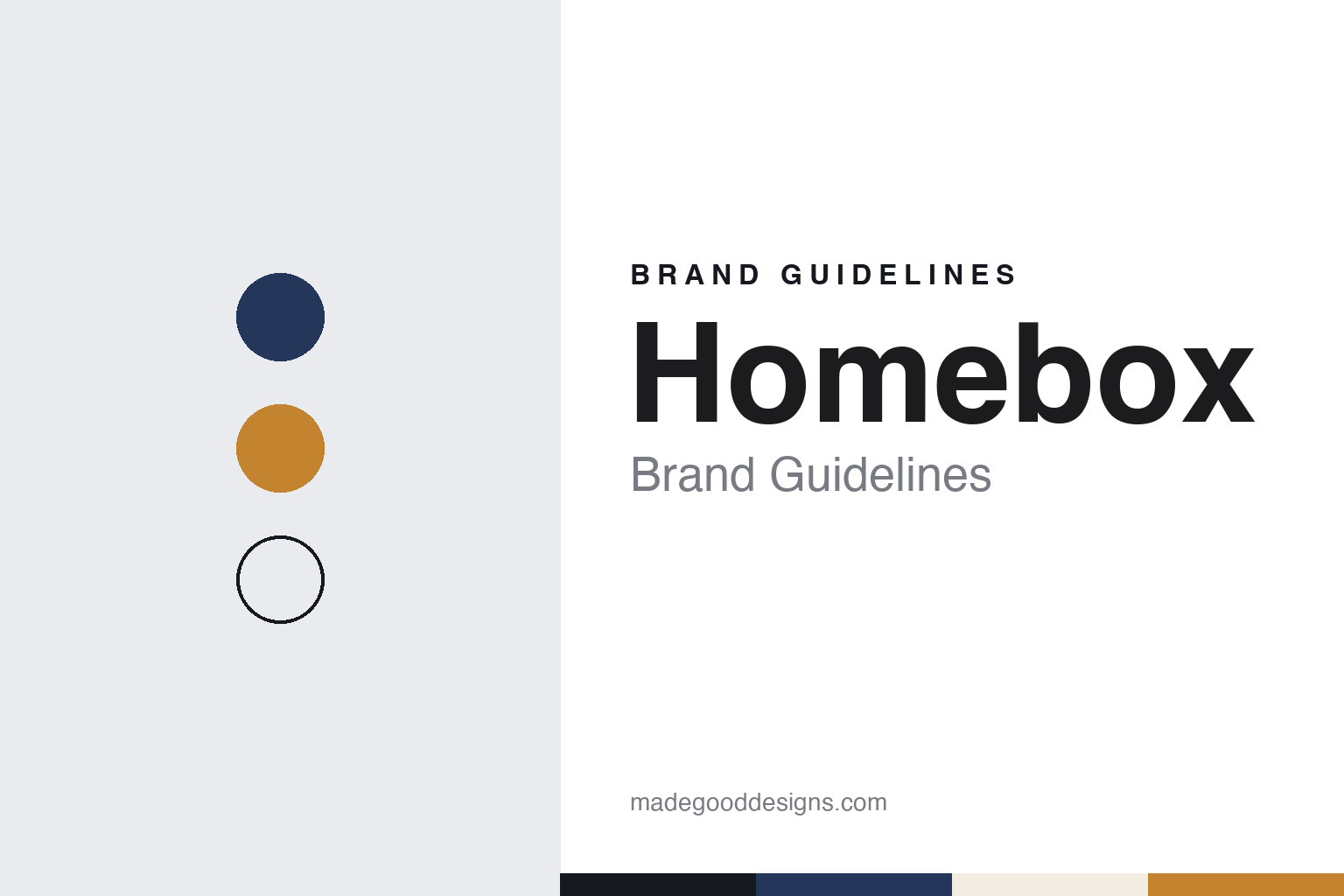
Two constants: a box indigo, warm card and tape amber palette and a rounded geometric sans register. Abstract homage — not a Homebox product or mark; no building, sign or logo is reproduced.
Place Boulnois
An American idea, a Paris address and a family group.
Homebox opened its first self-storage centre in Paris in 1996, on place Boulnois in the 17th arrondissement, the company says on its history page. Its account credits Nicolas Rousselet with the idea: on a trip to the United States he saw how well self-storage was doing, and on his return he set up what Homebox describes as the first French company to offer the service. Le Journal des Entreprises, in an April 2024 report on the brand’s plans for eastern France, also gives 1996 as the year Homebox was created.
The company frames the business as an American import. Its history page says self-storage grew up in the United States in the 1970s, as Americans moved home more often, and that strong growth in the US market during the 1990s showed what the sector could become. The French version keeps the basic offer: individual lockable boxes rented to households and businesses, with free access during opening hours and no fixed contract length beyond a one-month minimum, as the company’s own pages put it. Box sizes run from half a square metre to about 50 square metres, the website says, and the centres also sell cartons and packing material.
Homebox is part of a family group. It sits inside Groupe Rousselet, the holding company based in Clichy, just outside Paris, that also owns the G7 taxi company and the van-hire brand Ada. French Wikipedia lists Homebox among the group’s subsidiaries and places it, with the archive-storage firm Novarchive, in the group’s storage division. The group was known as Groupe G7 until 2016, when it took the Rousselet name, according to the company, and Nicolas Rousselet chairs and runs it.
Colour
Franchisees, square metres and a first centre in Germany.
Much of the growth came through franchising. Homebox’s franchise page speaks of 18 years of experience in franchising and says the network counts more than 200 storage centres in France and abroad, with about ten openings a year. The French trade site L’Observatoire de la Franchise, which covers the network under its trading name Homebox Distribution, reported in March 2023 that it had passed 500,000 square metres of storage space during 2022, across 152 branches, 125 of them in mainland France and the overseas departments.
The network has its own internal structure. The company describes a steering committee that sets strategy and a consultative committee made up in equal parts of franchisees and of locataires-gérants, the managers who run centres under a lease-management contract, which acts as the network’s voice on day-to-day matters. Since May 2021, Homebox says, it has been run by two deputy managing directors, Soukaïna Arharbi and Vincent Poirot.
Abroad, the company says it opened its first centre in Germany in 2015. In May 2022 L’Observatoire de la Franchise reported a new opening in Andorra and gave the network at that time as 140 centres in Europe, 120 of them in France and about twenty in Spain, Germany, Switzerland and Portugal. Homebox’s governance page now speaks of more than 300 staff across six countries.
New centres often reuse old buildings. La Gazette Nord-Pas-de-Calais reported on 31 October 2026 that a franchised Homebox centre had opened on the former Fosse 9 site of the Annequin colliery, south-east of Béthune, the brand’s first in that area, adding to its centres in Lille, Marcq-en-Barœul and Lomme; the paper noted that customers can reach their boxes every day from 6 a.m. to 10 p.m. Le Journal des Entreprises reported in 2024 that the centre planned for Vandœuvre-lès-Nancy would reuse a former car-breaker’s building of about 5,000 square metres, and Homebox’s press page lists the Nancy opening in January 2026. La Gazette also noted that the brand prefers to rehabilitate existing sites, which it presents as part of a commitment to sustainable urban development.
Typography
Design and documentation.
Self-storage is a property business that has to sell itself to people at a moment of change: a move, a renovation, a smaller home or a growing stock of inventory. The way operators present themselves follows from that. The building is the first advertisement, and cladding, roll-up doors and roadside signs can all carry a brand colour. Where a company publishes its building colours or signage system, this guide reports them as the company’s own description.
Online, the category has settled on a familiar set of tools. An operator’s website can lead with a store finder, a unit size guide that explains what fits in each space, a choice of unit types such as heated or drive-up storage, packing supplies and an account page for paying rent and booking. When one owner runs several regional brands, those sites can share a single template, with only the name, the city list and the colours changing, as StorageVault’s Access Storage and Sentinel Storage sites did in November 2026.
Campaigns and characters do the work the buildings cannot. Some operators use mascots, slogans or sports sponsorships to make a functional service memorable; StorageVault, for example, took stadium and broadcast signage with the Toronto Blue Jays in 2023, according to Inside Self Storage. When a guide mentions a mascot or campaign, it says where and when the company used it.
Behind the shop front sits a corporate layer. Some operators are listed companies or real estate investment trusts, or are owned by private-equity firms and family groups, and their investor pages explain store counts, rentable area, acquisitions and listings. Those figures are given here only as a dated source states them, and mergers or takeovers that have not closed are described as pending, with the date they were announced.
Aa
A rounded geometric sans for a capitalised name. (Specimen set in Outfit, a sans STAND-IN; NOT the Homebox logo.)
HOMEBOX
Capital letters, a closeness line and a booking path.
On its own pages the company sets its name in capitals, HOMEBOX, while the trade press usually writes Homebox. Its manifesto page carries the line “Ne soyez jamais loin de ce dont vous êtes proches” — roughly, never be far from the things you are close to — and builds the rest of the text around closeness: local centres, staff on site and what it calls the HOMEBOX family, built up over 30 years. The brand also advertises on national television; its press page shows a 15-second spot alongside news coverage of centre openings, including reports on the evening bulletins of TF1 and France 2 in 2025.
The website is built around booking. A centre finder, a volume simulator that estimates the box size a move needs and a four-step rental path sit at the top of the home page, with service pages split between private customers (moving, renovation, students, expatriation) and businesses (archives, stock, tools, event equipment). The company also rents returnable storage boxes and presents its social and environmental commitments, including partnerships with associations, as part of an ambition it describes as becoming a “responsible number one”.
For a design guide, Homebox shows how a self-storage operator can present itself through a family group, a franchise network and a capitalised wordmark. Compare it with Safestore, whose French business trades as Une Pièce en Plus, and with Annexx, a Toulouse operator founded in the early 2000s. For this guide we use a box indigo, warm card and tape amber palette with a rounded geometric sans, an unofficial interpretation; no product or logo is reproduced.
Explore & save
Keep Homebox’s identity on hand — save it to a board in the Made Good inspiration library.
Homebox identity set
Pin the Homebox box indigo, warm card and tape amber palette and the rounded geometric sans register to your own board.