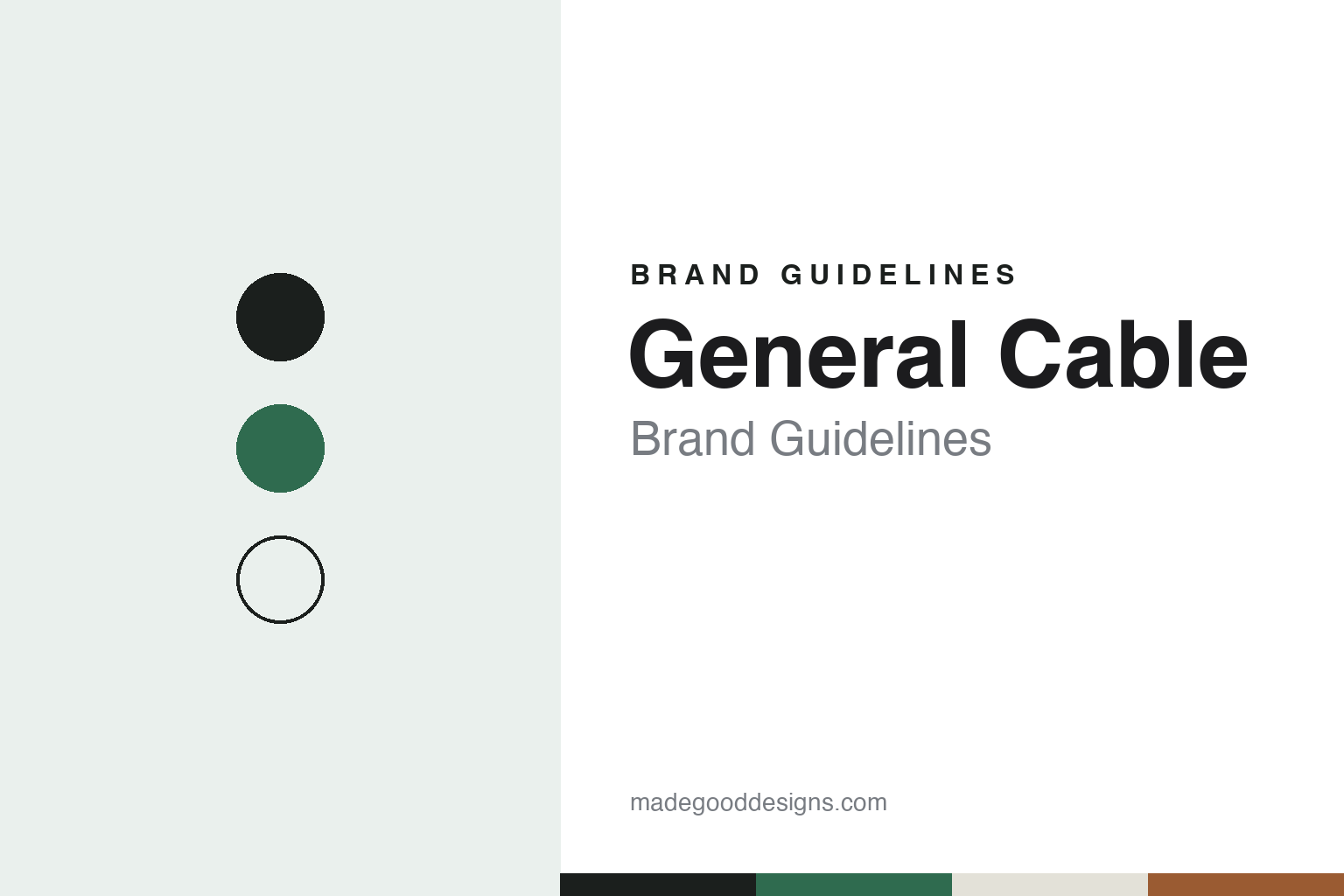
General Cable Brand Guidelines
A 1927 cable merger that ended inside Prysmian in 2018.
Aa
Two constants: a green, black and copper palette and an industrial sans register. Abstract homage — not a General Cable or Prysmian product or mark; no cable, logo or label is reproduced.
A banker’s merger
A dozen wire firms, one name and a hard start.
General Cable was not founded by one person in one workshop. It was assembled. The International Directory of Company Histories, the Gale reference series, traces its oldest root to Standard Underground Cable, a company it says the inventor George Westinghouse set up in 1882 to supply cable for his electrical ventures. In 1925 Safety Insulated Wire & Cable of Bayonne, New Jersey, bought two smaller firms to form Safety Cable, and in 1927 Safety Cable was combined with Standard Underground and several other companies, in a deal arranged by the banking firm Kissel, Kinnicutt & Co., to create the General Cable Corporation. English Wikipedia gives the same year and place, New Jersey, and names Phillips Wire, Rome Wire and Standard Underground among the older firms brought together.
The early years were difficult. The Gale history describes a merger of about a dozen companies with many outdated plants, heavy debt and a crowded management layer, and says the company lost money for five straight years in the early 1930s after the copper price collapsed. It credits Dwight Palmer, who became president in 1933, with the turnaround: he won the contract to supply cable for a power line from the Hoover Dam to Los Angeles, which led to work at the Bonneville and Grand Coulee dams. During the Second World War, the same source says, the company grew from six plants and about 2,000 employees to ten plants and about 12,000, before cutting back to six plants after 1945.
Growth resumed in the 1950s, with new plants in Illinois, California, Florida and Texas and a run of acquisitions. By the Gale history’s count the company ran 41 plants at its peak in 1967. In 1973 it moved its executive offices from Manhattan to Greenwich, Connecticut.
Colour
New names, new owners and a move to Kentucky.
The 1970s and 1980s brought a long period of changing ownership. The Gale history records that General Cable bought the capacitor maker Sprague Electric in 1976, sold its power and control cable operation to Pirelli Cable in 1978, and in 1979 renamed itself GK Technologies, while keeping General Cable Corporation as a legal name. In May 1981 the Penn Central Corporation acquired GK Technologies and folded it into a separate unit. English Wikipedia also dates Penn Central’s ownership from 1981 to 1992.
In 1992 Penn Central spun off its wire and cable businesses, and the new company took back the name General Cable Corporation. After a contest between Ohio and Kentucky, the Gale history says, tax incentives brought its headquarters to Highland Heights, Kentucky, near Cincinnati; English Wikipedia says the Highland Heights site has operated since 1992 and also served as the North American headquarters. The company did not stay put under one owner for long. In June 1994 it was bought by Wassall PLC, a British holding company, which sold most of its stake through a public offering in May 1997 and the rest a few months later. From then on General Cable traded on the New York Stock Exchange under the ticker BGC.
Its largest step came in 1999, when it bought the energy cable business of the British group BICC plc. For a time it operated as BICC General, the Gale history says, and the entry, which runs to 2000, then described it as the third-largest wire and cable maker in the world. It soon sold the weaker former BICC businesses in Europe, Africa and Asia to a subsidiary of the Italian group Pirelli and went back to General Cable as its trading name, then bought the Mexican cable maker Telmag to expand in Latin America. The same entry lists Carol, BICC and Brand Rex among its brand names at the time.
By 2016, English Wikipedia says, General Cable employed about 11,000 people in plants, distribution centres, technology centres and offices, with regional operations in North America, Latin America and Europe. Its range covered copper, aluminium and optical-fibre cable, including low-, medium- and high-voltage power cable. English Wikipedia also records that in 2016 the company resolved investigations by the US Securities and Exchange Commission and the Department of Justice under the Foreign Corrupt Practices Act, over improper payments to officials in Africa and Asia.
Typography
How cable makers present themselves.
Cable makers sell products that most people never see once they are installed. Power lines run under streets and seabeds, data cable sits inside walls, and magnet wire is wound into motors. Their public image therefore leans on what can be photographed before installation: the cable itself, the plant that makes it and the ships that lay it.
The most common picture is the cut end. Company pages and catalogues show a cable in cross-section, with copper or aluminium conductor, insulation, screens and outer sheath set out in rings, often against a plain background. Wide shots of full reels and drums stacked in a yard do the same job at a larger scale, turning a long product into a single object that a camera can frame.
Submarine work has added another set of images. Press releases about offshore wind and grid links are often illustrated with cable-laying vessels, carousels of coiled cable and tall factory towers where high-voltage cable is made. These photographs carry the story of size and reach without needing a consumer product, and they are usually credited to the company that issued them.
Words matter as much as pictures. Makers organise their ranges into product families with short trade names, voltage classes and standard codes, and their corporate pages spend a lot of space on plants, subsidiaries and owners: where a factory stands, when it opened and which group holds the shares. For a designer, the category offers a practical vocabulary of rings, coils, ships and site maps, and a reminder that an industrial identity is often built from documentation rather than from packaging.
Aa
An industrial sans for a wire and cable maker. (Specimen set in Public Sans, a sans STAND-IN; NOT the General Cable logo.)
General Cable
A green triangle, then a new owner.
The independent company ended in 2018. On 3 December 2017 General Cable signed a merger agreement with Prysmian Group, the Milan cable maker that grew out of Pirelli’s cable business. Prysmian announced on 6 June 2018 that it had completed the acquisition: it bought all outstanding General Cable shares for cash, and General Cable became a privately held company within the Prysmian group, with its shares no longer listed on the New York Stock Exchange or any other market. The generalcable.com address now leads to Prysmian’s website.
Highland Heights kept its role. In December 2022, LINK nky reported that Prysmian had opened a renovated 80,000-square-foot North American headquarters there, near Northern Kentucky University, and that the work would allow up to 400 jobs to be retained at the site. The paper said Prysmian’s regional footprint included 28 manufacturing facilities and more than 5,800 employees. Some older names lived on: Prysmian’s North American brands page in 2026 lists the Carol brand of cord sets and electronic wire, which the Gale history had named among General Cable’s brands in 2000.
The mark is the part of the identity that is documented. English Wikipedia says General Cable introduced its first trademark logo when it formed in 1927 and modified it five times; the later version paired the name in stylised black lettering with a green Reuleaux triangle, a curved triangle of constant width, on the left, as a modernised form of the 1927 symbol.
For a design guide, General Cable shows how a merged company can hold one name and one geometric symbol through decades of new owners, from Penn Central to Wassall to Prysmian. Compare Prysmian, the group that absorbed it, and Superior Essex, another American wire and cable maker with a long ownership history. For this guide we use a triangle green, conductor black, sheath stone and drawn copper with a sans, an unofficial interpretation; no product or logo is reproduced.
Explore & save
Keep General Cable’s identity on hand — save it to a board in the Made Good inspiration library.
General Cable identity set
Pin the General Cable green, black and copper palette and the industrial sans register to your own board.