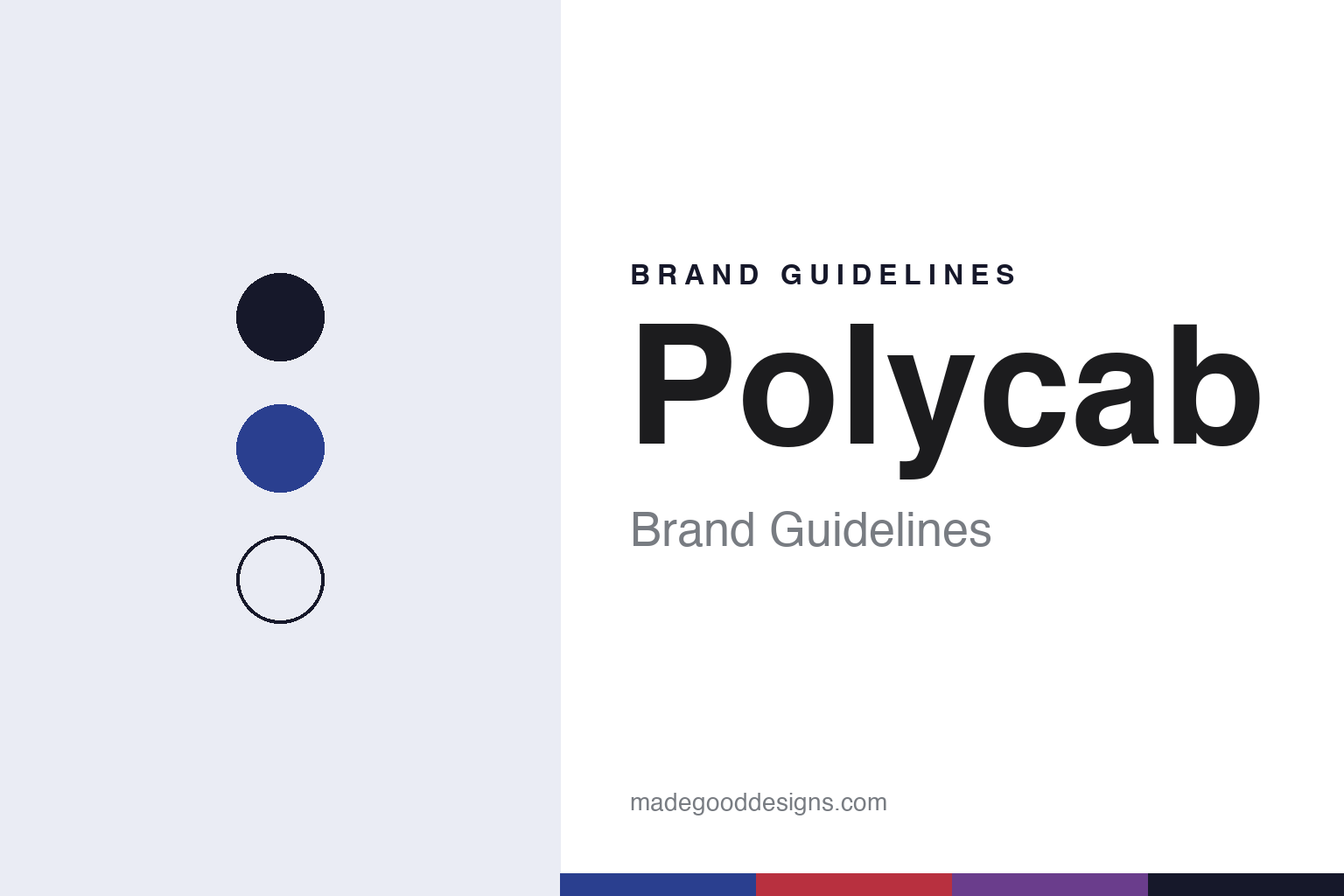
Polycab Brand Guidelines
A 1964 Bombay shop, Halol wires and an Interbrand refresh.
Aa
Two constants: a red, blue and purple palette and a rounded geometric sans register. Abstract homage — not a Polycab product or mark; no cable, logo or nameplate is reproduced.
Sind Electric Stores
A Bombay shop, a family and a Gujarat factory.
Polycab began as a shop. The company’s history page says Thakurdas Jaisinghani set up Sind Electric Stores in Bombay in 1964; English Wikipedia places the store in Lohar Chawl and says he had moved to Bombay after the Partition of India. It sold fans, light fittings, switches and wire, Wikipedia says. In 1968, the history page says, his four sons, Girdhari, Inder, Ajay and Ramesh Jaisinghani, began to manage the business.
Manufacturing came next. In 1975 the family formed a partnership, Thakur Industries, to build a cable and wire factory on industrial-estate land at Andheri, Mumbai, the company says. In 1983 Polycab Industries was registered as a small-scale unit with the Gujarat government’s Directorate of Industries; English Wikipedia says its factory at Halol, in Gujarat, made PVC-insulated wires and cables, copper and aluminium products, and bare copper wire.
The business was incorporated as Polycab Wires Private Limited in Mumbai in 1996, and in 1998 a plant at Daman began making power cables, house wires, telephone, optical-fibre and switchboard cables, according to the history page. Halol remains central to the story: the company says its central quality and test laboratory is there, accredited by NABL and UL, and in an October 2026 interview with Wire & Cable India its telecom chief described the Halol site as backward-integrated, with strength elements for its optical-fibre cables made in-house.
Colour
From cables to fans, switches and a listing.
From cables Polycab moved into what Indian companies call fast-moving electrical goods. Its history page dates its entry into switches to 2013 and into fans and LED lighting to 2014, alongside a miniature-circuit-breaker plant at Nashik; ceiling fans followed at Roorkee, in Uttarakhand, from 2016, a joint venture with Techno Electromech for LED lighting in 2017, and water heaters from 2019. In 2020 it launched HOHM, a connected smart-home system. Wikipedia adds that it entered engineering, procurement and construction work in 2009. The solar side has kept growing: Wire & Cable India reported on 23 October 2026 that Polycab had launched a hybrid inverter and battery pack at the Renewable Energy India Expo in Greater Noida, shown alongside its inverters, distribution boxes, solar cables and cable accessories.
It has also worked with larger partners. Wikipedia records a joint venture with the French cable maker Nexans from May 2008 for rubber cables used in shipbuilding, railways and wind power. With Trafigura it formed Ryker Base in 2016 to make copper rod at Halol; the company bought out the remaining half in 2020, and Wikipedia says Ryker Base was sold to Hindalco Industries in November 2021.
Polycab went public in April 2019, listing on the National Stock Exchange and BSE; its history page says the offer was subscribed 52 times. Inder Jaisinghani is chairman and managing director, according to Wikipedia and Wire & Cable India. Today the company says it runs 28 manufacturing facilities, including its two joint ventures, across Gujarat, Maharashtra, Uttarakhand and Daman, and calls itself India’s largest maker of wires and cables, with a market share it puts at 26%. It names its product certifications as including BIS, BASEC, UL and IEC.
Typography
How cable makers present themselves.
Cable makers sell products that most people never see once they are installed. Power lines run under streets and seabeds, data cable sits inside walls, and magnet wire is wound into motors. Their public image therefore leans on what can be photographed before installation: the cable itself, the plant that makes it and the ships that lay it.
The most common picture is the cut end. Company pages and catalogues show a cable in cross-section, with copper or aluminium conductor, insulation, screens and outer sheath set out in rings, often against a plain background. Wide shots of full reels and drums stacked in a yard do the same job at a larger scale, turning a long product into a single object that a camera can frame.
Submarine work has added another set of images. Press releases about offshore wind and grid links are often illustrated with cable-laying vessels, carousels of coiled cable and tall factory towers where high-voltage cable is made. These photographs carry the story of size and reach without needing a consumer product, and they are usually credited to the company that issued them.
Words matter as much as pictures. Makers organise their ranges into product families with short trade names, voltage classes and standard codes, and their corporate pages spend a lot of space on plants, subsidiaries and owners: where a factory stands, when it opened and which group holds the shares. For a designer, the category offers a practical vocabulary of rings, coils, ships and site maps, and a reminder that an industrial identity is often built from documentation rather than from packaging.
Aa
A rounded geometric sans for a brand built around the letter “O.” (Specimen set in Manrope, a sans STAND-IN; NOT the Polycab logo.)
Ideas. Connected.
A dawn palette with a meaning for each colour.
The current identity dates from 18 September 2023. Wire & Cable India reported that Polycab had unveiled a new logo, brand line and philosophy that day, designed by Interbrand, as part of a programme the company calls Project LEAP. The line moved from “Connection Zindagi Ka” to “Ideas. Connected.”, and the stated purpose became “Connecting all to a brighter future.” The visual identity, the report said, takes the colours of dawn and builds its emblem around the letter “O,” a prominent sound in the Polycab name.
Each of the three colours carries a meaning, the company says: red for its leadership in wires and cables, blue for its connection with customers through consumer products, and purple for future readiness, tied on its website to its IoT range. The launch came with a television commercial, “Ghar Jo Aapko Samjhe,” built around the idea of a home that understands its owner and created by Ogilvy, the same report said. At the unveiling, Inder Jaisinghani described the company’s path from “a single electrical store” to wire and cable manufacturing. Wikipedia notes that the company has also been named a Superbrand by Superbrands India.
The identity also reaches the trade. Electricians matter to a wire brand, and Polycab marks an annual Electricians’ Day: on 10 June 2026, Wire & Cable India reported, it held “Samman Samaroh” recognition ceremonies for electricians and their families in several cities, ran a social-media film asking consumers to thank their electricians, and said it had reached more than 10,000 electricians at more than 900 locations through its Polycab Experts Program, calling them “Partners for Life.” The company’s About page frames the whole brand in the same register, describing its palette as inspired by the first light of morning.
For a design guide, Polycab shows how a wire maker rebuilt its identity around a consumer story, with a dawn palette whose colours are each assigned a business meaning. Compare KEI Industries, another Indian cable maker that has turned to consumer marketing, and Nexans, its joint-venture partner from 2008. For this guide we use a red, a deep blue and a purple with a sans, an unofficial interpretation; no product or logo is reproduced.
Explore & save
Keep Polycab’s identity on hand — save it to a board in the Made Good inspiration library.
Polycab identity set
Pin the Polycab red, blue and purple palette and the rounded geometric sans register to your own board.