Finolex Cables Brand Guidelines
The 1958 Pune wire maker named for “fine” and “flexible.”
Aa
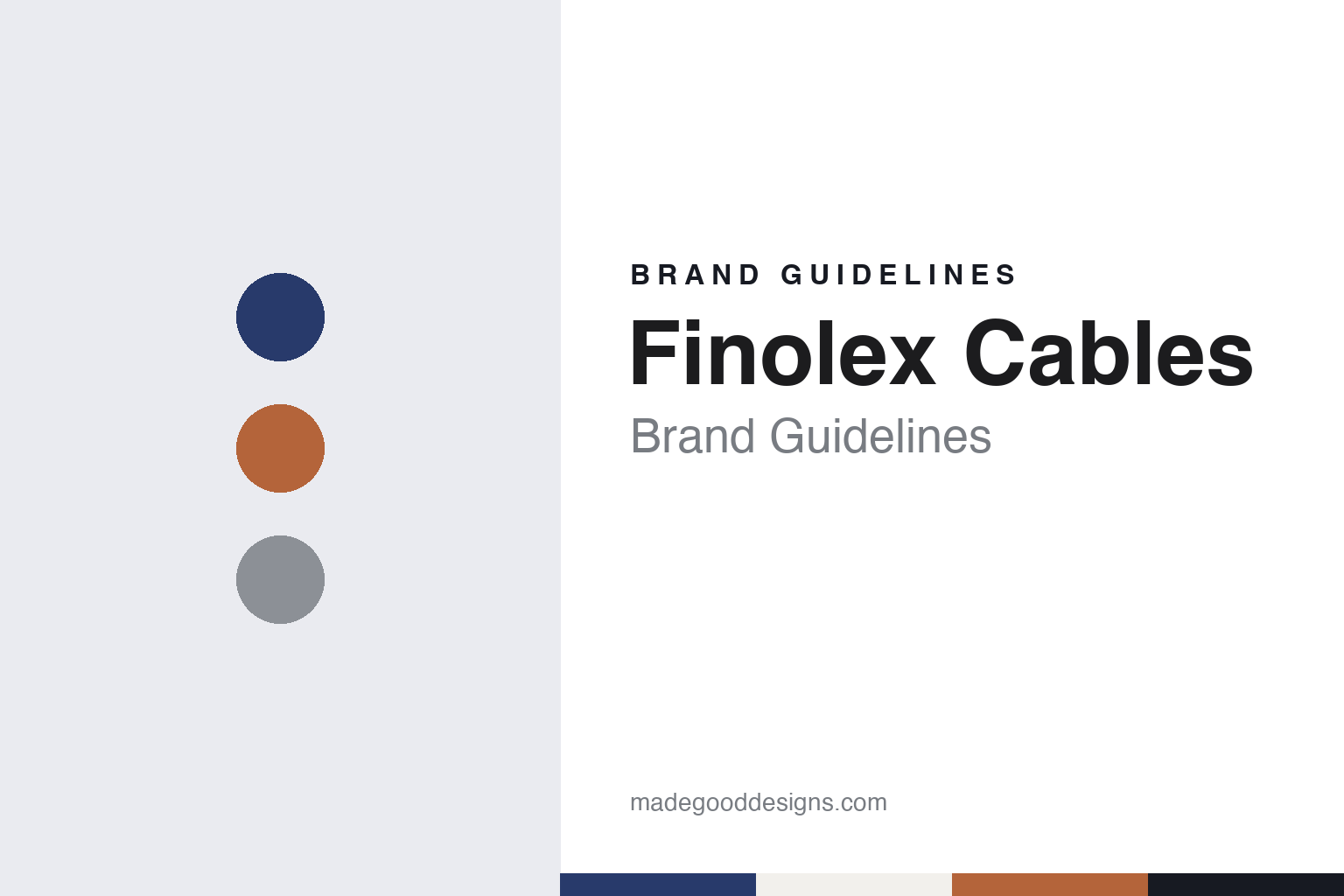
Two constants: a deep indigo, drawn copper and conduit grey palette and a sturdy grotesque sans register. Abstract homage — not a Finolex product or mark; no cable, logo or wordmark is reproduced.
Fine and flexible
A copper cable maker founded in 1958.
Finolex Cables dates its start to 1958. The company says it was founded that year by Pralhad P. Chhabria and Kishan P. Chhabria, and English Wikipedia’s article on the wider Finolex Group gives the same year and the same two founders, there written as P. P. Chhabria and K. P. Chhabria. The group is based in Pune, in Maharashtra, and today includes Finolex Cables, Finolex Industries, Finolex J-Power Systems and Finolex Plasson Industries, according to Wikipedia.
The name explains the first product. The company says the word Finolex comes from “fine” and “flexible”, a reference to the fine copper drawn for its first line, flexible cables. Wikipedia gives a slightly fuller account of the mark: “Fine” and “Flexibles,” with an “O” crossed by an electric arc to suggest the electrical cable business the company was in. That arced letter is the only part of the drawn mark that Wikipedia describes.
The legal history runs through an earlier name. In the company’s own timeline, the business began as a partnership firm called Indian Cable Industries, which set up a light-duty cable facility at Pimpri, in Pune. Indian Cable Industries then acquired a firm called Alpha Rubber Co., the timeline says, and the company name was changed to Finolex Cables Ltd. A low-voltage power cable plant followed at Pimpri, and the company later listed its shares through a maiden public issue.
Early growth came from vehicles. The company says the founders moved from copper cable into PVC-insulated electrical cables for the automobile industry, and automotive cable has stayed part of the business since. In April 2024 The Hindu BusinessLine reported that Finolex was working to triple the automotive cable capacity of its plant in Uttarakhand, and that a new electron-beam facility in Pune would add capacity for cables used in electric vehicles.
Colour
Copper, telephone lines and glass fibre.
The business then moved into communication lines. The company’s timeline records a technical collaboration with a German partner, an optical fibre cable plant at Urse, near Pune, launched in a joint venture with AT&T, and a plant there for jelly-filled telephone cables. A copper rod plant followed through a joint venture with Essex, which the company describes as part of a backward-integration strategy, so that the business could draw its own rod rather than buy it in.
The map of plants widened in stages. The timeline lists factories at Verna in Goa for jelly-filled telephone cables, light-duty cables and optical fibre cable; glass fibre manufacture at Urse; and a cable plant and an electrical switch plant at Roorkee in Uttarakhand. Two later joint ventures added an extra-high-voltage power cable plant at Shirwal, in Maharashtra, with J-Power Systems of Japan, a Sumitomo Electric subsidiary, and an optical fibre plant near Pune with Corning. The company now names its main plants as Pimpri, Urse, Goa and Roorkee.
Its cable range is broad. The company lists house wires, power and control cables up to 33 kV, jelly-filled telephone cables, automotive and battery cables, coaxial and CATV cables, LAN cables, solar cables and fibre optic cables, alongside flexible industrial cables and winding wires. Around them sits a newer range of electrical goods: switches sold under the Finotouch name, fans, lighting, water heaters, room heaters, irons, switchgear, PVC conduits and smart door locks.
Recent investment has gone into fibre and polymers. The Hindu BusinessLine reported in July 2026 that Finolex had completed nearly 90 per cent of a previously announced capital programme that included an electron-beam facility for solar cables and high-performance wires, a preform plant for optical fibre and capacity added across several plants. The Hindu reported in October 2026 that the company described the preform unit as completing its backward integration in fibre cable, and that it was preparing to launch automotive cables made with electron-beam technology for wiring harnesses.
Typography
Design and documentation.
Cable makers sell products that most people never see once they are installed. Power lines run under streets and seabeds, data cable sits inside walls, and magnet wire is wound into motors. Their public image therefore leans on what can be photographed before installation: the cable itself, the plant that makes it and the ships that lay it.
The most common picture is the cut end. Company pages and catalogues show a cable in cross-section, with copper or aluminium conductor, insulation, screens and outer sheath set out in rings, often against a plain background. Wide shots of full reels and drums stacked in a yard do the same job at a larger scale, turning a long product into a single object that a camera can frame.
Submarine work has added another set of images. Press releases about offshore wind and grid links are often illustrated with cable-laying vessels, carousels of coiled cable and tall factory towers where high-voltage cable is made. These photographs carry the story of size and reach without needing a consumer product, and they are usually credited to the company that issued them.
Words matter as much as pictures. Makers organise their ranges into product families with short trade names, voltage classes and standard codes, and their corporate pages spend a lot of space on plants, subsidiaries and owners: where a factory stands, when it opened and which group holds the shares. For a designer, the category offers a practical vocabulary of rings, coils, ships and site maps, and a reminder that an industrial identity is often built from documentation rather than from packaging.
Aa
A sturdy grotesque sans for a wire and cable maker. (Specimen set in Archivo, a sans STAND-IN; NOT the Finolex logo.)
Finolex Cables
From a cable maker to an electrical products company.
The company now presents itself as more than a cable maker. On its site it says it is moving from wires and cables towards becoming an electrical products company, and its home page gives fans, lights, switches, switchgear and water heaters as much room as cable. The cable range is still the base: wires and cables lead the product menu, and the company says it sells through a network of around 600 distributors, 5,000 channel partners and more than 200,000 retailers across India.
Its newest growth story is about data. The Hindu BusinessLine reported in July 2026 that the company saw data centres, semiconductor projects and other infrastructure in Karnataka as demand for its communication cables, power cables, solar cables and wires, and that it had opened a large warehouse at Nelamangala, near Bengaluru, to supply southern India. In October 2026 The Hindu reported, from a press meeting in Vijayawada, that the company planned to supply LAN and power cables to a data centre cluster forming around Visakhapatnam, and had a team looking at the market for subsea cables used by data centres.
The identity itself is plain and verbal: a name built from two descriptive words and the arced “O” that Wikipedia describes; the company’s current copy adds a running play on the letter X, promising to “Xceed” customers’ “Xpectations.” Product families take short coined names in the same spirit, such as Finotouch for switches and FinoGreen for one line of industrial cables. Plants, joint ventures and the long timeline do the rest of the work, setting out an Indian manufacturer that grew outward from one material, fine copper.
For a design guide, Finolex Cables shows how a coined name built from what a product does can carry a company from one cable line into a whole range of household electrical goods. Compare Polycab and KEI Industries, two other Indian wire and cable makers. For this guide we use a deep indigo, a drawn copper and a conduit grey with a sans, an unofficial interpretation; no product or logo is reproduced.
Explore & save
Keep Finolex Cables’s identity on hand — save it to a board in the Made Good inspiration library.
Finolex Cables identity set
Keep the Finolex Cables deep indigo, drawn copper & conduit grey palette and the sturdy grotesque sans register for reference.