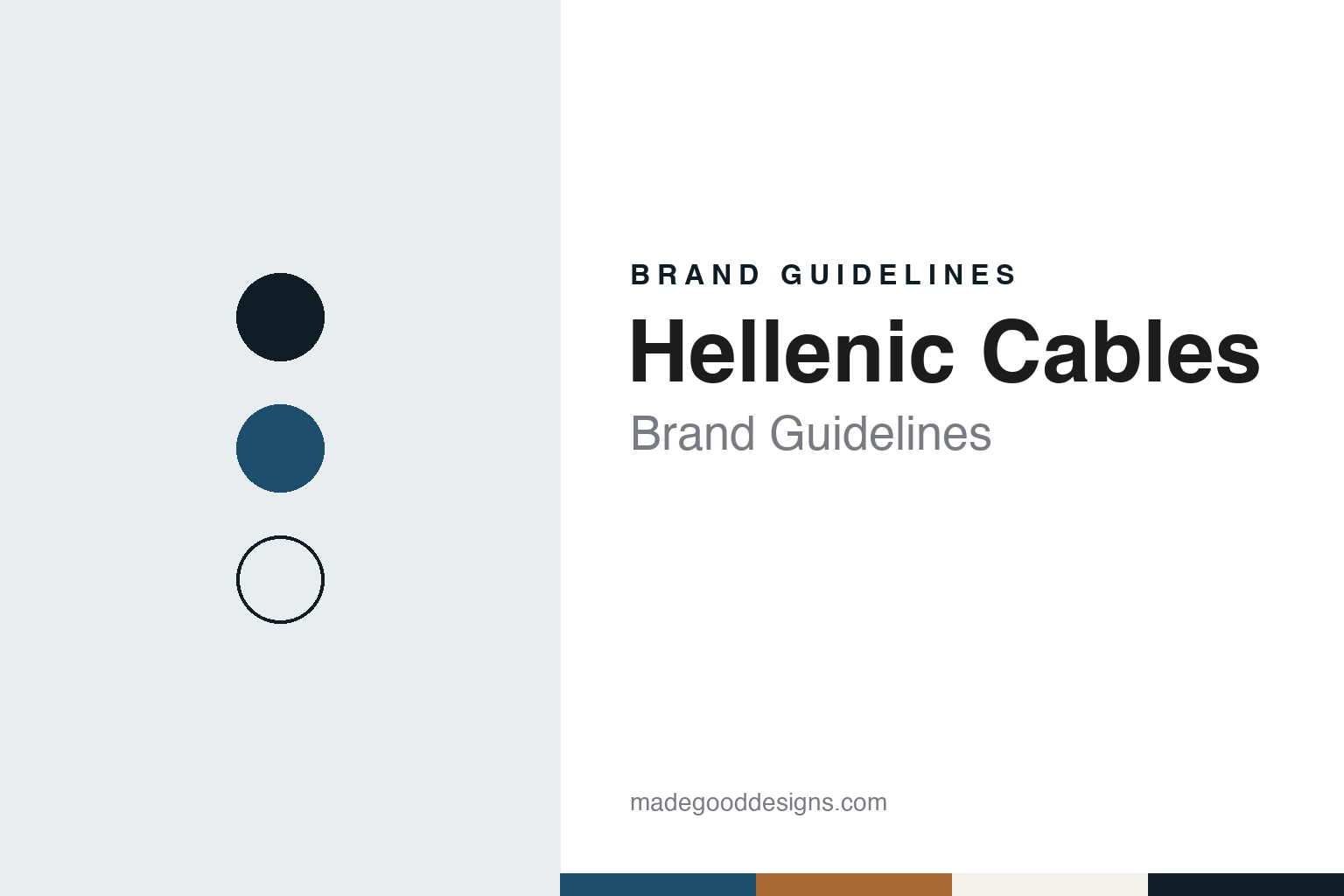
Hellenic Cables Brand Guidelines
Viohalco’s 1950 cable line, Fulgor and long HVDC links.
Aa
Two constants: an Ionian blue, bronze and marble white palette and an engineering sans register. Abstract homage — not a Hellenic Cables product or mark; no cable, logo or nameplate is reproduced.
Viohalco’s cable line
From a 1950 cable line to a listed company.
Hellenic Cables grew out of a metals group. Greek Wikipedia’s article on the company, which also records its international name as CABLEL, dates the start of cable production to 1950, inside Viohalco, the Greek copper and aluminium group. English Wikipedia says Viohalco itself was established in 1937 and made its debut on the Athens Stock Exchange in 1947. The sources used for this guide do not say how Viohalco operated during the occupation of 1941–1944.
The cable business became a company of its own later. Greek Wikipedia lists 1973 as the year Hellenic Cables S.A. (Ελληνικά Καλώδια Α.Ε.) was founded, 1991 as the start of fibre-optic cable production and 1994 as the year it was listed on the Athens Stock Exchange. The same article places its headquarters in Athens and names its main product groups as submarine cable, high- and extra-high-voltage cable, medium- and low-voltage power cable, and telecommunications, fibre-optic and data cable.
Expansion abroad and into heavier cable followed. In 1999, Greek Wikipedia says, Hellenic Cables took a majority of the Romanian cable maker Icme Ecab. A new plant at Thiva (Thebes) was completed in 2003 with a high-voltage line, and a further line for high- and extra-high-voltage cable rated up to 400 kV started in 2008. In 2011 the company bought Fulgor, a Greek maker of power cable up to 150 kV, medium-voltage submarine cable, fibre-optic cable, bare conductors and copper and aluminium rod. Fulgor’s new production unit at Soussaki in Corinthia began operating in 2014, the article says, and that Corinth site is where the company’s submarine cable is made today.
Colour
Island links and offshore wind.
Today the business sits inside a larger listed group. Offshore Energy described Hellenic Cables in August 2026 as “the cables segment of Belgium-headquartered Cenergy Holdings,” and Greek Wikipedia’s Viohalco article lists Cenergy as one of Viohalco’s main listed subsidiaries, with shares traded on Euronext Brussels and the Athens exchange. Viohalco itself moved its headquarters from Athens to Brussels in 2013 and was listed on Euronext Brussels on 22 November 2013, English Wikipedia says. Fulgor is now a wholly owned subsidiary of Hellenic Cables, according to Cenergy’s November 2026 announcement as reported by euro2day.gr.
Its signature work is submarine power cable for island links. In November 2024 Offshore Energy reported a turnkey contract with Greece’s Independent Power Transmission Operator (IPTO) for about 38 kilometres of 150 kV submarine and land cable between Kefalonia and Zakynthos and between Lefkada and Kefalonia. The submarine cable was to be made at the recently expanded Corinth plant and the land cable at Thiva, which was going through its own capacity expansion. The same report said Hellenic Cables had been the main contractor for the earlier Zakynthos–Kyllini interconnection.
The work reaches beyond Greece. In March 2025 Marine Technology News reported that Hellenic Cables and the installer Asso.subsea had won a turnkey contract from RTE, the French grid operator, for the export cables of the Dunkerque offshore wind farm: two 225 kV links, with Hellenic Cables designing, making and supplying about 32 kilometres of submarine cable and 38 kilometres of underground cable at its facilities in Greece, and handling jointing, testing and commissioning, while Asso.subsea transports and lays the submarine cable. Across the Atlantic, the same publication reported in October 2024 a contract to supply 65 kilometres of 132 kV inter-array cable for the Leading Light Wind project off New Jersey, with some components to be made at Corinth and delivery planned for 2030.
Direct-current cable is the newer line. In August 2026 Offshore Energy reported that Hellenic Cables had qualified its 525 kV HVDC cable systems with XLPE insulation for both submarine and underground use, citing CIGRE Technical Brochure 852 and, for the underground system, IEC 62895.
Typography
How cable makers present themselves.
Cable makers sell products that most people never see once they are installed. Power lines run under streets and seabeds, data cable sits inside walls, and magnet wire is wound into motors. Their public image therefore leans on what can be photographed before installation: the cable itself, the plant that makes it and the ships that lay it.
The most common picture is the cut end. Company pages and catalogues show a cable in cross-section, with copper or aluminium conductor, insulation, screens and outer sheath set out in rings, often against a plain background. Wide shots of full reels and drums stacked in a yard do the same job at a larger scale, turning a long product into a single object that a camera can frame.
Submarine work has added another set of images. Press releases about offshore wind and grid links are often illustrated with cable-laying vessels, carousels of coiled cable and tall factory towers where high-voltage cable is made. These photographs carry the story of size and reach without needing a consumer product, and they are usually credited to the company that issued them.
Words matter as much as pictures. Makers organise their ranges into product families with short trade names, voltage classes and standard codes, and their corporate pages spend a lot of space on plants, subsidiaries and owners: where a factory stands, when it opened and which group holds the shares. For a designer, the category offers a practical vocabulary of rings, coils, ships and site maps, and a reminder that an industrial identity is often built from documentation rather than from packaging.
Aa
An engineering sans for a submarine-cable maker. (Specimen set in Archivo, a sans STAND-IN; NOT the Hellenic Cables logo.)
Hellenic Cables
A Greek name on long subsea routes.
The most recent big contract is a direct-current link to the Dodecanese. On 9 November 2026 Cenergy Holdings announced that Hellenic Cables, through Fulgor, had signed a turnkey contract with IPTO for the engineering, procurement, construction and installation of a 320 kV HVDC interconnection between Corinth and Kos, euro2day.gr reported. The project covers about 1,260 kilometres of submarine cable and 30 kilometres of underground cable, and the HVDC cable is to be made at the company’s facilities in Corinth and Thiva. The French financial site Idéal Investisseur reported the same details on 10 November 2026, describing Fulgor as part of the Hellenic Cables division.
The trade reports on the company describe its projects by route, voltage and length — Kefalonia–Zakynthos at 150 kV, Dunkerque at 225 kV, Corinth–Kos at 320 kV — the same terms Cenergy uses in its announcements as quoted by euro2day.gr. The name stays in two forms: Hellenic Cables in English and Ελληνικά Καλώδια in Greek, with CABLEL recorded by Greek Wikipedia as the international name.
For a design guide, Hellenic Cables shows how an industrial brand inside a metals group can be read through the routes it connects. Compare NKT and Prysmian, two other European power-cable makers. For this guide we use an Ionian blue, a harbour ink and a bronze tone on marble white with a sans, an unofficial interpretation; no product or logo is reproduced.
Explore & save
Keep Hellenic Cables’s identity on hand — save it to a board in the Made Good inspiration library.
Hellenic Cables identity set
Pin the Hellenic Cables Ionian blue, bronze and marble white palette and the engineering sans register to your own board.