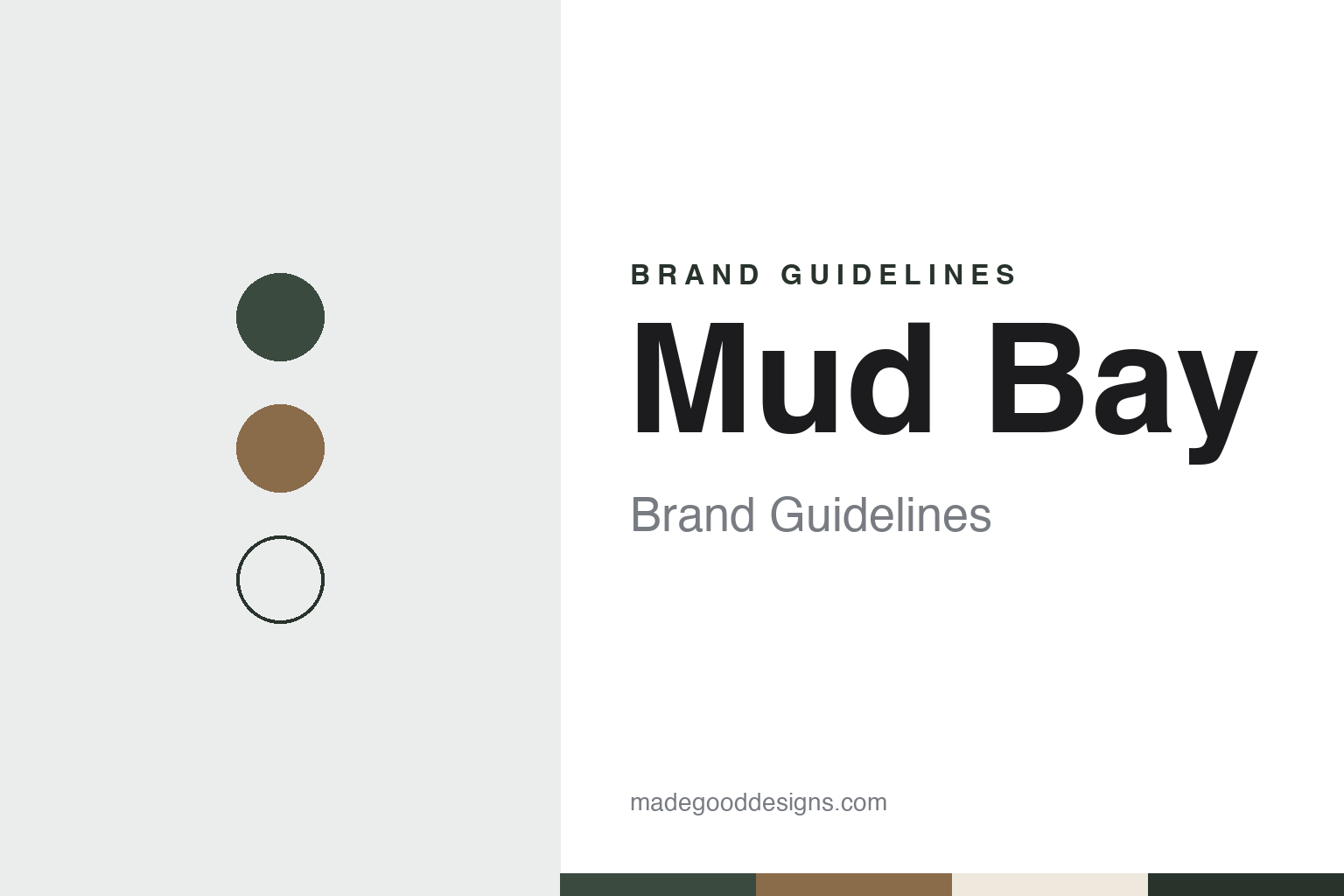
Mud Bay Brand Guidelines
A farm store on a tidal inlet that became a Pacific Northwest pet chain.
Aa
Two constants: a tideflat green and mudflat brown palette and a slab serif register. Abstract homage — not a Mud Bay asset; no logo, sign or store fascia is reproduced.
Mud Bay Road
A farm store outside Olympia.
Mud Bay takes its name from a road and a stretch of water. In 1988 Elsa Wulff bought a small farm store on a hill above Mud Bay, outside Olympia, Washington, according to a case study published by MIT Sloan in February 2019. The company’s own history adds that the store stood in an eighty-year-old building on Mud Bay Road, which runs west out of Olympia across the southern end of Mud Bay, one of the southern arms of Puget Sound. English Wikipedia places it at the corner of Mud Bay Road and Kaiser Road, in a feed store built in 1905.
The first name was not quite the present one. English Wikipedia says the store was first called “Mud Bay Grainery,” after the building’s previous tenant, a health-food shop called The Grainery, and that the owners soon re-spelled it “Mud Bay Granary.” The word was dropped in 2002, leaving the plain Mud Bay name the chain uses today.
The early shop sold almost anything. The MIT Sloan case lists local oysters, pop tarts, folk art, hog feed and dog food on its shelves, and describes customers warming their hands over a wood stove. It was a family business from the start: Elsa Wulff’s son Lars Wulff joined in 1989 as the store’s third employee, and her youngest daughter Marisa Wulff came back to Olympia in 1993 after an MBA in the Netherlands and began working at the store alongside a full-time job. The case study names the three of them as the company’s founders.
Over the following years the family narrowed the range to food and supplies for dogs and cats. The case study says they baked organic dog cookies in a bagel bakery they rented on Friday nights, trained staff in dog and cat nutrition, and wrote booklets for customers with titles such as “How to Read a Pet Food Label.” The company tells the same story on its own site.
Colour
Eight stores from Bosley’s.
The single store became a chain in 2000. The MIT Sloan case says Mud Bay bought eight stores from a court-appointed receiver who was winding down Bosley Pet Food Marts, a Pacific Northwest pet chain that had become insolvent. Mud Bay turned the conventional Bosley stores into dog and cat food stores, cutting the product range and putting time into staff training; after two difficult years, the case study says, it was again profitable, with about 85 employees and nine stores.
Growth then came steadily, first in Washington and later in Oregon. English Wikipedia counts 13 or 14 stores by 2004, 17 by June 2009, 33 by 2015 and 56 stores in Oregon and Washington by 2020; the MIT Sloan case described Mud Bay in May 2018 as a chain of 45 pet stores in the Pacific Northwest. The company says it opened its own distribution centre in 2003 and tripled its size in 2007 to handle the number of manufacturers it was buying from.
The stores themselves were described in some detail by the case study’s authors. A typical Mud Bay was a little over 4,200 square feet with around 3,750 products. Most non-food items, such as collars and litter, stood on tables and stands in the middle of the floor while food lined the walls; large signs, visible from anywhere in the store, marked each product category, and bins of dog treats sat on the floor at dog height. Staff are known inside the company as “Muddies,” and first-time visitors were given a thank-you pack with a handwritten note.
That vocabulary carries into the company’s events. Its yearly all-staff gathering, a day of training and team-building, is called Mudstock, according to both KUOW and the MIT Sloan case.
Typography
How pet-supply retailers present themselves.
Pet-supply retailers present themselves first through the store. Many trade from large out-of-town units described as superstores, where food, bedding, toys and aquarium or small-animal supplies run down long aisles under plain category signs. Several chains have added services under the same roof: grooming salons, vet clinics and training, each often with its own name that sits beside the main shop name on the fascia and in the aisles.
Naming follows the same pattern. Chains tend to keep one short shop name and add own-label ranges with names of their own, so a single store can carry the retailer’s brand, its food and accessory ranges and many outside makers side by side. In the UK, for example, Pets at Home dates its Wainwright’s food range to 2007, and trade reports of Jollyes have named its K9, Lifestage and Raw and Simple ranges. When a chain unifies these names, as Pets at Home did in 2023, the change is usually reported in the design and retail press.
Loyalty clubs and online shops are the other public face. Retailers publish membership schemes for regular buyers, such as Pets at Home’s VIP club, launched in 2012 according to the company, alongside websites with click-and-collect, delivery and repeat-order options. Shelf prices, promotions and member offers are presented in the stores and online, and change often, so a design guide describes how they are shown rather than what they are.
Behind the shop fronts sit corporate and investor pages. These usually give a founding story, the current owner and any stock-market listing, and many chains in this category have passed between private-equity owners before or after a listing. This guide sets out what dated sources say about each company’s founders, owners and listings, and treats the companies’ own descriptions as their claims.
Aa
A sturdy slab serif with a feed-store feel. (Specimen set in Bitter, a serif STAND-IN; NOT the Mud Bay logo.)
Mud Bay
Owned by the people who work there.
The most far-reaching change in Mud Bay’s structure came in 2015, when it introduced an employee stock ownership plan. At the company’s annual Mudstock meeting on 20 August 2015, employees signed a “declaration” of worker ownership, the Seattle public radio station KUOW reported six days later in an interview with the two co-chief executives, Lars and Marisa Wulff. English Wikipedia says the plan effectively made Mud Bay an employee-owned company, and that the signing took place at Green River Community College.
The MIT Sloan case gives the reasoning as the founders saw it: employee ownership was meant to make staff think and act as owners, give them a long-term stake, and let Mud Bay continue beyond the hands-on leadership of Elsa, Lars and Marisa Wulff. For a few years afterwards, English Wikipedia says, many decisions were made by a team called “The 20,” most of whose members were elected by their fellow employee-owners; once the company passed 500 employees in 2020, most decisions returned to the executives, with the aim of standardising its stores.
English Wikipedia describes Mud Bay as an employee-owned pet store based in Olympia, with locations across the Pacific Northwest. Its 2020 count, in the same article, was entirely in Washington and Oregon, and the name still points back to the inlet outside Olympia where the farm store stood.
For a design guide, Mud Bay shows how a regional retailer can build an identity on a local place name, in-store signage and its own language for its staff and events. Compare the larger national chains Petco and Pet Supplies Plus. For this guide we use a tideflat green, a mudflat brown and a feed-sack cream with a serif, an unofficial interpretation; no product or logo is reproduced.
Explore & save
Keep Mud Bay’s identity on hand — save it to a board in the Made Good inspiration library.
Mud Bay identity set
Pin the Mud Bay tideflat green and mudflat brown palette and the slab serif register to your own board.