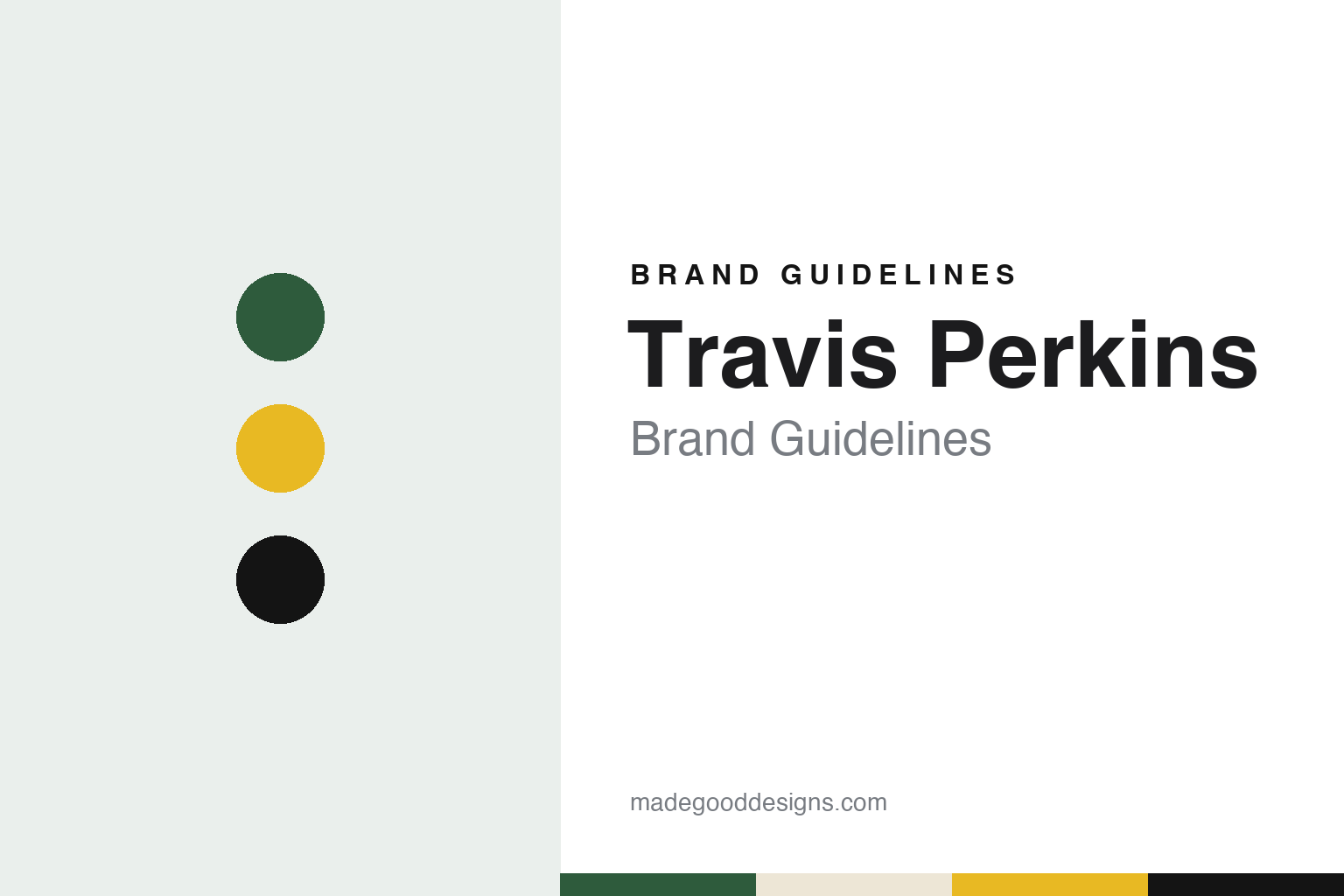
Travis Perkins Brand Guidelines
A London joinery of 1797 and a Northampton merchant of 1899, joined under one mark in 1988.
Aa
Two constants: a green, yellow and black palette and a merchant sans register. Abstract homage — not a Travis Perkins product or mark; no sign, logo or lorry livery is reproduced.
Two merchants, two centuries
A London joinery, a Northampton timber merchant and a merger.
Travis Perkins is a British builders’ merchant group with its head office in Northampton. Its name joins two older businesses, and each brought its own history. English Wikipedia traces the longer line to 1797, when the Benjamin Ingram company of joiners and carpenters was founded on Beech Street in London. That firm merged with Perkins to become Ingram Perkins in 1850, and in 1970 Ingram Perkins merged with Sandell Smythe & Drayson to form Sandell Perkins, which was listed on the London Stock Exchange in 1986, English Wikipedia says. The group’s own heritage timeline sets out the same sequence of names.
The other half was Travis & Arnold. English Wikipedia says it was founded by Ernest Travis in 1899, began in London and moved to Northampton in 1904, with the Midlands becoming its core market. The Independent reported on 7 September 2001 that Travis & Arnold had listed on the stock market in 1964, and that three generations of the Travis family had chaired the business, starting with the founder.
In 1988 the two merchants merged to form Travis Perkins. DIY Week reported in January 2020 that the merger allowed the new company to trade nationally as one business, and the same article recalled the corporate identity programme that came with it (see below). The Independent reported in 2001 that the last member of the Travis family was leaving the board that autumn, ending a family line on the board that ran back to 1899.
The Independent noted in 1994 that forest products were an important part of the Travis Perkins trade, while the AAH chain it was then buying concentrated on structural materials such as cement, bricks, drainage and roofing products. English Wikipedia today lists its product lines as general building materials, timber, plumbing and heating, kitchens, bathrooms, landscaping materials and tool hire.
Colour
Branches, specialists, a DIY chain and a demerger.
Travis Perkins grew largely by buying other merchants. The Independent reported on 18 March 1994 that it was buying the AAH building materials chain of 46 branches, concentrated in the north of England, to sit alongside its own branches in the Midlands and the south; the enlarged group would have 214 branches, the paper said. English Wikipedia lists later purchases including Keyline in 1999, City Plumbing Supplies and Commercial Ceiling Factors in 2002, BSS Group in 2010 and the rest of Toolstation in January 2012.
The main step into retail came in December 2004. BBC News reported on 16 December 2004 that Travis Perkins, then selling building materials through 740 branches, had agreed to buy Wickes, a chain of 172 home-improvement stores that belonged to the privately owned Focus Wickes group, arguing that many Wickes customers were tradespeople or serious DIY enthusiasts. The deal was subject to shareholder and regulatory approval at the time; Wickes then stayed in the group for more than 16 years. English Wikipedia says the demerger of Wickes was completed in April 2021, and a Travis Perkins announcement of 28 April 2021 gave that date for the completion, with Wickes shares admitted to the London Stock Exchange that morning.
Toolstation has given the group its own story of growth and retreat. The Construction Index reported in March 2024 that the group was planning to take Toolstation out of France and was reviewing its business in the Netherlands and Belgium; DIY International reported in April 2025 that the French business had ended at the end of 2024. In November 2026 Travis Perkins announced that the Munich investor Fidelium Partners had agreed to buy Toolstation Benelux; the sale was agreed in November 2026 and not completed at the time of writing.
As of November 2026, the Travis Perkins plc website listed the merchant business with more than 550 branches, including more than 150 Benchmarx kitchen and joinery showrooms, alongside Toolstation, Keyline for civils and drainage, BSS for pipeline and heating supplies, CCF for insulation and interior products and TF Solutions for air conditioning and heat pump materials. English Wikipedia describes Travis Perkins plc as listed on the London Stock Exchange and a constituent of the FTSE 250 Index.
Typography
Design and documentation.
DIY chains, home-improvement retailers and builders’ merchants present themselves through the places where customers meet them. A home-improvement store is usually a large warehouse-style building with long aisles, high racking and a garden or timber area, and the chains describe those stores in their own words on their websites. A builders’ merchant is more often a yard and a branch, where tradespeople buy timber, bricks and fixings across a counter. For a design reader, the shed, the yard and the counter are where the colours, signs and lettering of these companies are seen at full size.
Many trade suppliers also sell from a catalogue and a website, with orders collected from a counter or delivered to site. Printed catalogues, product codes and click-and-collect services appear in the companies’ own descriptions, and in the trade press that covers them. Liveried vans and lorries carry the same names and colours from the branch to the building site, so a merchant’s identity often travels further on the road than it does on the high street.
Store and own-label naming is usually plain. Chains carry a founder’s surname, two merged surnames, or a literal compound of a product and a place, and many sell house ranges under their own names alongside the branded tools and materials they stock. Groups often run several trading names side by side, one for each trade or customer type, rather than folding them into one.
Corporate pages fill in the rest: founders, owners, listings, demergers and the investment groups that sit behind many chains. Ownership in this sector changes more often than the shop signs do, so the guides in this series date each change of owner to an independent source, describe each name and colour as documented, and treat the palettes shown here as unofficial interpretations.
Aa
A sturdy, slightly condensed sans for a merchant’s yard. (Specimen set in Barlow Semi Condensed, a sans STAND-IN; NOT the Travis Perkins logo.)
Travis Perkins
A T, a P and two sets of colours.
The Travis Perkins identity has a documented design story. DIY Week reported on 28 January 2020 that the logo created for the newly merged company in 1988 had been led by Margaret Hill-Tout, then a graphic designer at the branding agency Cooper Clark and New, who had been commissioned to develop a corporate identity for the new group. She told the magazine that she wanted something bold that suited the earthiness of the company’s trade customers.
The design borrowed from both parents. According to the same report, the designer took the colours of Travis & Arnold, black and yellow, and the colours of Sandell Perkins, green and black, and combined the T of one company with the P of the other to show two equal businesses coming together. DIY Week noted that Travis Perkins plc, the listed parent, now uses a different logo, while the 1988 mark was still in use more than 30 years later across the merchant branches and the company’s lorries.
The magazine also quoted the guidelines that went with the 1988 identity. In them the chairman of the day asked that customers should recognise the company at once whenever they saw a branch, a lorry, an advertisement, a price list or an invoice, and set out the aim of establishing the name and logo across the country, from Hull to Penryn. For a design reader, that list is a compact summary of where a builders’ merchant meets its customers: in the yard, on the road and on paper.
The later history shows the group keeping trading names apart rather than folding them into one. Wickes kept its own name through 16 years of ownership, Toolstation and Keyline kept theirs, and Benchmarx sits inside the merchant branches as a showroom name.
For a design guide, Travis Perkins shows how a merger mark can carry two companies’ colours and initials into one symbol, and how a written identity programme can name the branch, the lorry and the invoice as places the brand must work. Compare Wickes, which the group owned from 2004 to 2021, and Jewson, another long-established British builders’ merchant. For this guide we use a yard green, a timber yellow and an ink black with a condensed sans, an unofficial interpretation; no product or logo is reproduced.
Explore & save
Keep Travis Perkins’s identity on hand — save it to a board in the Made Good inspiration library.
Travis Perkins identity set
Save the Travis Perkins green, yellow and black palette and the merchant sans register to your own board.