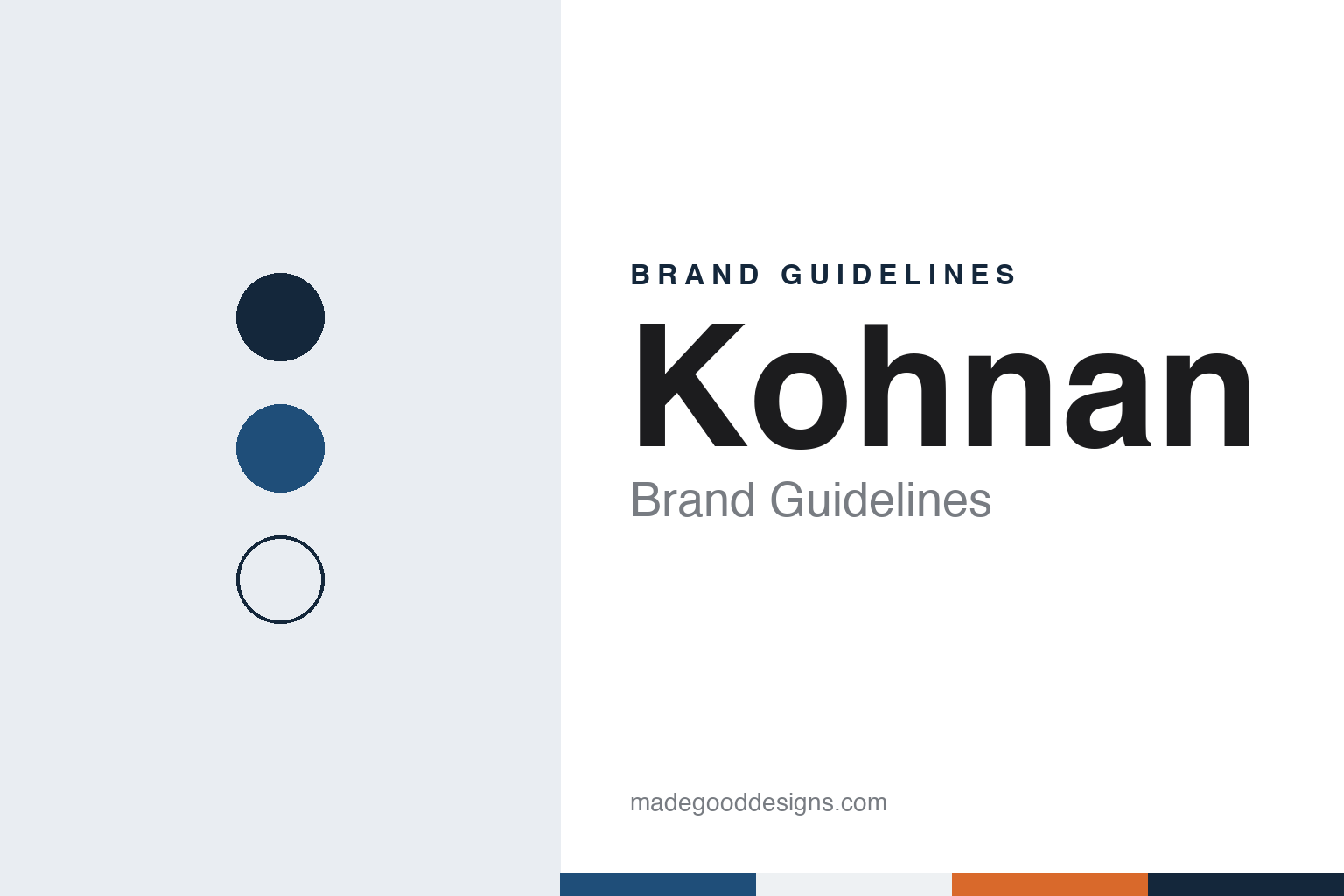
Kohnan Brand Guidelines
A 1978 Sakai home centre born from a 1961 fuel business.
Aa
Two constants: a harbour blue, concrete mist and work orange palette and a utility gothic sans register. Abstract homage — not a Kohnan product or mark; no logo, sign or shopfront is reproduced.
From fuel to DIY
A petroleum dealer’s new venture in Sakai.
Kohnan’s roots are in fuel. Japanese Wikipedia says Kozo Hikita started a petroleum business, Konan Sekiyu Shokai (港南石油商会), in January 1961, incorporated it in July 1967 and renamed it Konan K.K. in February 1974. On 20 September 1978 that company set up Kohnan Shoji in Sakai, Osaka Prefecture, as a way to diversify; the company’s own overview gives the same founding date. The first store, Kohnan Senboku in Sakai, opened on 23 December 1978, Japanese Wikipedia says, and the company’s timeline lists it as its first home centre.
Growth stayed close to Osaka at first. The first store outside Osaka Prefecture, at Tamatsu in Kobe, opened in April 1984, according to Japanese Wikipedia, and the company joined the Japan DIY association in 1986. From the mid-1990s, Japanese Wikipedia says, Kohnan also opened in city centres rather than only on suburban roads, and moved to larger stores. The company listed on the second section of the Osaka Securities Exchange in September 1996, moved to its first section and then listed on the first section of the Tokyo Stock Exchange in 2001; it moved to the TSE Prime market in 2022.
The fuel trade that started it all was later given up. In September 2008, Japanese Wikipedia says, the petroleum business of the founding company, Kohnan Fleet, was sold to Itochu Enex, which ended the group’s own fuel retailing. In the company’s timeline, Naotaro Hikita became president in 2013, and he is still named as president today. Kohnan moved its head office from Sakai to Shin-Osaka, in Yodogawa-ku, in 2020; its registered head office remains in Sakai.
Store numbers rose steadily. The company marks 300 stores in 2014, a group total of 500 in 2021 and 600 in 2024, and lists 671 stores as at the end of February 2026. It describes its business as home centres, retailing for building tradespeople and members-only building-materials wholesale.
Colour
Kohnan, Kohnan PRO and Home Stock.
Kohnan runs several store names. The main format, Home Center Kohnan, covers DIY goods, household goods and car and leisure goods, and the company says each store has DIY specialist staff; Japanese Wikipedia says some stores have sales floors of more than 2,000 tsubo, a traditional unit of about 3.3 square metres. Kohnan PRO began in the 2000 financial year as an annex to the Higashi-Yodogawa Sugahara store, aimed at people working in building, civil engineering, electrical work and plumbing, the company says. Japanese Wikipedia adds that PRO stores open at 6.30 or 7 in the morning and that many are built so that trucks can pull up alongside or drive in for loading.
Smaller and newer formats followed. The first Home Stock store opened in 2000 on Awaji Island in Hyogo Prefecture, a small home centre for local catchments of about 10,000 people, according to the company. In September 2020 Kohnan opened the first CAMP DEPOT, a camping store, on the site of its former head office in Sakai, Japanese Wikipedia says, citing DCS Online. In 2024 the company opened an urban concept store, gardens umekita.
Own brands carry much of the range. Japanese Wikipedia, citing company reports, lists LIFELEX as the main value-priced private brand, SOUTHERNPORT for leisure goods including outdoor equipment and PortTech for household appliances. Since 2021, it says, Kohnan has also supplied its private-brand goods to retailers outside its group, among them Kansai Supermarket and the Niigata chain Hiraseii Home Center. Customers can shop online through the Kohnan eshop, opened in 2003, and tradespeople through a separate Kohnan PRO site from 2016. In 2019 the company introduced the Rakuten Point Card and its own prepaid money, Kohnan Pay.
Much of the recent growth came from buying other chains. Kohnan bought Beaver Tozan, originally the DIY arm of the Hakone Tozan Railway, from Odakyu in May 2017 and merged it in March 2023; took over Kendepo, a members-only building-materials wholesaler, in 2019; and in February 2020 took over the home-centre and renovation business of Doit, a subsidiary of Pan Pacific International Holdings, reopening the stores as Kohnan Doit, Japanese Wikipedia says. The Kyushu retailer Home Improvement Hirose, a partner from 2018, became a subsidiary in 2023; Home Center Mitsuwa of Fukui was consolidated in October 2025; and in December 2025 Kohnan bought I’nT Holdings, a furniture and interiors online retailer.
Typography
Roadside stores and own labels.
Japan’s big electronics, furniture and home-centre chains mostly grew from single regional shops, and their corporate pages still tell that story in the same order: a founding year and town, a founder, a date when the company was incorporated, and the dates when its shares were listed, now usually on the Tokyo Stock Exchange’s Prime Market. Many have since become holding companies, with the stores run by a subsidiary and the parent group named separately, so the name on the sign and the name on the share register are not always the same.
Store names carry much of the identity. Some groups keep a different name for each store format: Yamada Denki, for example, uses Tecc Land for its roadside stores, LABI for its large stores beside city stations and Tecc LIFE SELECT for stores that add furniture and household goods, according to Japanese Wikipedia. Others have done the opposite. Edion put four regional store names under one name, EDION, in October 2012, the company says.
The roadside store is the common type. Japanese Wikipedia describes Tecc Land buildings with the car park on the ground floor and the sales floors above, and Edion lists roadside stores alongside shopping-mall tenants and city stores. Point cards are part of the offer as well: Yamada tested its point system before rolling it out, and Edion has added several shared point programmes since 2015, Japanese Wikipedia records.
Own-label ranges are named plainly and sit beside the makers’ brands. Edion sells products under its e angle and e angle select names, and a line developed with the furniture retailer Nitori, while Yamada sells furniture under the IDC OTSUKA name after absorbing the retailer Otsuka Kagu in 2022. This guide sets out what can be checked about each chain, and marks what rests on the company’s own word.
Aa
A plain gothic sans for a chain that opens early for tradespeople. (Specimen set in BIZ UDPGothic, a sans STAND-IN; NOT the Kohnan logo.)
Kohnan
From Sakai to Ho Chi Minh City and Phnom Penh.
Kohnan went abroad in 2016. Its first overseas store opened on 1 July 2016 in AEON Mall Binh Tan in Ho Chi Minh City, Vietnam, Japanese Wikipedia says, and the company lists Kohnan Vietnam among its group companies. A Cambodian subsidiary was set up in February 2022, Japanese Wikipedia says, and the first store in Cambodia, at Sen Sok City in Phnom Penh, opened in July 2022.
In 2026 Kohnan turned to another listed chain. The Sankei Shimbun reported on 13 February 2026 that Kohnan had announced a tender offer for Arenza Holdings, a home-centre operator based in Fukushima and then a consolidated subsidiary of the Tokai retailer Valor Holdings, which held 50.55 per cent and was not part of the offer. On 31 March 2026 Kohnan announced that the offer had succeeded, leaving it with 38.79 per cent of the voting rights, and that Arenza would become an equity-method affiliate from 6 April 2026.
For a design guide, Kohnan shows how one name can stretch from a suburban DIY store to an early-opening trade counter and a camping shop. Compare Komeri, a Niigata chain that grew from a rice shop, and Cainz, another Japanese home-centre chain. For this guide we use harbour blue, concrete mist and work orange with a sans, an unofficial interpretation; no product or logo is reproduced.
Explore & save
Keep Kohnan’s identity on hand — save it to a board in the Made Good inspiration library.
Kohnan identity set
Pin the Kohnan harbour blue, concrete mist and work orange palette and the utility gothic sans register to your own board.