Komeri Brand Guidelines
A 1952 Sanjō rice shop turned a nationwide home-centre chain.
Aa
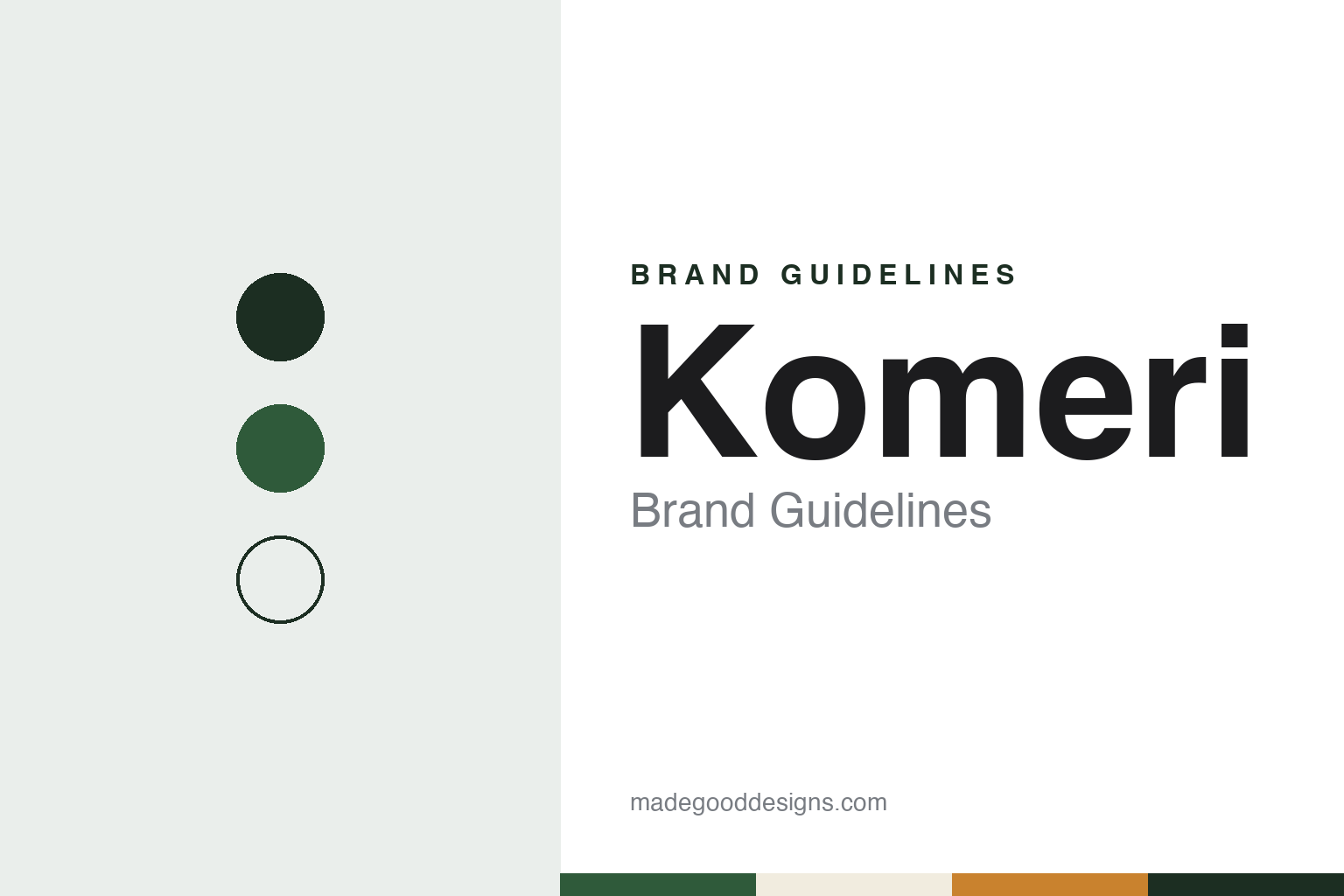
Two constants: a field green, rice paper and harvest amber palette and a rounded gothic sans register. Abstract homage — not a Komeri product or mark; no logo, sign or shopfront is reproduced.
Komeri Shōten
A rice dealer in a metalworking town.
Komeri began in April 1952 in Sanjō, Niigata Prefecture, as a rice dealer. Japanese Wikipedia says the rice farmer Torashichi Sasage registered with the prefecture as a staple-food retailer and opened the shop under the name Komeri Shōten (米利商店). The name, it says, joins 米, “kome,” the word for rice, with 利, a character taken from Riemon, a Sasage family name. The company’s own timeline gives the same month and year for the founding of the rice business.
The shop grew into a fuel and household business before it became a home-centre chain. According to the company, it was incorporated as Komeri Shōten in July 1962, began selling LP gas and oil in December 1963, put up a new building in Sanjō with a petrol and gas station on the same site in 1967, and shortened its name to Komeri, still written in characters, in January 1973.
The turn to home centres came in April 1977, when the company opened HC Sanjō, its first home-centre store; Japanese Wikipedia says the site now trades as a Hard & Green hardware and materials store. The first Hard & Green store followed in September 1983 in Shibata, Niigata. In April 1984 the company introduced a corporate-identity programme and changed its symbol mark, its timeline says. In 1985 it spun off its fuel division as Life Komeri, opened its first store outside Niigata, in Yonezawa in neighbouring Yamagata Prefecture, and in July 1985 changed its trade name to Komeri written in katakana. The head office moved to Niigata city in November 1986.
The shares followed. Komeri listed on the Niigata Stock Exchange in October 1987, on the second section of the Tokyo Stock Exchange in September 1994 and on its first section in September 1997, the company says; Japanese Wikipedia adds that the Niigata listing ended in March 2000. Today the shares trade on the TSE Prime market. The company’s timeline marks 100 stores in December 1991, 500 consolidated stores in November 2001, 1,000 stores in July 2010 and 1,200 stores in June 2020. In June 2003 Kenichi Sasage became chairman and chief executive and Yuichiro Sasage president and chief operating officer; the company now names Yuichiro Sasage as president, and Japanese Wikipedia lists Kenichi Sasage as honorary chairman and founder.
Colour
Power, Hard & Green, PRO and Athena.
Komeri trades under four store names. In April 2019, its timeline says, it reorganised its stores as Power, Hard & Green, PRO and Athena; Japanese Wikipedia says a separate “Home Center” format was folded into Hard & Green at that point. As of 31 October 2026 the company listed 1,235 stores in 46 prefectures: 1,086 Hard & Green stores, 121 Komeri Power stores, 26 Komeri PRO stores and two Athena stores. Diamond Chain Store Online gave the same total and date in November 2026.
Hard & Green is the backbone. In September 2016 Nikkan Kogyo Shimbun, writing on its Newswitch site, described it as a convenience store for farming and fishing villages, selling daily goods alongside farm and building materials. It reported a standard sales floor of about 1,000 square metres and catchments of about 10,000 people, and said Komeri was reviewing the format with smaller floors of 600 to 700 square metres and catchments a few thousand people smaller. At that time there were close to 1,000 Hard & Green stores, the paper said. Japanese Wikipedia says many of the original Hard & Green stores have about a third of the floor area of a typical home centre and concentrate on DIY and farming goods, which gives the small stores a rural rather than suburban character. It also notes that Sanjō, the company’s home town, is known for metalworking such as knives and tools.
The other formats are larger or more specialised. Japanese Wikipedia describes Power as a large format with a sales floor of about 20,000 square metres and an everyday-low-price policy, Athena as an interiors store, and PRO as a specialist in materials, building products, tools and hardware. In October 2026 Diamond Chain Store Online described Komeri PRO as the format for tradespeople, Power as a mega home centre for medium and large catchments and Hard & Green as the small format for small catchments.
Own labels and services sit across the formats. The company says its original brand Komeri Select launched in November 2009 and that two further brands, BICROP and SOLVIC, appeared in October 2023. It began online sales through Komeri.com in April 2000, issues the Komeri Card and Aqua Card, and launched a smartphone payment service, Kokko Pay, in November 2022. Farming ties run through its history: the company lists a collaboration with a Nagano agricultural co-operative from March 2020, and Diamond Chain Store Online reported that on 6 November 2026 Komeri announced talks on collaboration with JA Kazuno in Akita and JA Iruma-no in Saitama.
Typography
Roadside stores and own labels.
Japan’s big electronics, furniture and home-centre chains mostly grew from single regional shops, and their corporate pages still tell that story in the same order: a founding year and town, a founder, a date when the company was incorporated, and the dates when its shares were listed, now usually on the Tokyo Stock Exchange’s Prime Market. Many have since become holding companies, with the stores run by a subsidiary and the parent group named separately, so the name on the sign and the name on the share register are not always the same.
Store names carry much of the identity. Some groups keep a different name for each store format: Yamada Denki, for example, uses Tecc Land for its roadside stores, LABI for its large stores beside city stations and Tecc LIFE SELECT for stores that add furniture and household goods, according to Japanese Wikipedia. Others have done the opposite. Edion put four regional store names under one name, EDION, in October 2012, the company says.
The roadside store is the common type. Japanese Wikipedia describes Tecc Land buildings with the car park on the ground floor and the sales floors above, and Edion lists roadside stores alongside shopping-mall tenants and city stores. Point cards are part of the offer as well: Yamada tested its point system before rolling it out, and Edion has added several shared point programmes since 2015, Japanese Wikipedia records.
Own-label ranges are named plainly and sit beside the makers’ brands. Edion sells products under its e angle and e angle select names, and a line developed with the furniture retailer Nitori, while Yamada sells furniture under the IDC OTSUKA name after absorbing the retailer Otsuka Kagu in 2022. This guide sets out what can be checked about each chain, and marks what rests on the company’s own word.
Aa
A rounded gothic sans for a katakana name adopted in 1985. (Specimen set in Zen Kaku Gothic New, a sans STAND-IN; NOT the Komeri logo.)
Komeri
A rice shop’s name, written in katakana.
The name carries the company’s origin. Komeri has been written in katakana since July 1985, but the characters behind it still point to the rice shop of 1952. Japanese Wikipedia notes, citing a 2010 article in the Jōetsu Town Journal, that television advertising sometimes says the name with a flat accent while many people, especially in Niigata, stress the first syllable, and that the company said there was no fixed rule and that different regions could say it in different ways.
The corporate address on the web is also a clue to the group. The company website sits on the bit.or.jp domain, which Japanese Wikipedia says belongs to Bit-A, the group’s information-systems company, founded in 1990 according to Komeri’s timeline; the online shop trades as Komeri.com. Other group companies listed by the company include Hokusei Sangyo for logistics, Life Komeri for fuel, Komeri Capital for the card business and Movie Time, which Japanese Wikipedia says runs bookshops under the Komeri Shobō name.
Komeri has also gone abroad on a small scale. It set up Komeri Thailand in February 2018 and opened its first Thai store, a Hard & Green in Phanom Sarakham, in June 2021, the company says. At home, the company lists twelve distribution bases, from Hokkaido to Fukuoka, and Japanese Wikipedia says the Komeri Kansai distribution centre in Hashimoto, Wakayama, began operating in February 2026.
For a design guide, Komeri shows how a chain built for farming towns can keep one name across very different store sizes. Compare Kohnan, an Osaka home-centre chain that grew out of a fuel business, and DCM, which brought several regional chains under one name. For this guide we use field green, rice paper and harvest amber with a sans, an unofficial interpretation; no product or logo is reproduced.
Explore & save
Keep Komeri’s identity on hand — save it to a board in the Made Good inspiration library.
Komeri identity set
Pin the Komeri field green, rice paper and harvest amber palette and the rounded gothic sans register to your own board.