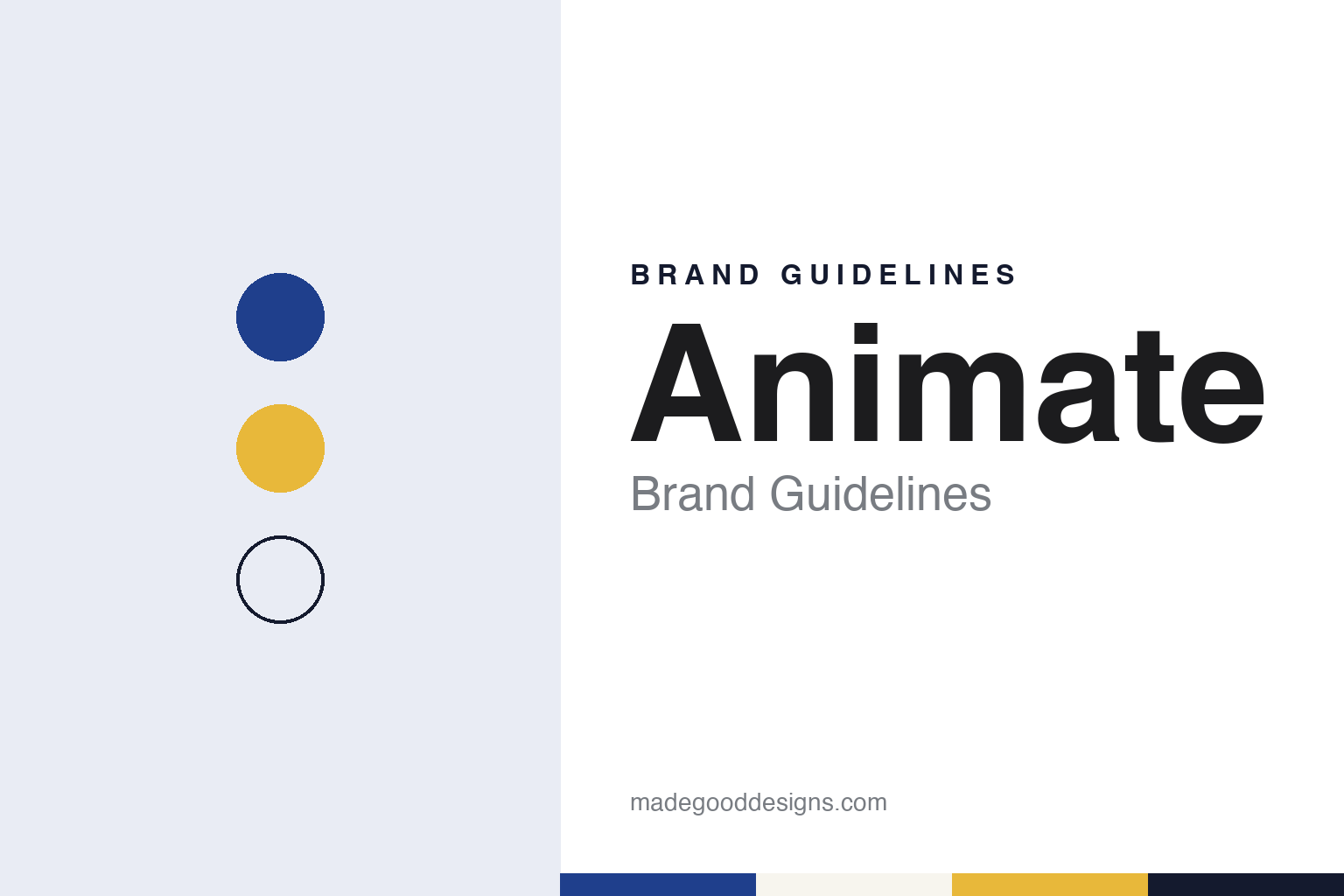
Animate Brand Guidelines
A 1983 Ikebukuro shop, a radio-tower monogram and a cartoon store manager.
Aa
Two constants: an Animate blue and yellow palette and a plain grotesque sans register. Abstract homage — not an Animate product or mark; no logo, character or sign is reproduced.
Ikebukuro, 1983
A shop in front of Sunshine City.
Animate opened its first shop in Ikebukuro, Tokyo, in March 1983, in front of the Sunshine City complex, Anime News Network reported in November 2022, citing the Animation Business Journal. English Wikipedia describes the company, Animate Ltd., as the retail arm of the character-goods company Movic. Japanese Wikipedia gives the fuller story: Animate began as a division of Movic, which was set up in October 1983; the retailer was incorporated as its own company in July 1987, and the relationship later reversed, so that Movic now sits inside the Animate group, under a holding company, Animate Holdings, formed in November 2012.
The early chain was not run by one company. Japanese Wikipedia says its stores were split among four arrangements: an eastern network built around the Ikebukuro shop and run by Movic, a western network built around a store in Osaka’s Abeno district and run by a company called Coade, a separately run Yokohama shop, and sales agents, ordinary bookshops that ran Animate stores under contract. These were later brought together under Animate Ltd. Stores are still run as separate profit centres, the same source says, so fairs, events and stock vary from shop to shop.
The Ikebukuro shop has moved twice. Japanese Wikipedia says it began in a building shared with other tenants, then moved into a whole building of its own, and on 17 November 2012 moved again into a company-built building near Ikebukuro station; the previous building became an annex with a costume shop and a café. In November 2022 Anime News Network described a further expansion onto a neighbouring site beside the Hareza Ikebukuro complex: ten floors including a basement, with an event hall, a theatre space, an exhibition area and a café alongside the shop floors.
Colour
Character goods, books and events.
What Animate sells is shaped by licences. Japanese Wikipedia says much of its character merchandise is developed by group companies under licence from rights holders, so many items are not sold in ordinary toy shops, and that music, video and game releases often come with Animate’s own reservation extras on top of a maker’s first-run bonuses. Larger stores hold events with voice actors and anime-song singers, usually entered with tickets given out with reservations or purchases. At the till, books and CDs are handed over with a free clear plastic cover made by the group company Coade, the same source says.
The group reaches well beyond the shop counter. English Wikipedia lists Acos, a costume subsidiary with its own shops; Frontier Works, which makes video and music releases and publishes books; the publisher Libre; and the bookseller Shosen, which joined the group in June 2011. Japanese Wikipedia adds the Animate Café business, split off as a separate company in March 2018.
The chain’s mascot is Anisawa Meito, the “Anime Tenchō,” or anime store manager, whom English Wikipedia describes as a wild-haired, muscular figure in an Animate uniform who goes to extremes to promote the shop. An original video animation about him, produced by Gainax, was released in 2002, and another followed in 2010.
The wordmark has changed once. Japanese Wikipedia says the company used a red logo in a rounded gothic face from 1983 until the early 2000s; in 2000 it moved to a wordmark set in Arial, with the “i” in yellow and the other letters in blue, and adopted a symbol that treats the A and the M as a radio tower. In 2016, which the same source links to the thirtieth anniversary of incorporation, it added a symbol based on the Anime Tenchō character while keeping the wordmark.
Typography
Counters, collections and signs.
Japan’s second-hand, hobby, book and sports chains tend to present themselves through the store itself before any logo. Many of them grew from a single shop, and their corporate pages often open with that first branch, the town it stood in and the year it opened, followed by a timeline of new formats, franchise agreements and listings on the Tokyo Stock Exchange.
In second-hand retail, the buying counter is as much a part of the identity as the sales floor. Chains publish what they buy, how customers can bring goods in or send them by post, and which stores take which categories, from books and CDs to trading cards, toys, clothing and electronics. Some run separate buying-only centres or online services alongside their shops, and describe these on the same corporate pages as their stores.
Hobby and collector chains lean on display and naming. Shops are often split into small rooms or annexes, each with its own name and a single subject, such as manga for one readership, vinyl figures or vintage toys, so that a sign at the door tells a visitor what lies inside. Book chains, by contrast, describe long aisles, broad stock and space to browse, and some have used bright lighting and open layouts to make used books look like new retail. Mascots and capitalised store names appear on signs, bags and advertising.
Behind the shop fronts sit corporate structures that the companies set out in plain terms: founders, holding companies, parent groups, franchisees and shareholders, along with overseas stores that opened, moved or closed. The guides in this group follow those published histories, and treat colours and typefaces as an unofficial interpretation rather than an official brand standard.
Aa
A plain grotesque sans, in the spirit of a wordmark set in Arial. (Specimen set in Arimo, a sans STAND-IN; NOT the Animate logo.)
Animate abroad
Taipei, Torrance, Waterloo and Makati.
Animate went abroad through partners. English Wikipedia says its first overseas store opened in Ximending, Taipei, in 2000, run by Animate Oversea, a joint venture with Kadokawa Taiwan and a local distributor that also ran branches in Hong Kong. In Thailand the shops are run by Japan Manga Alliance, a joint venture of Animate with the publishers Kadokawa, Kodansha, Shueisha and Shogakukan set up in 2015; its first shop, Animate Bangkok, opened in the MBK Center on 6 February 2016, English Wikipedia says. Animate Shanghai was set up in May 2011. In November 2022 Anime News Network put the chain at more than 120 stores worldwide, with branches in mainland China, Taiwan, Thailand and South Korea.
In the United States, Animate International announced at Anime Expo in July 2023 that Animate USA would open a store in the Del Amo Fashion Center in Torrance, California, Anime News Network reported: 3,843 square feet with a 313-square-foot event space for pop-ups, selling keychains, acrylic stands, button badges, figures and books, close to the company’s US warehouse, in a mall that already housed UNIQLO, Book Off and Sanrio. English Wikipedia says the store opened that summer.
Britain followed with a pop-up. Animate opened a shop in The Sidings, beneath platforms 20 to 24 at London’s Waterloo station, on 31 October 2025, Anime News Network reported, the first time an Animate store had appeared in the UK; that run lasted until 7 January 2026. In Southeast Asia, Animate Manila opened at One Ayala in Makati on 16 October 2026, according to Animate Times, the company’s own news site.
For a design guide, Animate shows how a specialist retailer can build its identity around a character as much as a wordmark: a plain sans name in blue and yellow, a radio-tower monogram and a cartoon store manager who stars in his own animation. Compare Mandarake, another Tokyo chain for anime and manga collectors, and Kinokuniya, the Shinjuku bookseller. For this guide we use a deep blue, a warm yellow and a soft paper white with a sans, an unofficial interpretation; no product or logo is reproduced.
Explore & save
Keep Animate’s identity on hand — save it to a board in the Made Good inspiration library.
Animate identity set
Pin the Animate blue and yellow palette and the plain grotesque sans register to your own board.