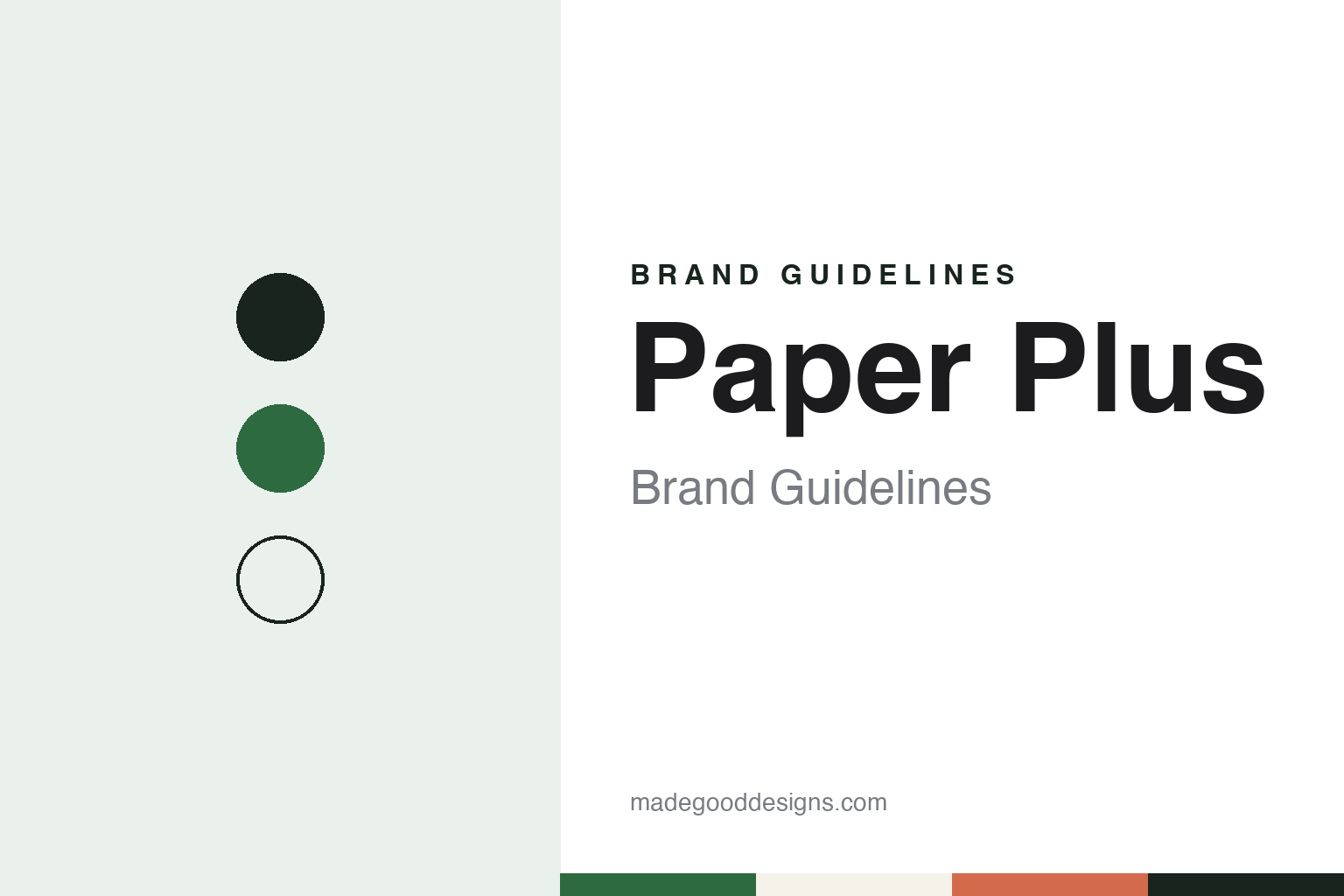
Paper Plus Brand Guidelines
A buying group of five stationers that became a franchise owned by its own shopkeepers.
Aa
Two constants: a fern green, ink, card white and coral palette and a friendly sans register. Abstract homage — not a Paper Plus product or mark; no logo, mascot or shopfront is reproduced.
National Stationers
Five independent shops and a buying group.
Paper Plus began as a buying group rather than a chain. English Wikipedia says that in 1983 five independent stationery retailers in New Zealand formed a buying co-operative, that a common brand followed and developed into a franchise, and that each new member bought a share in the group. The franchise started out as National Stationers and was renamed Paper Plus in 1990, according to the same source, which puts the head office in Penrose, Auckland.
That ownership structure is the brand’s defining feature. BusinessDesk described Paper Plus New Zealand in September 2012 as “the cooperative franchisor” of the Paper Plus, Take Note and Office Spot stores, and in July 2025 as a company that “operates as a co-operative and acts as the retailer’s franchisor.” The people who run the shops under the name are, as members, also the owners of the company that licenses it. Writing in Franchise New Zealand magazine in 2006, the group’s then chief executive said that the franchise was owned by the franchisees themselves rather than by a single franchisor or a corporation, that a member leaving had to sell its share, and that the co-operative’s management had moved from Wellington to Auckland in 1997.
Colour
Paper Plus, Take Note and a 2005 purchase.
Paper Plus shops sell books, stationery, toys, cards, magazines and gifts, and English Wikipedia says some also carry a New Zealand Post and Kiwibank agency or a Lotto counter. The same source traces the network over time: 82 Paper Plus stores in 1999, 23 of them in Auckland, and 90 in 2006, 25 of them in Auckland. Shelf Awareness described the chain in August 2014 as having more than 100 stores across New Zealand, and Inside Retail reported in July 2018 that the group had 115 stores nationwide.
The group grew through other banners as well. English Wikipedia says Take Note, a book and stationery franchise for smaller towns and main streets, was created in 2001 by rebranding the Top Line and Paper World stores, and had 72 stores in 2006, many of which then offered New Zealand Post services; it sells books, stationery, diaries, calendars and toys. With effect from 1 September 2005, Paper Plus (NZ) Ltd bought the Books & More franchise chain, which added 33 stores and took the group to 192, the same source says; Books & More had begun as a joint venture between New Zealand Post and Blue Star, then the owner of Whitcoulls, according to the 2006 Franchise New Zealand article. A third banner, Office Spot, opened in Ashburton in 2007 to sell home-office and business supplies, and English Wikipedia says that Ashburton store is the only one still trading.
In 2011 the co-operative tried to buy a national rival. When Whitcoulls’ Australian owner, REDgroup Retail, went into administration, Paper Plus carried out due diligence on Whitcoulls and arranged funding, BusinessDesk reported in September 2012. Its then chief executive told the news service that Paper Plus had got “very close” and that the contest “came down to ourselves and the Normans,” the owners of the James Pascoe Group, which bought the chain in 2011.
Typography
Bookselling in New Zealand and Australia.
Bookshop chains and online booksellers present themselves in different places. A chain’s identity is seen first on the street: the name over the shop front, the table displays inside, and the bookmarks, bags and seasonal catalogues handed over at the counter. An online bookseller has no shop front, so its name, its website and the catalogue pages it publishes carry the same work, along with the parcels that arrive at the door.
Store and imprint names are usually plain. Many chains carry a founder’s surname, as Dymocks does with William Dymock, who opened his first Sydney shop in 1879, according to English Wikipedia. Others are coined for the web, such as Booktopia, founded in Sydney in 2004. Older names often survive inside newer businesses: Angus & Robertson became an online brand within Booktopia after a 2015 purchase, SmartCompany reported, and the last Dymocks shop in New Zealand passed to Paper Plus franchisees in 2012, according to Stuff.
Ownership shapes the presentation. Some chains are franchise networks, in which local operators run shops under one name; others are family companies, listed companies or units of larger retail groups. The corporate pages that booksellers publish, and the trade and business press that covers them, set out founders, owners, acquisitions and, where they happened, administrations and changes of owner.
This guide describes each bookseller from dated sources: who founded it, who owns it, and what happened when the business changed hands. Where a chain closed or passed through administration, it says so with the date. The palettes and typefaces shown are our own unofficial interpretations, not the companies’ marks.
Aa
A friendly, open sans for a neighbourhood book and stationery shop. (Specimen set in Work Sans, a sans STAND-IN; NOT the Paper Plus logo.)
Paper Plus
A member-owned brand, refitted and refinanced.
The shop format has been reworked more than once. In August 2014 Shelf Awareness reported the appointment as chief executive of Sam Shosanya, previously head of Complete Entertainment Services, a distributor to The Warehouse Group. In July 2018 Inside Retail reported that Paper Plus had opened a new concept store at Barrington Mall in Christchurch, the flagship of the first phase of a transformation project. The trade title said the shop was laid out in what the company called “experiential zones” for adults and children, with a space to personalise products, a community calendar and a shelf where customers could swap books, and that the group had designed a “kit of parts” so that franchise owners could convert their own shops to the concept, choosing the options that suited their customers and budget. Inside Retail added that the group had set up joint ventures that included an in-house publishing business and a wholesale sourcing business with United Sourcing Group.
The co-operative’s finances came under strain in the mid-2020s. BusinessDesk reported in July 2025 that Paper Plus New Zealand had turned to its members for capital in July 2024 after running into problems with its bank loan covenants, and that a member capital raise and cost cuts had since helped it complete the renegotiation of its borrowing facilities with the Bank of New Zealand. The same report said the group was back in profit for the year to March 2025, after six years of breaking even or making losses. A document filed with the Companies Office showed that in October 2024 the directors had resolved to offer new shares to holders of the class of shares held by members, BusinessDesk reported.
For a design guide, Paper Plus shows how a brand owned by its own shopkeepers keeps a common look across stores that are each run independently. Compare Whitcoulls, the national chain Paper Plus bid for in 2011, and Waterstones, a British bookselling chain. For this guide we use a fern green, ink, card white and a warm coral with a sans, an unofficial interpretation; no product or logo is reproduced.
Explore & save
Keep Paper Plus’s identity on hand — save it to a board in the Made Good inspiration library.
Paper Plus identity set
Pin the Paper Plus fern green, ink, card white and coral palette and the friendly sans register to your own board.