AbeBooks Brand Guidelines
A Victoria marketplace that joined up the world’s secondhand bookshops.
Aa
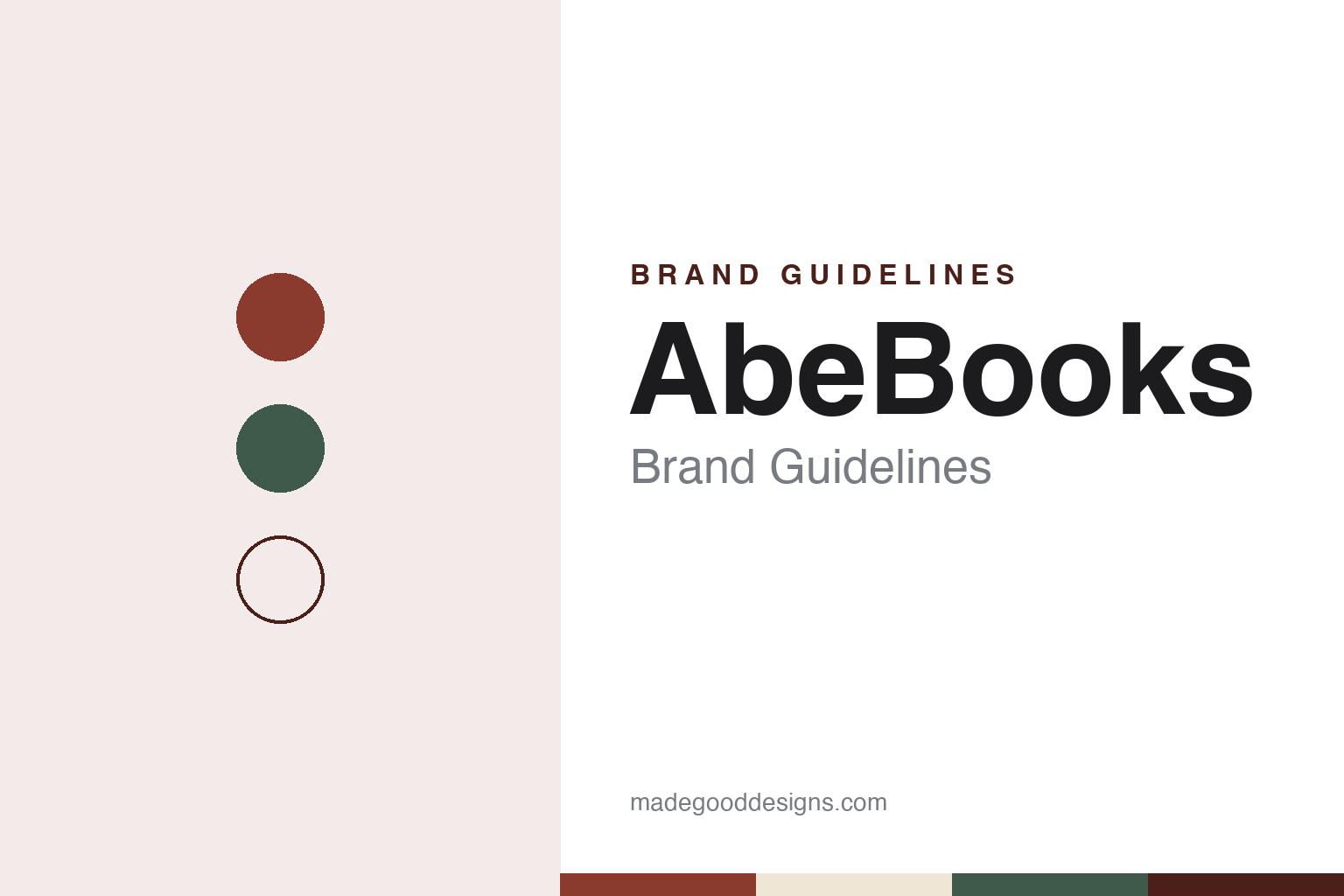
Two constants: a red, paper and green palette and an antiquarian serif register. Abstract homage — not an AbeBooks asset; no logo, listing or page is reproduced.
Advanced Book Exchange
A Colwood bookshop and an online exchange.
AbeBooks began on Vancouver Island as the Advanced Book Exchange. The Victoria business magazine Douglas reported in its December 2018/January 2019 issue that the idea came from Cathy Waters, who owned a shop called Timeless Books in Colwood, near Victoria, and was tired of placing advertisements in trade magazines to track down rare books for her customers. With her husband Keith Waters, an information-technology specialist, and their friends Rick and Vivian Pura, she set up an online marketplace to connect booksellers and buyers.
English Wikipedia says the company was incorporated in 1995 and launched its websites in 1996, at first with listings from just four bookstores, and that the name AbeBooks comes from the original Advanced Book Exchange. TechCrunch called it a “twelve year old Canadian company” in August 2008 and said it had been around since 1996.
The model has stayed close to that start. AbeBooks holds no stock of its own; it is a marketplace on which independent booksellers list their books, and each order is sent by the seller. TechCrunch described it in 2008 as a digital marketplace for established booksellers, focused on used, rare and out-of-print titles. English Wikipedia says sellers upload their inventory with condition and price, that prices are fixed rather than auctioned, and that the range runs from common paperbacks to first editions and signed copies, along with prints, maps, sheet music and paper ephemera. The charging model changed too: English Wikipedia says AbeBooks began with a flat listing fee and added a commission on sales in the early 2000s, and sellers now pay a monthly subscription linked to the size of their listings plus a fee on each sale.
Colour
A marketplace that grew by buying others.
AbeBooks expanded in Europe and beyond through acquisitions, according to English Wikipedia. In 2001 it bought JustBooks, a German online book marketplace, which opened the German, French and British markets; in 2004 it added new books to its listings and bought IberLibro of Spain; in 2005 it bought the American price-comparison site BookFinder.com; and in 2006 it bought FillZ, an inventory and order-management service, and a 40 per cent stake in LibraryThing, the book-cataloguing site. TechCrunch confirmed the LibraryThing stake in 2008. English Wikipedia adds that from the late 1990s AbeBooks also had reseller agreements with eBay, Half.com, Barnes & Noble.com and Amazon, which let it place booksellers’ stock on those sites; those agreements ended in 2005, and Wikipedia says only the Amazon arrangement was later in place.
Ownership changed early. Douglas reported that the company was sold to the German media group Hubert Burda Media in 2003, and the chief executive’s 2008 letter to booksellers, published by TechCrunch, also dated Burda’s majority shareholding to 2003; English Wikipedia instead says the founding partners were bought out in 2002. By the time Amazon arrived, Douglas said, the founders had left the business.
Today AbeBooks runs a family of regional sites. English Wikipedia lists abebooks.com, .co.uk, .de, .fr, .it and .ca, plus ZVAB.com in Germany and iberlibro.com in Spain. Its home page describes rare and collectible books, used copies, and signed and first editions from booksellers around the world, under the heading books, art and collectibles. Douglas reported that the company was just beginning to branch out into art and paper collectibles such as postcards and magazines.
Watch the names: BookFinder.com and LibraryThing are separate sites that AbeBooks owns or part-owns, not other names for it, and ZVAB and IberLibro trade under their own names.
Typography
Bookshop chains and online booksellers.
Bookshop chains and online booksellers present themselves in different places. A chain’s identity is seen first on the street: the name over the shop front, the table displays inside, and the bookmarks, bags and seasonal catalogues handed over at the counter. An online bookseller has no shop front, so its name, its website and the catalogue pages it publishes carry the same work, along with the parcels that arrive at the door.
Store and imprint names are usually plain. Many chains carry a founder’s surname, as Dymocks does with William Dymock, who opened his first Sydney shop in 1879, according to English Wikipedia. Others are coined for the web, such as Booktopia, founded in Sydney in 2004. Older names often survive inside newer businesses: Angus & Robertson became an online brand within Booktopia after a 2015 purchase, SmartCompany reported, and the last Dymocks shop in New Zealand passed to Paper Plus franchisees in 2012, according to Stuff.
Ownership shapes the presentation. Some chains are franchise networks, in which local operators run shops under one name; others are family companies, listed companies or units of larger retail groups. The corporate pages that booksellers publish, and the trade and business press that covers them, set out founders, owners, acquisitions and, where they happened, administrations and changes of owner.
This guide describes each bookseller from dated sources: who founded it, who owns it, and what happened when the business changed hands. Where a chain closed or passed through administration, it says so with the date. The palettes and typefaces shown are our own unofficial interpretations, not the companies’ marks.
Aa
An antiquarian serif for a marketplace of secondhand shops. (Specimen set in Crimson Pro, a serif STAND-IN; NOT the AbeBooks logo.)
Amazon and the sellers
A 2008 takeover and a 2018 reversal.
On 1 August 2008, TechCrunch reported that Amazon had agreed to acquire AbeBooks, which by then listed some 110 million books from 13,500 sellers. In a letter to booksellers, the chief executive said AbeBooks would continue as a stand-alone business, with its headquarters staying in Victoria and its European offices in Düsseldorf. TechCrunch noted that the deal gave Amazon a stake in LibraryThing while it was already an investor in Shelfari, a rival book-cataloguing site. English Wikipedia dates the completed sale to December 2008.
A decade later the arrangement looked much the same. Douglas reported in its December 2018/January 2019 issue that AbeBooks remained a standalone subsidiary with about 135 employees, around 100 in Victoria and 35 in Düsseldorf, working from an office in Victoria West, although it had adopted parts of Amazon’s corporate culture, such as starting meetings with a written document read in silence. The magazine noted that AbeBooks was one of about three dozen subsidiaries linked from the foot of Amazon’s home page, alongside names such as Zappos and the Internet Movie Database.
The sellers have also shaped the business. In November 2018 AbeBooks told rare and used booksellers in the Czech Republic, Hungary, Russia and South Korea that it would stop supporting them, citing costs and a payment-provider change. Nearly 600 booksellers around the world responded by withdrawing their listings, taking millions of titles off sale, and after two days AbeBooks reversed the plan, Shelf Awareness reported on 8 November 2018. ChannelX reported that the International League of Antiquarian Booksellers had reached an agreement with AbeBooks that dealers in those countries could keep trading on the site.
For a design guide, AbeBooks shows how a marketplace can borrow the look and language of the secondhand bookshop while holding no stock at all. Compare Amazon, its owner since 2008, and Book Depository, another online bookseller Amazon bought, which closed in 2023. For this guide we use a binding red, leather brown, foxed paper and a library green with a serif, an unofficial interpretation; no product or logo is reproduced.
Explore & save
Keep AbeBooks’s identity on hand — save it to a board in the Made Good inspiration library.
AbeBooks identity set
Pin the AbeBooks red, paper and green palette and the antiquarian serif register to your own board.