Komplett Brand Guidelines
Sandefjord’s online electronics shop, built around a warehouse and a web address.
Aa
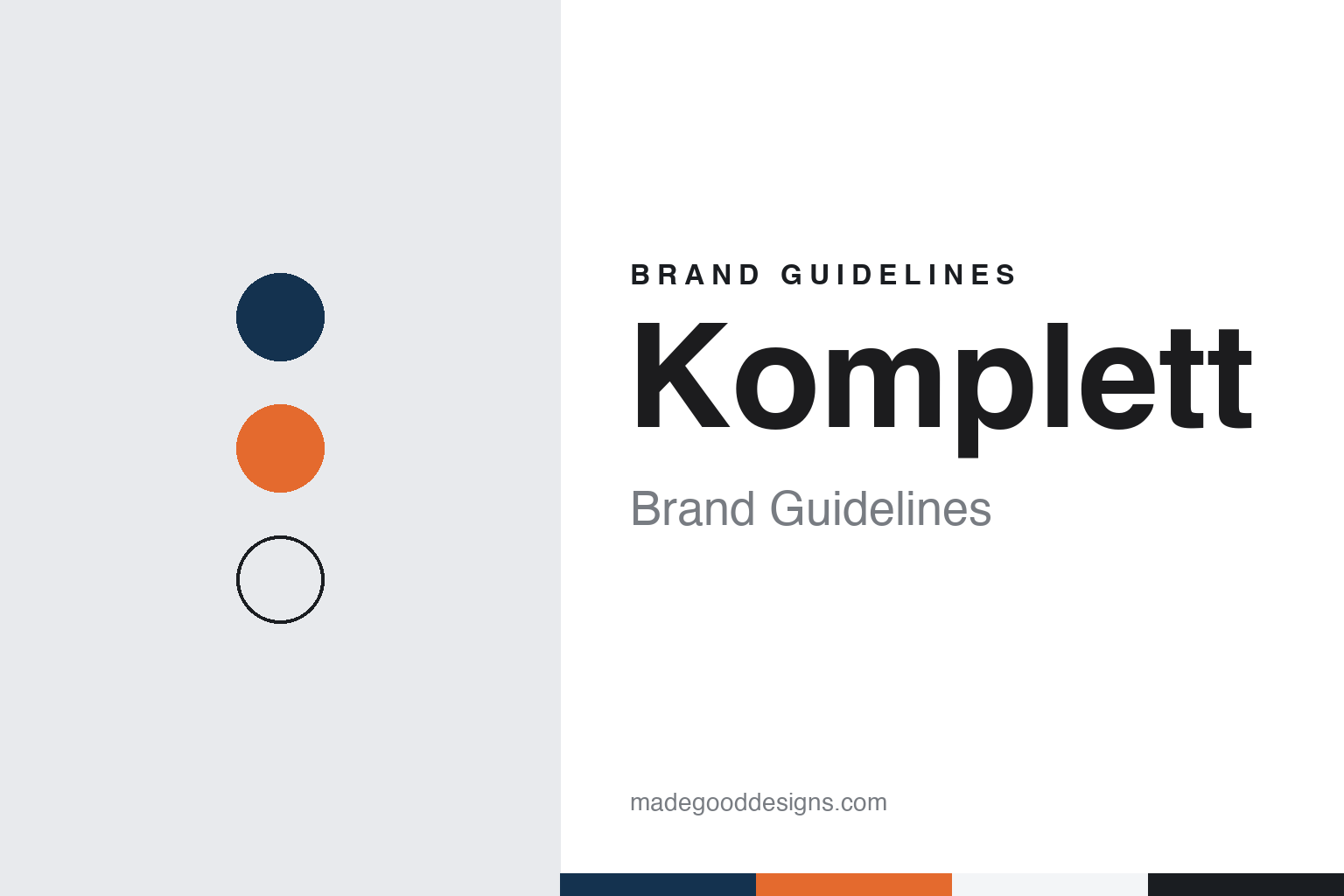
Two constants: a deep blue, orange and ice palette and a geometric web sans register. Abstract homage — not a Komplett asset or mark; no logo, website or product is reproduced.
Komplett.no
A Sandefjord distributor that put its shop on the web.
Komplett is a Norwegian online retailer of electronics with its head office in Sandefjord, where the company was founded, English Wikipedia says. Komplett Group dates itself to 1991, the year it gives for the founding of Norek AS, and says that in 1996 it opened the webshop Komplett.no. Norwegian and Swedish Wikipedia give the same two dates. The sources used for this guide do not name the founders, so none are given here.
The distributor and the webshop were then brought together. The company dates the merger of Norek and Komplett to 1998; Norwegian and Swedish Wikipedia date it to 1999 and say the merged business was first called Norkom. Norwegian Wikipedia adds that in 1999 Komplett opened a physical shop in Oslo together with Viking Computer, a business from Arendal that became part of the group and disappeared as a brand name; those shops, run as Komplett Data, were renamed Datakjeden in 2003 and sold in 2009.
Komplett ASA was listed on the Oslo stock exchange in 2000, the company and Norwegian Wikipedia say, the same year Komplett.se opened in Sweden. The early 2000s brought a push into the rest of Europe: Swedish Wikipedia records a warehouse at Tilburg in the Netherlands from 2003 to supply webshops in western Europe. In 2007 Komplett bought the Swedish online retailer Inwarehouse, merged with Torp Computing Group — bringing in the distributor Itegra and the webshop MPX.no — and opened Komplett.dk in Denmark, Norwegian Wikipedia says. The same encyclopaedia says the webshops in Britain, Germany, Austria and France closed in 2008, and those in the Netherlands, Belgium and Ireland were sold to the Dutch Paradigit group in 2010, leaving the business focused on Scandinavia.
The company’s home town also carries its name in another way. Norwegian and Swedish Wikipedia say Komplett bought the naming rights to Sandefjord Fotball’s new stadium in 2007, which opened as Komplett.no Arena — a web address used as the name of a building.
Colour
Canica, a relisting and NetOnNet.
Ownership is a large part of Komplett’s story. On 24 October 2008 the Norwegian Competition Authority, Konkurransetilsynet, granted Canica Invest AS a partial exemption from the merger standstill rule so it could buy more shares in Komplett ASA, then listed on Oslo Børs; at that date, the decision says, Canica held 39.88 per cent of the company. Komplett Group says it was acquired by Canica and delisted in 2011, and E24 reported in June 2021 that it had been ten years since Canica, the investment company of Stein Erik Hagen, took the online retailer off the exchange.
The return came in June 2021. E24 reported on 18 June 2021 that Komplett would go back on Oslo Børs on the following Monday and that Canica was selling shares to bring its holding down to around 60 per cent. On 9 February 2022 E24 reported that Komplett had agreed to buy the Swedish electronics retailer NetOnNet from SIBA Invest, owned by the Bengtsson family; the two brands were to carry on under their own names and the parent was to stay listed. Komplett Group says the combination with NetOnNet took place in 2022. Its shareholder list, based on the Norwegian securities register and updated on 19 October 2026, shows Canica Invest holding 42.4 per cent and SIBA Invest 31.7 per cent; E24 also put Canica’s stake at just over 42 per cent in March 2026.
Komplett Group now describes three consumer brands. Komplett is, in the company’s words, a pure online brand focused on electronics, computing and gaming, trading on Komplett.no, Komplett.se and Komplett.dk, with two pick-up points, one in Oslo and one at the Sandefjord warehouse. NetOnNet runs online shops in Sweden and Norway and 31 warehouse shops, and Webhallen, a Swedish gaming-focused brand that joined the group in 2013, has 12 stores, the company says. For businesses there is Komplett Bedrift in Norway and Komplett Företag in Sweden; Norwegian Wikipedia says the Norwegian business shop began as MPX.no in 2002 and took the Komplett Bedrift name on 20 October 2017. Distribution to resellers runs under the Itegra name.
Logistics sits at the centre. Norwegian Wikipedia says a further warehouse of 14,000 square metres opened beside the existing one in Sandefjord in 2008, and that Komplett builds desktop PCs under its own name at the Sandefjord logistics centre; the company says it nearly doubled the capacity of its AutoStore system in 2015 and expanded the Sandefjord site in 2017. Along the way the group tried many side-businesses — a bank, a cosmetics shop, a pharmacy and a car-parts shop among them — before what it calls a “back to core” strategy in 2018; Norwegian Wikipedia says it left the bank in 2018 and that in 2019 the investor Verdane bought into the pharmacy, cosmetics and car-parts shops.
Typography
Design and documentation.
Consumer-electronics retailers present themselves first through the store. Many trade from large units on the edge of towns, with long aisles divided into product areas such as computing, television, sound, phones and kitchen appliances. Trade reports describe how these floors are laid out for trying things: in 2017 Tweakers described Coolblue’s first XXL store in Amsterdam as six product areas, and in 2026 Républik Retail described a Boulanger store near Lille with a playable gaming area and a seated space for watching projectors.
Delivery is part of the public face. Some chains run their own vans for large appliances and installation, and Coolblue says it added its own bicycle delivery service in cities in 2018. Online shops, click-and-collect counters and services for repair, trade-in, rental and refurbished goods are presented beside the shelves, often under names of their own that sit next to the shop name on signs and websites.
Naming follows a similar pattern. A chain usually keeps one short shop name and adds own-label ranges with separate names, so a single store can carry the retailer’s brand, its house labels and many outside makers side by side. French Wikipedia, for example, dates Boulanger’s Listo and Essentiel B labels to 2005. When a chain buys a rival abroad, it may keep the local name, as Boulanger did with Krëfel in Belgium after 2019.
Behind the shop fronts sit corporate pages. These usually give a founding story, the current owner and any stock-market listing or plan for one, and some owners publish their own announcements of changing stakes. This guide sets out what dated sources say about each company’s founders, owners and listings, and treats the companies’ own descriptions as their claims.
Aa
A geometric web sans for a shop that lives on screens. (Specimen set in Manrope, a sans STAND-IN; NOT the Komplett logo.)
Komplett
A web address as a brand name.
Komplett’s identity grew out of its address. The brand reached the public as Komplett.no, and the country endings did the work of a naming system as the shop spread: Komplett.se in 2000, Komplett.dk in 2007, then Komplett Bedrift and Komplett Företag for business buyers. The domain was even put on a stadium. Where the group bought businesses with names of their own — Webhallen in Sweden, NetOnNet from the Bengtsson family — it kept them, and E24 reported in 2022 that NetOnNet and Komplett were to carry on as separate brands. The result is a portfolio in which one short Norwegian word covers the online shops and the business sales, while acquired names keep their own customers.
Because the Komplett brand trades online only, with two pick-up points in the company’s description, its public face is the web shop, the delivery and the warehouse in Sandefjord rather than a chain of stores. The colour and typeface specifications are not set out in the sources used for this guide, so the tones and type chosen here are our own interpretation rather than the company’s.
For a design guide, Komplett shows how a retailer with no high-street presence can build a brand from a domain and a single warehouse town, then sit alongside bought brands without merging them. Compare Elkjøp, the Nordic electronics retailer, and Alza, the Czech electronics retailer. For this guide we use a deep blue, an orange, an ice white and ink with a sans, an unofficial interpretation; no product or logo is reproduced.
Explore & save
Keep Komplett’s identity on hand — save it to a board in the Made Good inspiration library.
Komplett identity set
Pin the Komplett deep blue, orange and ice palette and the geometric web sans register to your own board.