Edion Brand Guidelines
Four regional chains, one store name since 2012.
Aa
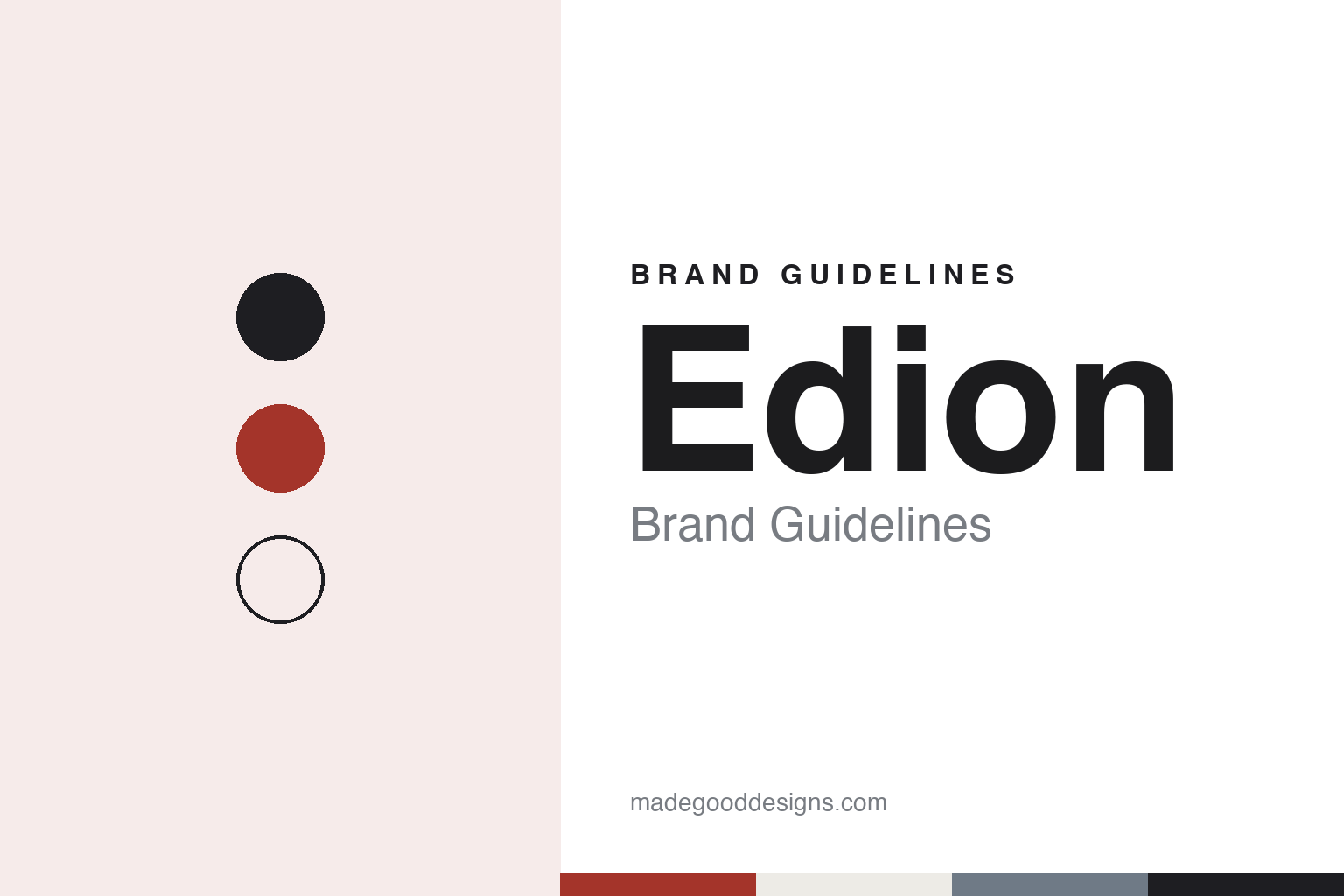
Two constants: an Edion brick red, graphite and grey palette and a Plain capital sans register. Abstract homage — not an Edion product or mark; no sign, logo or store front is reproduced.
Deodeo and Eiden
A western chain and a central one.
Edion is a company made of older chains. Its own history page lists three roots: Daiichi Sangyo, founded in May 1947, which became Deodeo; Eidensha, founded in April 1955, which became Eiden; and Midori Denkasha, founded in August 1961, which became Midori Denka. Japanese Wikipedia describes Deodeo as a chain based in the Chugoku region of western Japan, around Hiroshima, Eiden as based in the Chubu region around Nagoya, and Midori Denka as based in the Kinki region around Osaka.
The first two came together first. Japanese Wikipedia records that Deodeo and Eiden signed a memorandum on integration on 7 May 2001, at first planning to call the new company “D&E,” and chose the name Edion that November. The name is an acronym of “Exciting Discovery In One Network,” the same source says. Edion was set up as the two chains’ joint holding company on 29 March 2002, by a share transfer, the company says, and its shares were listed in Tokyo, Osaka and Nagoya. Today they trade on the Tokyo Stock Exchange’s Prime Market, according to the company.
The head office moved with the business. Edion’s history page records that its head-office functions moved to Nagoya in September 2003 and to Osaka in February 2007, where its main offices remain, in the Nakanoshima district. Its registered head office, however, has been in Hiroshima since June 2011, on the site where Deodeo began, Japanese Wikipedia says.
The group then grew by acquisition. Midori Denka became a subsidiary through a share exchange in April 2005. Edion bought a third of Ishimaru Denki, the electronics retailer centred on Tokyo’s Akihabara district, in July 2006 and all of it by October 2008. In June 2007 it took 40 per cent of Sanky, the company behind the 100Man Volt stores of the Hokuriku region, and in October 2011 the rest, according to the company’s history.
Colour
One name over many.
For ten years Edion kept the old names on its stores. Japanese Wikipedia says that by around 2008 the Kanto region alone had six store brands from the group, and that after a 2009 reorganisation into Edion East and Edion West the company first tried one brand per region. On 11 May 2012 it announced that its directly run stores would change their names, and on 1 October 2012 the Deodeo, Eiden, Midori and Ishimaru stores became EDION, the company’s history records. Japanese Wikipedia says the corporate logo was changed to match the store logo the same day.
The new mark first showed the Latin letters EDION with the katakana エディオン set above them as a reading guide. Japanese Wikipedia says the katakana was dropped around 2020, and dates the switch to the letters alone, on logos, store towers and signs, to 1 April 2020. Flagship stores were renamed by city: Deodeo’s main store became Edion Hiroshima Honten, Eiden’s became Edion Nagoya Honten and Ishimaru’s became Edion Akihabara Honten. Roadside stores, shopping-mall tenants, city stores and duty-free stores all use the one name, the same source says.
The last regional name went in 2025. On 1 April 2025 Edion merged Sanky into itself and turned the 100Man Volt stores into Edion stores, the company says; Japanese Wikipedia notes that some former 100Man Volt stores still carry traces of the old signs.
Inside the stores, Edion sells its own ranges. Japanese Wikipedia lists e angle, for products Edion develops itself, and e angle select, for products developed with makers, and records an earlier own brand, KuaL, launched in January 2005. Toys and video games sit in a corner called Neverland, a name that began in Eiden stores. In April 2017 Edion opened a store with the bookseller Culture Convenience Club’s Tsutaya Electrics format at Hiroshima Station, the same source says.
Typography
Signs, points and parent groups.
Japan’s big electronics, furniture and home-centre chains mostly grew from single regional shops, and their corporate pages still tell that story in the same order: a founding year and town, a founder, a date when the company was incorporated, and the dates when its shares were listed, now usually on the Tokyo Stock Exchange’s Prime Market. Many have since become holding companies, with the stores run by a subsidiary and the parent group named separately, so the name on the sign and the name on the share register are not always the same.
Store names carry much of the identity. Some groups keep a different name for each store format: Yamada Denki, for example, uses Tecc Land for its roadside stores, LABI for its large stores beside city stations and Tecc LIFE SELECT for stores that add furniture and household goods, according to Japanese Wikipedia. Others have done the opposite. Edion put four regional store names under one name, EDION, in October 2012, the company says.
The roadside store is the common type. Japanese Wikipedia describes Tecc Land buildings with the car park on the ground floor and the sales floors above, and Edion lists roadside stores alongside shopping-mall tenants and city stores. Point cards are part of the offer as well: Yamada tested its point system before rolling it out, and Edion has added several shared point programmes since 2015, Japanese Wikipedia records.
Own-label ranges are named plainly and sit beside the makers’ brands. Edion sells products under its e angle and e angle select names, and a line developed with the furniture retailer Nitori, while Yamada sells furniture under the IDC OTSUKA name after absorbing the retailer Otsuka Kagu in 2022. This guide sets out what can be checked about each chain, and marks what rests on the company’s own word.
Aa
A plain capital sans — five letters on every store since 2012. (Specimen set in Inter Tight, a sans STAND-IN; NOT the Edion logo.)
Partners
Renovation, furniture and a football club.
In August 2013 it formed a capital and business alliance with the building-products group LIXIL, which took a stake in the company; the company says the capital tie ended in April 2022 while the business tie continued. Edion sold its home-centre business in October 2014, according to its history, and Japanese Wikipedia says those stores passed to Kahma, now part of DCM.
Furniture came next. On 27 April 2022 Edion agreed a capital and business alliance with Nitori Holdings, the furniture and homeware retailer, the company and Japanese Wikipedia record. The trade site BCN+R reported on 15 November 2022 that Edion had announced it would begin selling some Nitori kitchen cupboards, starting at its Toyonaka store in Osaka prefecture on 18 November and its Itami store in Hyogo prefecture on 9 December. Japanese Wikipedia lists an own-brand line, e angle select DAY+VALUE, developed with Nitori.
The group reaches beyond shops. Its subsidiaries include a renovation and solar-installation business, a reuse and recycling company, programming classes for children and, since September 2023, the professional football club Sanfrecce Hiroshima, the company says. It gives a group total of 1,180 stores, 453 run directly and 727 franchised, as of 31 March 2026. Japanese Wikipedia notes that as of May 2026 there were no Edion stores in eleven prefectures, among them the six of the Tohoku region and Gunma, home of Yamada.
That neighbour may become a partner. In June 2026 Edion and Yamada Holdings signed a memorandum of understanding to begin talks on combining under a new joint holding company, with both becoming its wholly owned subsidiaries, Retail Insight Network reported on 8 June 2026; the combination had not been completed at the time of writing.
For a design guide, Edion shows how a group can retire long-used regional names in favour of one plain word. Compare Yamada Denki, which keeps separate names for its store formats, and Bic Camera, with which Edion had a short-lived alliance from 2007 to 2009. For this guide we use a brick red, a graphite and a slate grey with a sans, an unofficial interpretation; no product or logo is reproduced.
Explore & save
Keep Edion’s identity on hand — save it to a board in the Made Good inspiration library.
Edion identity set
Pin the Edion brick red, graphite and grey palette and the Plain capital sans register to your own board.