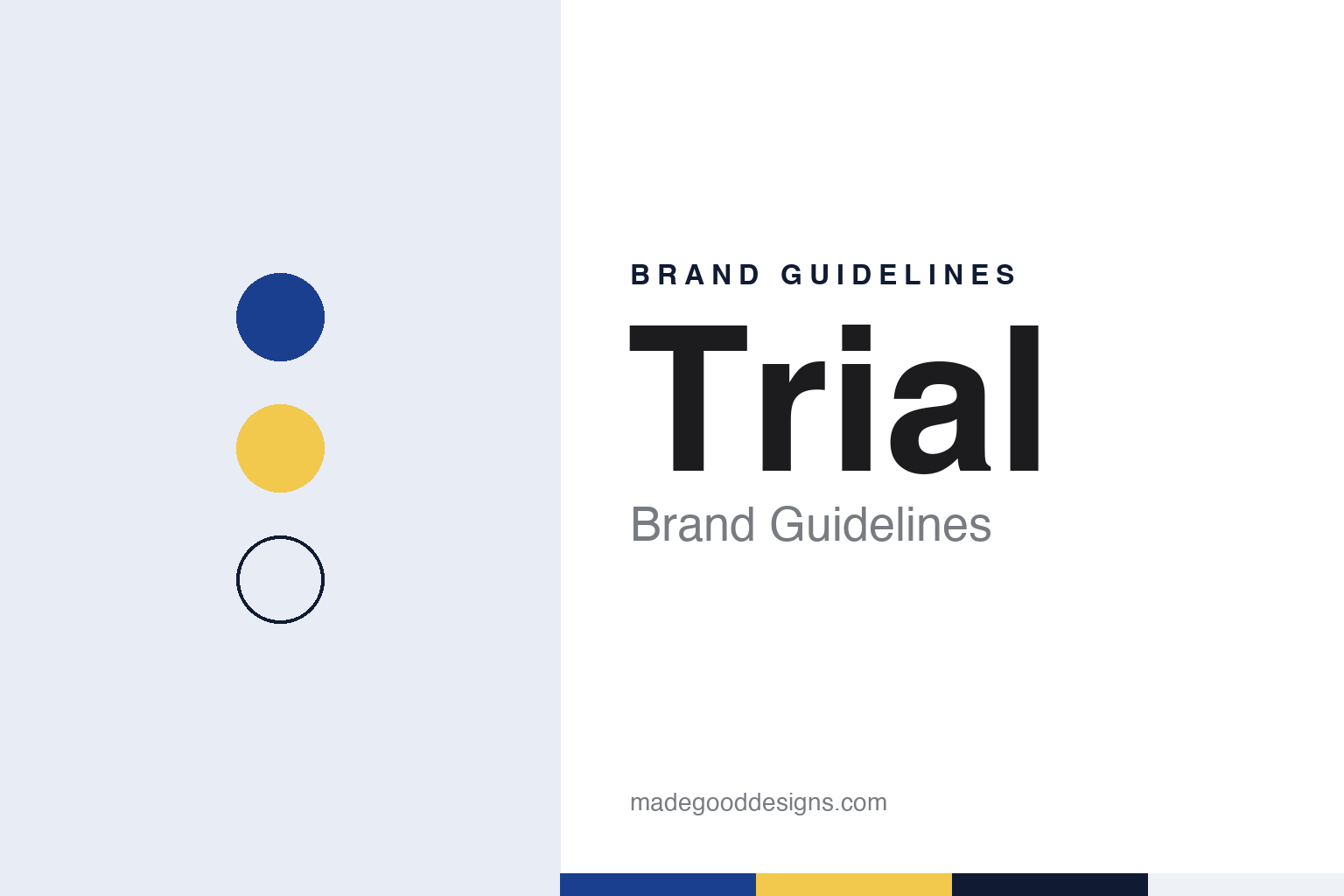
Trial Brand Guidelines
The Fukuoka recycle shop that became a supercenter chain run like a software company.
Aa
Two constants: a sign blue, ink blue and aisle yellow palette and a wide grotesque register. Abstract homage — not a Trial product or mark; no sign, logo or cart screen is reproduced.
Asahiya
A second-hand shop in Hakata.
Trial started in Fukuoka in 1974 as Asahiya, an antique dealer and recycling shop, according to the history published by its parent, Trial Holdings; the Asahi Shimbun also gave 1974 as the founding year in March 2025. Japanese Wikipedia places the shop in Sumiyoshi, in Fukuoka’s Hakata ward, opened in April 1974 by the family’s founder, and says it was incorporated as Asahiya in July 1981 with Hisao Nagata as president. He is chairman of Trial Holdings today, and Hiro Nagata is its president, the company’s profile says.
The company was renamed Trial Company in October 1984 and spent its early years selling home appliances and electronics, the group history says; Japanese Wikipedia names the appliance shops Elebit, with the first opening in Hakata in November 1984. Japanese Wikipedia also says the business was at first mainly about building software and selling personal computers, chiefly IT systems for retailers, and that a software subsidiary still handles sales support and analysis for its stores in Japan.
The shift to discount retail came in the 1990s. Trial opened its first discount store in 1992 — Japanese Wikipedia places it at Minamigaoka in Onojo, south of Fukuoka — and its first Supercenter Trial in 1996, on the airport bypass road in Kitakyushu. From the early 2000s it expanded across Japan, the company says, partly by buying other businesses and by moving into buildings left empty when general supermarkets withdrew.
Colour
Supercenters, smart carts and a blue sign.
The larger formats followed. Japanese Wikipedia lists a first Mega Center Trial at Kashima in Saga Prefecture in May 2006, and says the main supercenters generally run to 3,000 square metres or more, with new stores of about 4,000 square metres opened in numbers after 2013. Japanese Wikipedia dates its first Hokkaido store to 2008, and in June 2009 Trial bought CowBoy, a grocery chain operating mainly in Hokkaido, the company says. It set up a software development base in China in 2003 and, Japanese Wikipedia says, opened a supercenter in South Korea in 2005; Trial Holdings still lists TRIAL.Korea as an affiliate. In September 2015 the group moved to a holding-company structure under Trial Holdings. In October 2023, Japanese Wikipedia says, a new Trial subsidiary in Aomori took over 18 Satocho supermarkets there and reopened them under the Trial name.
Technology runs through the group’s own history. In 2018 it set up Retail AI and opened a supercenter at Island City in Fukuoka with shopping carts carrying payment tablets and AI cameras, the group history says. In 2022 it opened the first Trial GO, a small store in Miyawaka, Fukuoka. When Trial announced its purchase of Seiyu in March 2025, the Asahi Shimbun noted that its carts carry tablets and other devices that let customers pay without queuing at a till. Business Journal reported in August 2026 that the cart is Trial’s own design, and that Retail AI develops the AI cameras, electronic shelf labels and smart carts in-house.
The store signs are mostly blue. Japanese Wikipedia says Trial’s corporate colours are blues, with other colours on some formats, and that the current logo spells the name TRIΛL, with a Λ in place of the A. Older stores still carry the previous logo, in which the dot of the i was a star. Since the Island City store of 2018, it says, many new or refitted supercenters show only the TRIΛL name on the sign, without the format name.
Typography
Discount stores, baby shops and drugstores.
Japan’s discount stores, value-apparel chains and drugstores tend to present themselves above all through the shop floor. At Don Quijote, Japanese Wikipedia describes a method called “compressed display,” with goods packed in so tightly that the store becomes half a maze, and price cards written by hand: each store employs its own POP writers, whose lettering the chain calls Donki moji. In these chains the sign on the shelf often does more identity work than the logo above the door.
Own-brand ranges are the second layer. Large groups sell their own lines under names that sit alongside the store name rather than replacing it; Pan Pacific International Holdings, the parent of Don Quijote, lists ranges such as Jonetsu Kakaku, launched in 2009, and EDRP, whose packs are printed in black and white to cut costs. Mascots work in the same way. Don Quijote’s penguin, Donpen, dates from 1998, and in 2021 the company set rules for how the character may appear in signs and illustrations.
Store names are usually plain. Some come from a founding family or an older family shop, others from a borrowed idea: the Don Quijote name comes from Cervantes’s novel, according to a company FAQ quoted by Unseen Japan in 2022. Many chains also run a second name for a format or a market, such as Don Don Donki for stores outside Japan.
Behind the stores sit corporate websites that set out founders, parent groups, timelines and stock-exchange listings, often in both Japanese and English. This guide uses those pages for dated company facts, adds encyclopaedia and press sources where they exist, and describes each chain only by what it sells, how its stores look and who owns it, with no claims about the products themselves.
Aa
A wide grotesque — plain, bold capitals for a big-box sign. (Specimen set in Archivo, a sans STAND-IN; NOT the Trial logo.)
Trial
A 2024 listing and the purchase of Seiyu.
Trial Holdings listed its shares on the Growth Market of the Tokyo Stock Exchange in March 2024, the company says; Japanese Wikipedia gives the date as 21 March 2024 and notes that a listing approved in March 2023 had been withdrawn the following month. In 2026 the shares were added to the TOPIX index, the company says.
The next step was a purchase. On 5 March 2025, the Asahi Shimbun reported, Trial said it would buy the supermarket company Seiyu from the investment firm KKR and Walmart and make it a wholly owned subsidiary. The paper said Trial then ran 343 stores, mainly in Kyushu, while more than 90 percent of Seiyu’s 242 supermarkets were in the Kanto, Chubu and Kansai regions, and that a Trial board member was not considering an immediate change to the Seiyu name. The purchase was completed in July 2025: Trial Holdings says Seiyu became a wholly owned subsidiary that month and that 245 stores joined the group.
The two names now share some stores. Japanese Wikipedia says the first Trial Seiyu store, converted from a Seiyu at Hanakoganei in Tokyo, opened on 28 November 2025, with a logo of blue and red squares; Seiyu’s own-brand food has also gone on sale in Trial stores. It gives a count of 390 Trial stores across Japan as of July 2026. In January 2026, it says, Trial began a wide tie-up with Sugi Holdings, owner of Sugi Pharmacy, covering shared sites and own-brand goods.
For a design guide, Trial shows how a discount chain can make its checkout the most visible part of its identity, with a plain blue sign and a lettering trick in its name. Compare Don Quijote, another Japanese discount chain, and Sugi Pharmacy, its partner since 2026. For this guide we use a sign blue, an ink blue and an aisle yellow with a sans, an unofficial interpretation; no product or logo is reproduced.
Explore & save
Keep Trial’s identity on hand — save it to a board in the Made Good inspiration library.
Trial identity set
Pin the Trial sign blue, ink blue and aisle yellow palette and the wide grotesque register to your own board.