Sugi Pharmacy Brand Guidelines
The Aichi pharmacy that grew from one dispensing counter in Nishio.
Aa
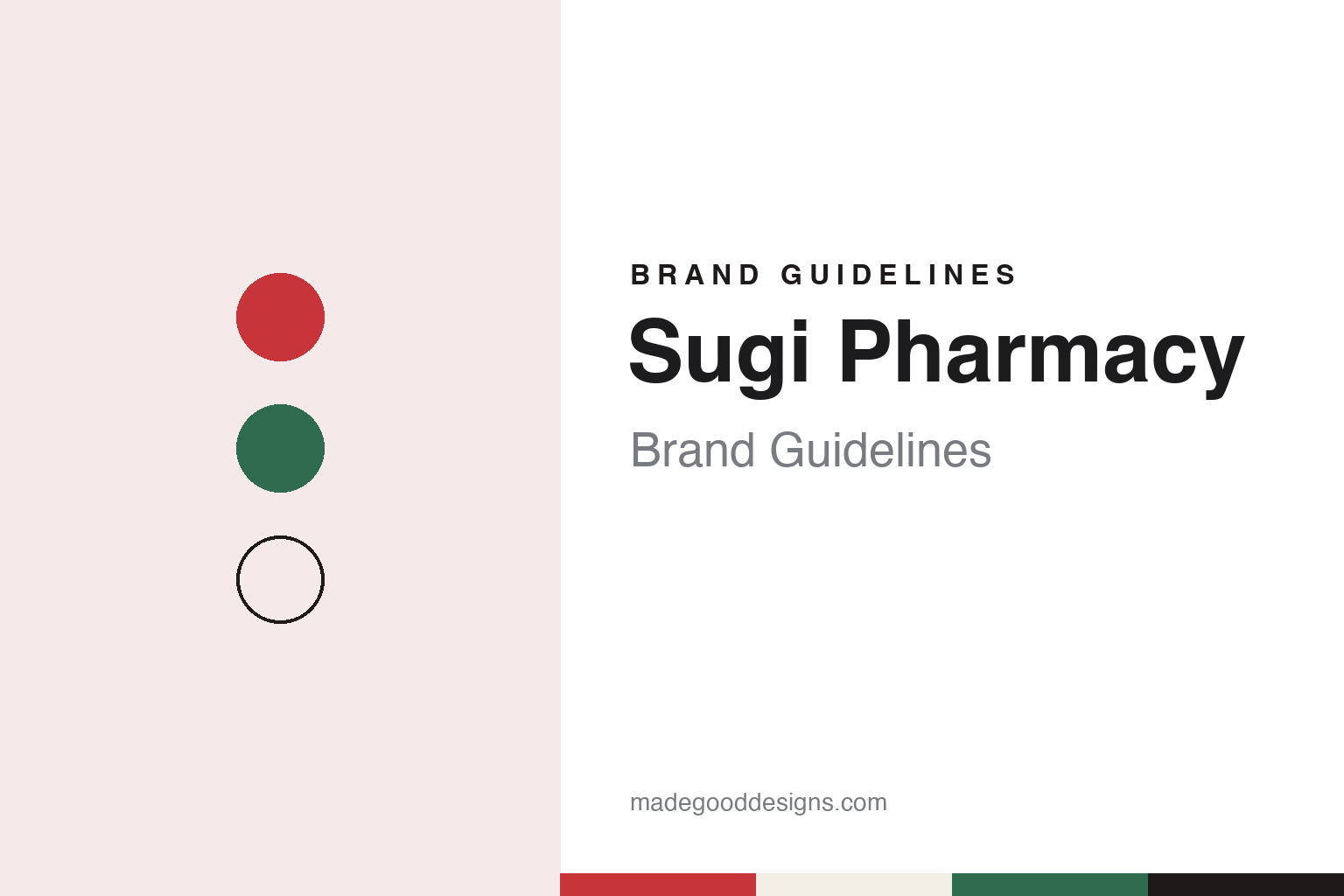
Two constants: a signboard red, cedar green and rice-paper palette and a plain gothic sans register. Abstract homage — not a Sugi Pharmacy product or mark; no sign, logo or character is reproduced.
Nishio, 1976
Two pharmacists and one dispensing counter.
Sugi Pharmacy began in December 1976 in Nishio, a city in Aichi Prefecture, as a single shop that sold medicines, health foods, cosmetics and household goods and filled prescriptions, according to the company history published by Sugi Holdings. Its founders were the pharmacist Hirokazu Sugiura and his wife Akiko Sugiura. Speaking to Toyo Keizai in December 2015, Hirokazu Sugiura said the two of them opened the shop in 1976 straight after he finished pharmacy school. He told the magazine that the American chain Walgreens was his model.
The business was incorporated as Sugi Yakkyoku (Sugi Pharmacy) in March 1982. Japanese Wikipedia says the name joins the first part of the founders’ surname with sugi, the Japanese word for the cedar tree. The head office moved from Nishio to Anjō in January 1997, the company says, and in September 2016 to the Ōbu Center, a new combined head office and distribution centre in Ōbu, also in Aichi, completed that July. In May 2017, Yakuji Nippo reported, Sugi Yakkyoku signed broad partnership agreements on local town-building with both Nishio, where it was founded, and Ōbu, where it is now based.
Founded in the mid-1970s, the company has no pre-war history. Katsunori Sugiura has been president of Sugi Holdings since May 2021, Japanese Wikipedia says, and the company names him as its president today.
Colour
From Aichi to Kansai, Kanto and Hokuriku.
Growth came in steps. The group listed on the Nasdaq Japan market in Osaka in June 2000, passed 100 stores that October and moved to the first sections of the Tokyo and Nagoya stock exchanges in August 2001, according to its history. Its first store in the Kansai region opened at Seta, in Shiga, in September 2002, followed by the first in Osaka in February 2004. The first Kanto store, at Wakō in Saitama, opened in August 2006, and the first in Hokuriku, at Tsuruga in Fukui, in February 2017. Japanese Wikipedia records that a capital and business alliance with Jusco, the retailer now called AEON, and the drugstore chain Tsuruha was agreed in January 2000 and dissolved in March 2006.
Acquisitions widened the network. Sugi took a stake in Japan, an Osaka discount-store operator, in October 2004, made it a subsidiary in December 2005 and a wholly owned one in March 2007; the Japan business was folded into Sugi Yakkyoku in March 2013. The Gunma drugstore chain Iizuka Yakuhin became a wholly owned subsidiary in February 2008. In September 2008 the listed company renamed itself Sugi Holdings and became a holding company over a newly formed Sugi Yakkyoku. In September 2024 it took control of I&H, which runs the Hanshin Chozai pharmacies around Kansai, and in 2025 it took an equity stake in Seki Yakuhin; Japanese Wikipedia says Seki became a consolidated subsidiary in September 2026. Talks on combining with Cocokara Fine, announced in June 2019, were called off that August, the encyclopedia says; Cocokara Fine later joined Matsumoto Kiyoshi.
Outside Japan, the company history lists business tie-ups with Great Tree Pharmacy of Taiwan in November 2020, Omicare of Vietnam in July 2021 and Alpro Pharmacy of Malaysia in July 2022, followed by a joint venture with an Alpro company in June 2023. In January 2026 Sugi Holdings and Trial Holdings began a broad collaboration, the company says. Japanese Wikipedia counts 1,731 locations at the end of October 2026, including Japan discount stores and home-care centres, with the Chubu home region holding close to a third of them. The company says its basic trading area is a two-kilometre radius around each store.
Typography
How Japanese discount stores, value-apparel chains and drugstores present themselves.
Japan’s discount stores, value-apparel chains and drugstores tend to present themselves above all through the shop floor. At Don Quijote, Japanese Wikipedia describes a method called “compressed display,” with goods packed in so tightly that the store becomes half a maze, and price cards written by hand: each store employs its own POP writers, whose lettering the chain calls Donki moji. In these chains the sign on the shelf often does more identity work than the logo above the door.
Own-brand ranges are the second layer. Large groups sell their own lines under names that sit alongside the store name rather than replacing it; Pan Pacific International Holdings, the parent of Don Quijote, lists ranges such as Jonetsu Kakaku, launched in 2009, and EDRP, whose packs are printed in black and white to cut costs. Mascots work in the same way. Don Quijote’s penguin, Donpen, dates from 1998, and in 2021 the company set rules for how the character may appear in signs and illustrations.
Store names are usually plain. Some come from a founding family or an older family shop, others from a borrowed idea: the Don Quijote name comes from Cervantes’s novel, according to a company FAQ quoted by Unseen Japan in 2022. Many chains also run a second name for a format or a market, such as Don Don Donki for stores outside Japan.
Behind the stores sit corporate websites that set out founders, parent groups, timelines and stock-exchange listings, often in both Japanese and English. This guide uses those pages for dated company facts, adds encyclopaedia and press sources where they exist, and describes each chain only by what it sells, how its stores look and who owns it, with no claims about the products themselves.
Aa
A plain gothic sans — a nod to the straightforward lettering of Japanese pharmacy signs. (Specimen set in Zen Kaku Gothic New, a sans STAND-IN; NOT the Sugi Pharmacy logo.)
Sugi Yakkyoku
Store names that follow the counter.
The store names follow the dispensing counter. Japanese Wikipedia says branches that fill prescriptions trade as Sugi Yakkyoku, while branches without dispensing trade as Sugi Drug or Drug Sugi; the group also runs Japan discount stores and, since the 2024 purchase, Hanshin Chozai pharmacies. Like other Japanese drugstores, the shops stock cosmetics, household goods, food and drink alongside medicines. The company history adds two milestones for the chain: its first 24-hour store in September 2017, and its first pharmacy on a hospital site, at Nagoya University Hospital, in November 2019. In the 2015 Toyo Keizai interview, the founder named a shop of about 30 tsubo near the Mitsukoshi department store in Nihonbashi, Tokyo, as the smallest in the chain.
The most visible part of the identity is the sign. Japanese Wikipedia describes the red signboard as the stores’ trademark and notes television commercials in which that red sign turns into other shapes. The chain once used the anime character Chibi Maruko-chan as an image character, and in February 2026, marking fifty years since the 1976 founding, it named the pop group Naniwa Danshi as anniversary ambassadors, the encyclopedia says.
For a design guide, Sugi Pharmacy shows how a regional pharmacy can carry one red sign and a family name across a large network while splitting its store names by what the counter does. Compare Matsumoto Kiyoshi, another Japanese drugstore named after its founder, and Welcia, another Japanese drugstore group. For this guide we use a signboard red, a cedar green and a rice-paper cream with a sans, an unofficial interpretation; no product or logo is reproduced.
Explore & save
Keep Sugi Pharmacy’s identity on hand — save it to a board in the Made Good inspiration library.
Sugi Pharmacy identity set
Pin the Sugi Pharmacy signboard red, cedar green and rice-paper palette and the plain gothic sans register to your own board.