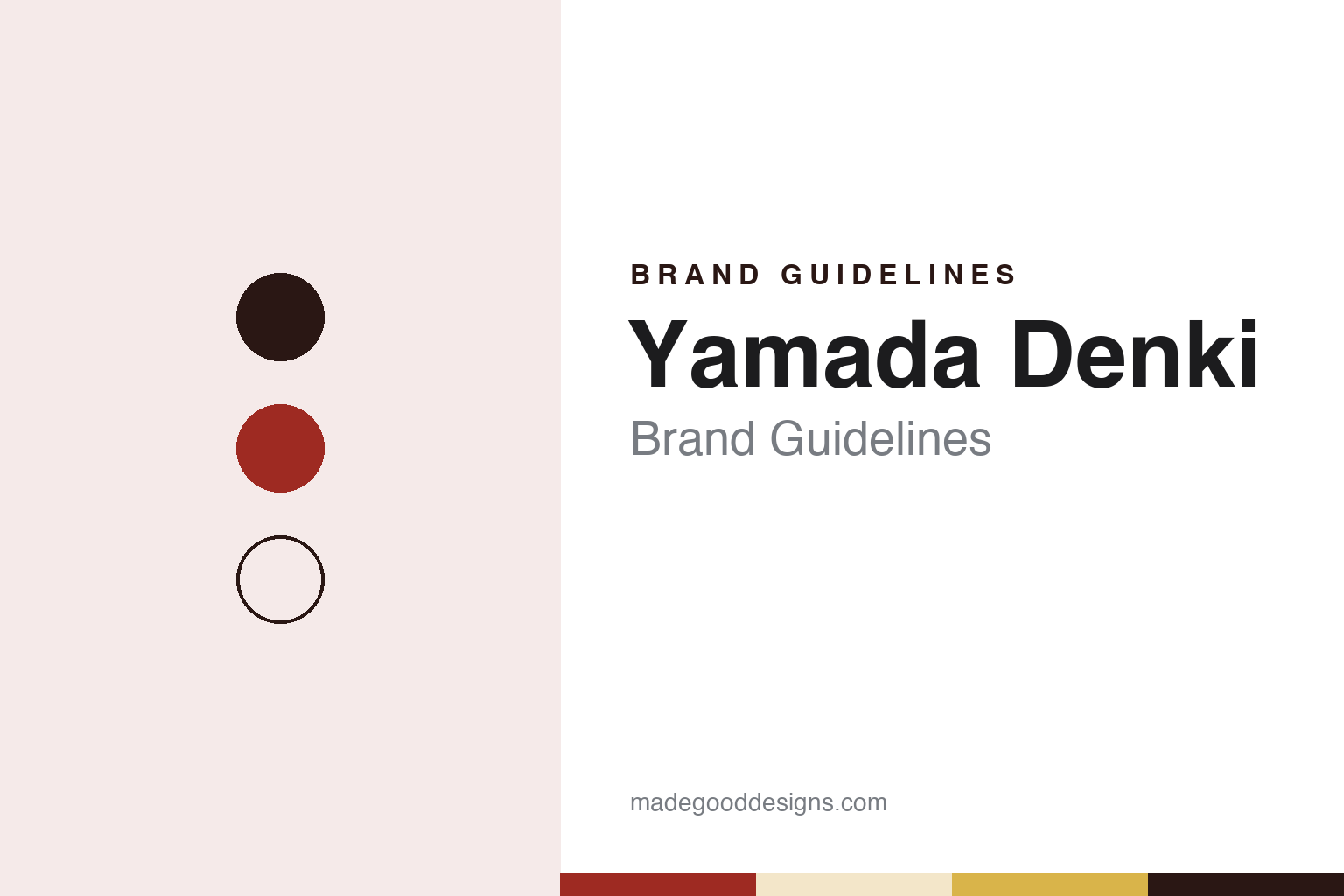
Yamada Denki Brand Guidelines
A 1973 Maebashi shop that grew into Tecc Land and the LABI stores.
Aa
Two constants: a Yamada Denki red, yellow and cream palette and a Roadside gothic sans register. Abstract homage — not a Yamada Denki product or mark; no sign, logo or store front is reproduced.
Maebashi
One shop in Gunma, 1973.
Yamada Denki began as one shop. Japanese Wikipedia says that in 1973 Noboru Yamada, who had worked at the electronics maker JVC, opened a privately owned store called Yamada Denka Center in Maebashi, the capital of Gunma prefecture, north of Tokyo. English Wikipedia gives the same year and the same JVC background. In 1983 the business became a company, Yamada Denki Co., Ltd., and grew as a chain of suburban electronics stores in its home prefecture.
English Wikipedia adds a corporate detail: the company in its present legal form dates from 21 May 1987, when the business merged into a dormant company founded in 1978 and took the Yamada Denki name. The shares followed a familiar Japanese path. Yamada Denki was listed on JASDAQ in 1989 and moved to the first section of the Tokyo Stock Exchange in September 2000; Japanese Wikipedia records that its holding company moved to the exchange’s Prime Market in April 2022, when the market sections were reorganised.
The early years were spent in the northern Kanto plain. Japanese Wikipedia describes how, from the 1980s, three regional chains, Yamada of Gunma, Kojima of Tochigi and K’s Denki of Ibaraki, opened stores in each other’s territory, and says the trio came to be known by their initials as the “Kita-Kanto YKK.” From the late 1990s Yamada went national. Its first store in the Kansai region opened in Yawata, Kyoto prefecture, in 1999, and English Wikipedia says that with the opening of a Tecc Land store in Aizumi, Tokushima prefecture, on 29 July 2005, the chain had stores in every one of Japan’s prefectures.
The company also left its first city. In July 2008 its head office moved from Maebashi to a new building in Takasaki, beside the east exit of Takasaki Station, which it shares with the LABI1 Takasaki store, Japanese Wikipedia says. Takasaki is also where Bic Camera began, and the two chains’ stores stand close together there.
Colour
Tecc Land by the road, LABI by the station.
Yamada’s store names are its most visible identity. The main format is Tecc Land, written Tecc.Land, a general electronics store built mainly beside main roads. Japanese Wikipedia notes that many Tecc Land buildings put the car park on the ground floor, with only the entrance at street level and the sales floors above, and that older stores had showy exteriors based on yellow, while recent ones use white and grey. Many carry the word “honten,” or main store, in their names.
For city centres the company built a second name. A test city store opened in central Hiroshima in June 2004, and on 10 March 2006 the chain opened LABI1 Namba in Osaka, the first of its large stores beside city stations, which Japanese Wikipedia says took the chain into the territory of Bic Camera and Yodobashi Camera. LABI is a coinage from “Life Ability Supply,” the same source says; the three flagship stores, in Takasaki, Ikebukuro and Namba, carry the name LABI1. English Wikipedia records that a LABI store in the Yunika building at Shinjuku’s east exit opened in April 2010 and closed on 4 October 2020.
Points mattered early. English Wikipedia says Yamada tested its point card system at experimental stores called “Digital 21” before adopting it, and that a national federation of booksellers asked it to lower the points rate it offered on books, which was later cut from 5 to 3 per cent.
The newer formats lean towards the home. Kaden Sumairu-kan YAMADA, from 2017, adds sofas, beds, kitchenware and renovation corners to electronics, and Tecc LIFE SELECT, first used at a rebuilt store in Kumamoto in June 2021, widens the floor for furniture, household goods and toys. After a 2021 reorganisation, Yamada Denki also runs stores under acquired names, among them TSUKUMO for computer parts, Matsuya Denki and Caden, Japanese Wikipedia says.
Typography
Signs, points and parent groups.
Japan’s big electronics, furniture and home-centre chains mostly grew from single regional shops, and their corporate pages still tell that story in the same order: a founding year and town, a founder, a date when the company was incorporated, and the dates when its shares were listed, now usually on the Tokyo Stock Exchange’s Prime Market. Many have since become holding companies, with the stores run by a subsidiary and the parent group named separately, so the name on the sign and the name on the share register are not always the same.
Store names carry much of the identity. Some groups keep a different name for each store format: Yamada Denki, for example, uses Tecc Land for its roadside stores, LABI for its large stores beside city stations and Tecc LIFE SELECT for stores that add furniture and household goods, according to Japanese Wikipedia. Others have done the opposite. Edion put four regional store names under one name, EDION, in October 2012, the company says.
The roadside store is the common type. Japanese Wikipedia describes Tecc Land buildings with the car park on the ground floor and the sales floors above, and Edion lists roadside stores alongside shopping-mall tenants and city stores. Point cards are part of the offer as well: Yamada tested its point system before rolling it out, and Edion has added several shared point programmes since 2015, Japanese Wikipedia records.
Own-label ranges are named plainly and sit beside the makers’ brands. Edion sells products under its e angle and e angle select names, and a line developed with the furniture retailer Nitori, while Yamada sells furniture under the IDC OTSUKA name after absorbing the retailer Otsuka Kagu in 2022. This guide sets out what can be checked about each chain, and marks what rests on the company’s own word.
Aa
A roadside gothic sans — names built for signs seen from the road. (Specimen set in Zen Kaku Gothic New, a sans STAND-IN; NOT the Yamada Denki logo.)
Yamada Holdings
From electronics to the whole house.
On 1 October 2020 the company became a holding company. Yamada Denki Co., Ltd. changed its name to Yamada Holdings, and its electronics retail business passed to a new subsidiary, Yamada Denki, English and Japanese Wikipedia say. The new retail company writes its name in katakana, ヤマダデンキ, where the old company had used the kanji 電機 for “electric,” and its English name is styled YAMADA-DENKI. The holding company stayed in Takasaki.
The group had already moved into housing. Japanese Wikipedia records that it took over the house builder S×L in 2011, now Yamada Homes, and the bathroom and kitchen maker Housetec in 2012, and made the house builder Hinokiya Group a subsidiary on 29 October 2020. In February 2026 it took 90 per cent of Toclas, a maker of kitchens and bathrooms whose roots lie in Yamaha’s furniture and housing equipment business, the same source says.
Furniture came through Otsuka Kagu, the Tokyo furniture retailer. Inside Retail Asia reported in February 2019 that the two companies had agreed a partnership to share sales knowledge, and in December 2019 that Yamada would take a majority shareholding, a step it said would strengthen Yamada’s housing business. Japanese Wikipedia records that Otsuka Kagu became a subsidiary on 30 December 2019, wholly owned in September 2021, and merged into Yamada Denki on 1 May 2022; its furniture is still sold under the name IDC OTSUKA, including in Yamada electronics stores. In September 2026 the group sold its electronics subsidiary in Shenyang and left the Chinese market, Japanese Wikipedia says.
A larger change has been announced but has not happened. In June 2026 Yamada Holdings and Edion signed a memorandum of understanding to begin talks on combining under a new joint holding company, of which both would become wholly owned subsidiaries, Retail Insight Network reported on 8 June 2026; the combination had not been completed at the time of writing.
For a design guide, Yamada Denki shows how a chain can sort its stores by name: one word for the roadside, another for the station, and a third for the home. Compare Edion, the Osaka chain that put all its stores under one name, and Bic Camera, which also began in Takasaki. For this guide we use a red, a sign yellow and a cream with a sans, an unofficial interpretation; no product or logo is reproduced.
Explore & save
Keep Yamada Denki’s identity on hand — save it to a board in the Made Good inspiration library.
Yamada Denki identity set
Pin the Yamada Denki red, yellow and cream palette and the Roadside gothic sans register to your own board.