Nitori Brand Guidelines
A 1967 Sapporo furniture shop that grew into a home-furnishings group.
Aa
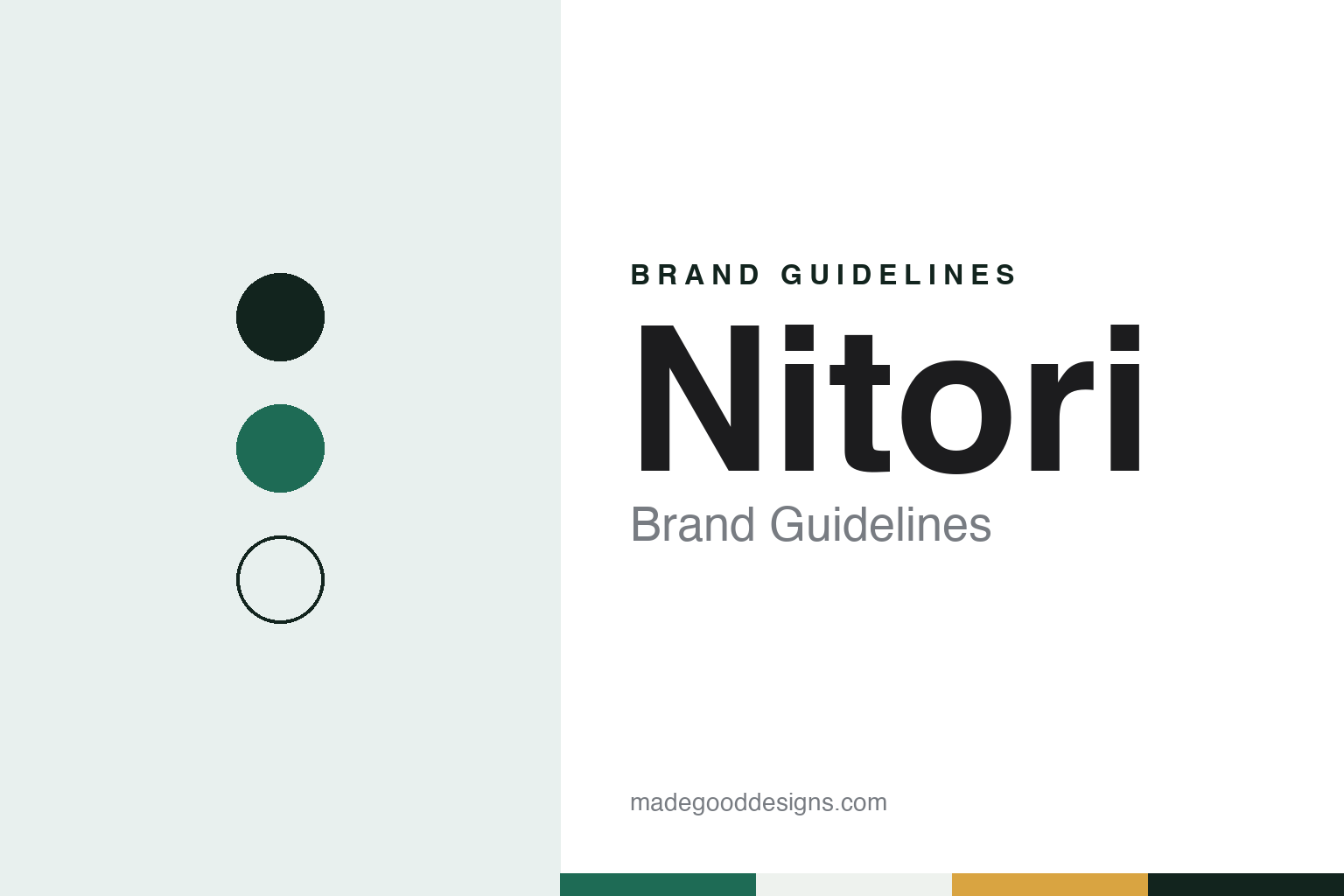
Two constants: a green, linen and oak palette and a plain retail gothic register. Abstract homage — not a Nitori product or mark; no sign, logo or product is reproduced.
A wholesale-centre name
One furniture shop in northern Sapporo.
Nitori began in December 1967 as a single furniture shop in Kita-ku, the northern ward of Sapporo, opened by Akio Nitori. Japanese Wikipedia gives its first name as Nitori Furniture Wholesale Centre, North Branch, and explains the choice: “wholesale centre” was meant to suggest low prices and a large floor, and “North Branch” was meant to make customers think there was a main store somewhere else. There was not; the branch was the whole business.
The shop became a company on 3 March 1972, as Nitori Furniture Store Co., according to the same source. It was renamed Nitori Furniture in June 1978 and simply Nitori in July 1986, the year it absorbed two smaller Hokkaido furniture retailers and turned their premises into branches. Its first store outside Sapporo opened in Tomakomai in 1981, and its first outside Hokkaido opened in Katsuta, Ibaraki, in 1993.
The shares were listed on the Sapporo Securities Exchange on 27 September 1989, and in October 2002 the company moved to the first section of the Tokyo Stock Exchange, Japanese Wikipedia says. The oldest store still trading, according to that article, is the Asabu store in Sapporo, the chain’s third, first opened in 1973 and rebuilt three times; since 2012 the Sapporo head office has shared its site.
In August 2010 the company split itself into a holding structure. The old Nitori became Nitori Holdings, while the retail business passed to a new company named Nitori and the logistics arm to a separate subsidiary. Nitori Holdings keeps its registered head office in Sapporo and a second headquarters in Tokyo’s Kita ward, and is a constituent of the Nikkei 225 index, according to Japanese Wikipedia. Akio Nitori remains the founder figure in the company’s story; in 2014 Toshiyuki Shirai became the first company president from outside the founding family.
Colour
Made, shipped and sold by one group.
Nitori is not only a shop. Japanese Wikipedia describes it as a retailer that took on the manufacturer-retailer model more common in clothing: the group buys raw materials abroad, has goods made, imports them, sells them in its own stores and delivers them to homes. The company calls this a “manufacturing, logistics and retail” business. It runs its own distribution centres in Sapporo, Shiraoka in Saitama, Kobe and Ōkawa in Fukuoka, and arranges its own shipping rather than leaving that to a trading house, the same article says. Group companies listed there include sourcing and furniture units in Vietnam, Thailand and mainland China.
The range covers furniture, interior goods and household items — bedding, tableware and kitchen tools, laundry goods and small appliances — a mix usually called home furnishing. Japanese Wikipedia says the company has cited IKEA as one of its models.
The store formats carry their own names. Most branches are large home-furnishing stores; Nitori Deco Home is a smaller format with no large furniture, which Japanese Wikipedia counts at 133 branches in 2023; Nitori Express is a city-centre format with a reduced range; Nitori Mall is a shopping-centre format with other chains as tenants; and N+ is an apparel line for adult women, launched in October 2019. Japanese Wikipedia says Nitori reached all 47 prefectures in March 2011, when it opened in Matsue, Shimane, and counts 716 stores in Japan at 31 December 2023.
Abroad, the first store opened in Kaohsiung, Taiwan, in May 2007, under the Chinese name 宜得利家居. In September 2023 Inside Retail Asia reported that Nitori was opening its first Hong Kong store in the Mega Box mall at Kowloon Bay, a month after its first store in Thailand, and that it then had 793 stores in Japan and 142 in mainland China, Taiwan, Malaysia and Singapore.
Typography
How the category presents itself.
Japan’s big electronics, furniture and home-centre chains mostly grew from single regional shops, and their corporate pages still tell that story in the same order: a founding year and town, a founder, a date when the company was incorporated, and the dates when its shares were listed, now usually on the Tokyo Stock Exchange’s Prime Market. Many have since become holding companies, with the stores run by a subsidiary and the parent group named separately, so the name on the sign and the name on the share register are not always the same.
Store names carry much of the identity. Some groups keep a different name for each store format: Yamada Denki, for example, uses Tecc Land for its roadside stores, LABI for its large stores beside city stations and Tecc LIFE SELECT for stores that add furniture and household goods, according to Japanese Wikipedia. Others have done the opposite. Edion put four regional store names under one name, EDION, in October 2012, the company says.
The roadside store is the common type. Japanese Wikipedia describes Tecc Land buildings with the car park on the ground floor and the sales floors above, and Edion lists roadside stores alongside shopping-mall tenants and city stores. Point cards are part of the offer as well: Yamada tested its point system before rolling it out, and Edion has added several shared point programmes since 2015, Japanese Wikipedia records.
Own-label ranges are named plainly and sit beside the makers’ brands. Edion sells products under its e angle and e angle select names, and a line developed with the furniture retailer Nitori, while Yamada sells furniture under the IDC OTSUKA name after absorbing the retailer Otsuka Kagu in 2022. This guide sets out what can be checked about each chain, and marks what rests on the company’s own word.
Aa
A plain retail gothic, the register of a roadside sign. (Specimen set in Zen Kaku Gothic New, a sans STAND-IN; NOT the Nitori logo.)
Nitori
A takeover, a partner and a market left.
The group’s main move outside furniture came in 2020. The home-centre chain Shimachu had agreed to a takeover bid from DCM Holdings; on 13 November 2020 it withdrew that approval and backed a tender offer from Nitori Holdings instead, on the basis that its shares would then be delisted, according to a Tokyo Stock Exchange market notice of 18 November 2020. Japanese Wikipedia says Nitori Holdings took 77.04 per cent of Shimachu on 6 January 2021, making it a consolidated subsidiary, and owned all of it from 26 March 2021. In June 2021 the two companies opened a shared format, Nitori Homes, in a converted Shimachu store in Saitama.
In April 2022 Nitori Holdings announced a capital and business tie-up with the electronics chain Edion, taking a 10 per cent holding made up of shares bought from LIXIL and on the market, according to Japanese Wikipedia.
Not every market lasted. Nitori entered the United States in 2013 under the name Aki-Home, taken from the founder’s first name, with stores in Tustin and Fullerton in California. On 30 September 2022 Nitori Holdings announced a full withdrawal from the US business by April 2023, closing its two remaining stores in Tustin and at Ontario Mills, Fashionsnap reported on 5 October 2022; the chain had grown to five US stores before that. The same report gave the group 708 stores in Japan, including Shimachu, and 93 abroad in August 2022. Japanese Wikipedia records that all US stores had closed by April 2023.
The visual identity is simple to describe. Japanese Wikipedia gives the chain’s image colour on signs as emerald green, notes that some stores and delivery centres still show the older design of a bird mark in blue, and says Deco Home moved from the green logo to an orange one.
For a design guide, Nitori shows how one plain colour and a short name can carry a group from a single Sapporo shop to stores across Asia. Compare Edion, the electronics chain it took a stake in, and DCM, the rival bidder for Shimachu. For this guide we use a green, a linen white and an oak gold with a sans, an unofficial interpretation; no product or logo is reproduced.
Explore & save
Keep Nitori’s identity on hand — save it to a board in the Made Good inspiration library.
Nitori identity set
Pin the Nitori green, linen and oak palette and the plain retail gothic register to your own board.