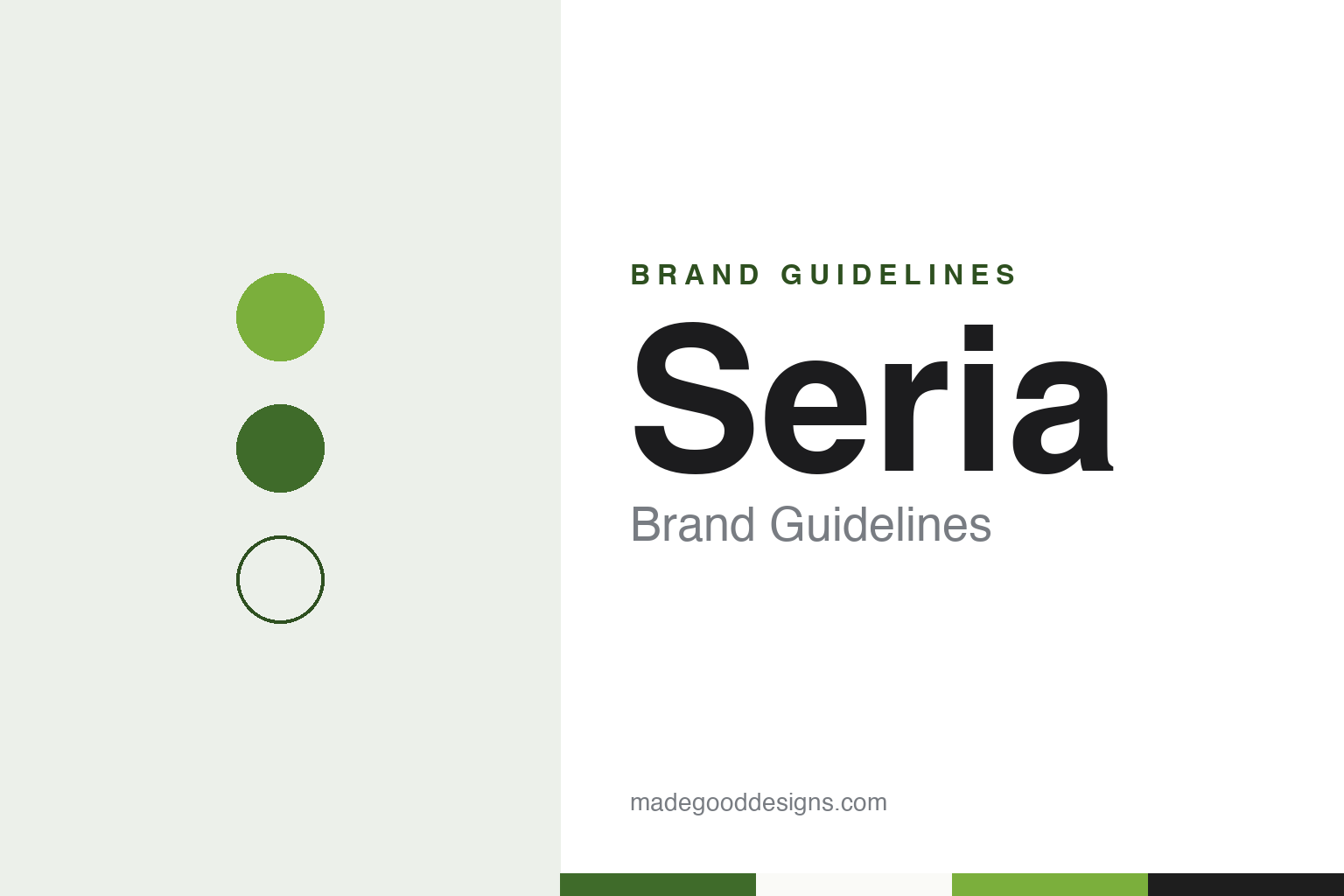
Seria Brand Guidelines
The Ōgaki single-price shop that set out not to look like one.
Aa
Two constants: a leaf green, white and deep moss palette and a rounded sans register. Abstract homage — not a Seria product or mark; no item, logo or sign is reproduced.
From Sanyo Agency to Seria
An Ōgaki business renamed in 2003.
Seria comes from Ōgaki, a city in Gifu Prefecture west of Nagoya, where it still has its head office. Japanese Wikipedia dates its founding to March 1985 and says the company was incorporated in October 1988 as Sanyo Agency, completing a head-office building in Ōgaki in May 1989. The financial analyst Mariko Kodama, in a 2026 book excerpted by President Online, also gives 1985 as the founding year, placing it in the decade when fixed single-price shops first appeared in Japan; ITmedia Business Online noted in August 2026 that the trade had at first been carried on largely through mobile sales and pop-up events, and that fixed stores multiplied from the 1980s.
The present name came in April 2003, when the company renamed itself Seria and opened the first store under the Seria Seikatsu Ryōhin name, according to both Japanese Wikipedia and ITmedia. Japanese Wikipedia adds that “Seria” is Italian for “serious,” and lists a trading subsidiary in Shanghai set up in February 2003. The shares were registered for over-the-counter trading with the Japan Securities Dealers Association in September 2003 and listed on the JASDAQ exchange in December 2004; the company is now traded on the Standard market of the Tokyo Stock Exchange, Japanese Wikipedia says.
Seria also invested early in store systems. Japanese Wikipedia says it installed a real-time point-of-sale system in all its directly run stores in September 2004 and an ordering-support system across them in September 2006, and President Online describes ranges developed jointly with domestic vendors and makers on the basis of customer-needs data.
Colour
Fewer things, chosen with care, in a calm shop.
Seria sells household goods at a single price point. President Online wrote in March 2026 that almost all of its range is everyday goods, with little confectionery or food, and that the company held its range at about 20,000 items while rotating 500 to 700 of them each month; ITmedia counted 28,000 items and more than 500 new ones a month in August 2026. Both describe a company that has kept to its one price while rivals added higher-priced lines, and Diamond Chain Store Online reported in November 2026 that Seria continues to concentrate its product development on that single price band.
The stores themselves are part of the pitch. Japanese Wikipedia sums up the company’s concept as a single-price shop that does not feel like one, with fewer, more carefully chosen products and calm interiors in place of cluttered aisles. ITmedia wrote that Seria presented itself from the start as a stylish variety store, and that from 2007 it adopted Color the days as its concept and rolled out stores in a white and yellow-green colour scheme, with tableware and similar goods displayed near the entrance. Japanese Wikipedia dates the first Color the days store to November 2007.
Seria tried large stores of the kind Daiso developed, ITmedia reported, but they did not work out and it concentrated on small shops instead. Japanese Wikipedia lists roadside sites, supermarkets such as Seiyu and Beisia, and shopping centres among its locations, with partner retailers — the Taiyo supermarket chain in Kagoshima and the Makeman home-centre chain in Okinawa — running Seria stores in those two prefectures. Where a few hit lines once drove growth, sales are now spread evenly across categories, president Eiji Kawai told Diamond Chain Store Online, naming stickers and character goods as the earlier examples.
Typography
Japanese discount, apparel and drugstore chains.
Japan’s discount stores, value-apparel chains and drugstores tend to present themselves above all through the shop floor. At Don Quijote, Japanese Wikipedia describes a method called “compressed display,” with goods packed in so tightly that the store becomes half a maze, and price cards written by hand: each store employs its own POP writers, whose lettering the chain calls Donki moji. In these chains the sign on the shelf often does more identity work than the logo above the door.
Own-brand ranges are the second layer. Large groups sell their own lines under names that sit alongside the store name rather than replacing it; Pan Pacific International Holdings, the parent of Don Quijote, lists ranges such as Jonetsu Kakaku, launched in 2009, and EDRP, whose packs are printed in black and white to cut costs. Mascots work in the same way. Don Quijote’s penguin, Donpen, dates from 1998, and in 2021 the company set rules for how the character may appear in signs and illustrations.
Store names are usually plain. Some come from a founding family or an older family shop, others from a borrowed idea: the Don Quijote name comes from Cervantes’s novel, according to a company FAQ quoted by Unseen Japan in 2022. Many chains also run a second name for a format or a market, such as Don Don Donki for stores outside Japan.
Behind the stores sit corporate websites that set out founders, parent groups, timelines and stock-exchange listings, often in both Japanese and English. This guide uses those pages for dated company facts, adds encyclopaedia and press sources where they exist, and describes each chain only by what it sells, how its stores look and who owns it, with no claims about the products themselves.
Aa
A rounded sans for a calm variety shop. (Specimen set in M PLUS Rounded 1c, a sans STAND-IN; NOT the Seria logo.)
Seria
Small shops, one price, two colours.
Seria is a listed company that runs its chain mostly through its own stores. ITmedia counted 2,155 stores at the end of June 2026, almost all of them directly operated; Japanese Wikipedia gives 1,787 stores as of March 2021. Its head office remains in Ōgaki, and as of November 2026 its president is Eiji Kawai, according to Diamond Chain Store Online.
The single price shapes most of what the brand presents. With rivals such as Daiso expanding into higher price bands, ITmedia described Seria as positioned more like a select shop for add-on and impulse purchases than a destination for a full range, and reported that the company credits its data analysis, which picks out slow-selling lines, for the way it runs its range. Japanese Wikipedia says the chain has kept its focus on women, the main customers of single-price shops, and that it accepts returns and exchanges within the receipt period even for goods that are not faulty, with opened items, food, special orders and carrier bags excluded. Its stores carry only goods at the one pre-tax price, with no higher-priced shelves, both Japanese Wikipedia and ITmedia say. In President Online, Kodama compared Seria’s joint product development with suppliers to the manufacturer-retailer model of Fast Retailing, the parent of Uniqlo, while noting that rising costs in China and elsewhere in Asia and a weak yen reduce the number of goods that can be sold at its price.
For a design guide, Seria shows how a single-price shop can take on a calmer, more domestic register through a store concept and a two-colour scheme rather than price signage. Compare Daiso, which took the opposite route into higher price bands, and Can Do. For this guide we use a leaf green, a soft white and a deep moss with a rounded sans, an unofficial interpretation; no product or logo is reproduced.
Explore & save
Keep Seria’s identity on hand — save it to a board in the Made Good inspiration library.
Seria identity set
Pin the Seria leaf green, white and deep moss palette and the rounded sans register to your own board.