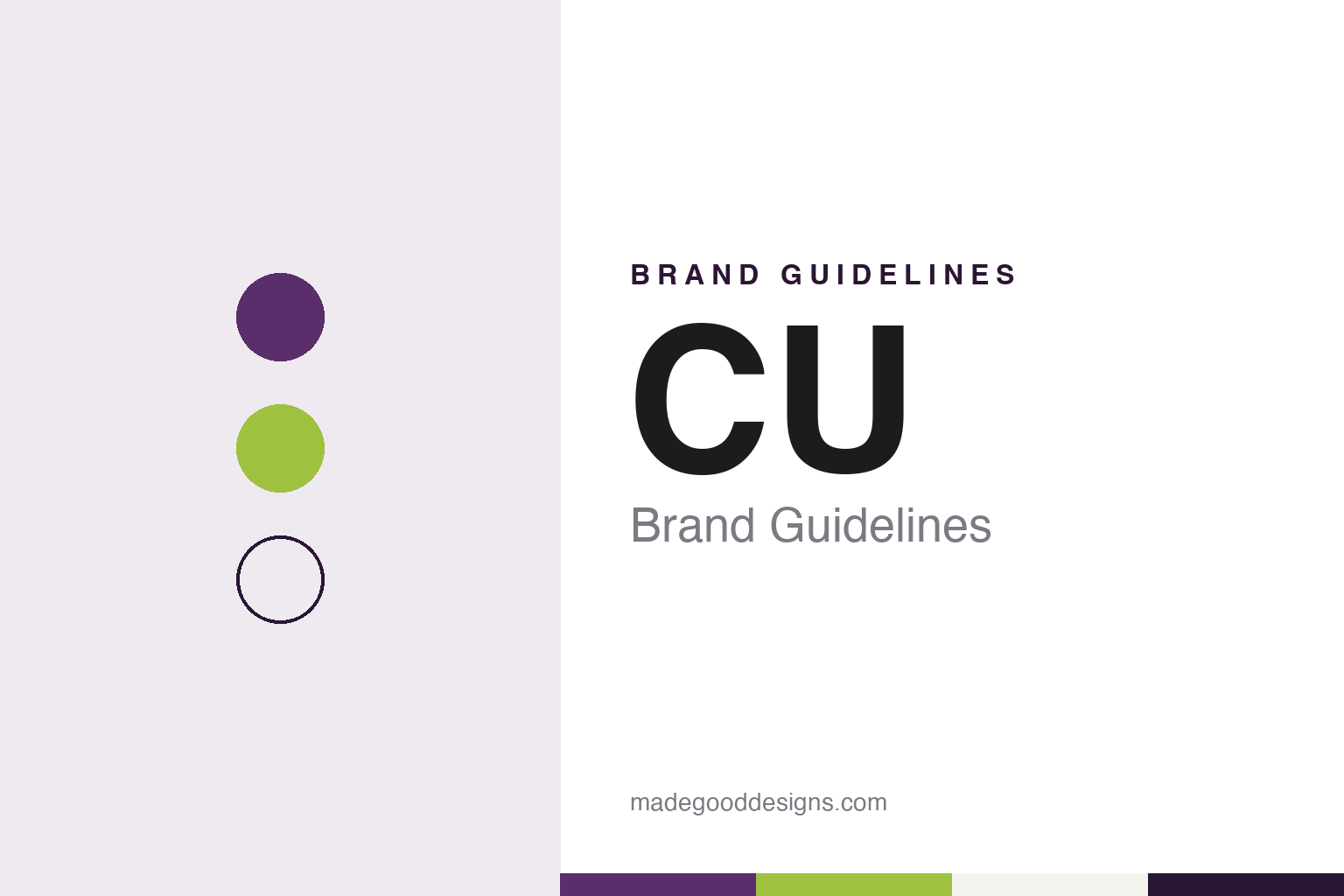
CU Brand Guidelines
The FamilyMart licence that became a two-letter Korean chain.
Aa
Two constants: a plum, lime and warm white palette and a rounded geometric sans register. Abstract homage — not a CU or BGF Retail product or mark; no sign, logo or package is reproduced.
FamilyMart Korea
A Japanese licence, a Korean group and a Seoul shop.
CU began as the South Korean arm of a Japanese convenience-store name. English Wikipedia says the Bogwang Group signed a licence with FamilyMart in 1990 to open convenience stores under that brand in South Korea, and that the first Korean FamilyMart opened in October 1990. BGF’s own corporate history says its convenience-store division was launched in October 1989 and names the first shop as the Garak store, opened in October 1990. Korea JoongAng Daily, writing in June 2012, gave 1992 as the year of the first store, so the sources differ on the date.
The business became a company of its own on 1 December 1994, when Bogwang set up Bo Gwang Family Mart to run its stores, according to English Wikipedia and BGF’s history. The chain grew steadily: English Wikipedia counts 2,000 stores in 2003 and 5,000 by 2010. The early milestones BGF lists are practical ones: a distribution centre for convenience stores in Seoul in 1992, others serving Busan and the Gyeonggi and Incheon area, and a network that reached Jeju Island in 2001.
In 2012 the business took a new name. The joint venture between Japan’s FamilyMart and the Bo Gwang Group changed its name to BGF Retail at a shareholders’ meeting on 7 June, Korea JoongAng Daily reported on 19 June 2012; English Wikipedia dates the change to 8 June. The paper reported that the more than 7,200 FamilyMart stores in Korea would be renamed CU from August, and that BGF Retail would keep the rights to the FamilyMart name in Korea so that no copycat could trade on it. English Wikipedia gives 1 August 2012 as the day the chain was officially renamed, and BGF says its first CU store opened that month at the Olympic Plaza in Seoul.
Colour
Convenience for You, sign by sign.
The new name was explained at its launch. CU stands for “Convenience for You,” BGF Retail’s chairman told the press conference reported by Korea JoongAng Daily in June 2012, and he presented it as a move to an independent store rather than an imitation of Japanese models. The changeover was gradual: the same report said the new name, together with in-shop displays reading “with Family Mart,” would be applied to all stores nationwide between August and October 2012. Korean Wikipedia says the phrase also sat in a corner of early CU signs and was later replaced by the operator’s own identity when the partnership ended around the company’s stock-market listing.
The paper also described the shops the name went on: small stores averaging 66 square metres, which BGF Retail planned to tailor to Korea’s growing number of one-person households, with more food and fewer other goods. English Wikipedia says the change was meant to create a “Korean-style” convenience store and to end royalty payments to FamilyMart.
BGF Retail listed on the Korea Exchange in May 2014, according to its corporate history. Korean Wikipedia says the company left the Bogwang group in December 2016, when the last Bogwang shares were sold, and that in November 2017 it was split into a holding company, BGF, and an operating company that kept the name BGF Retail.
Own-label ranges carry names of their own. BGF’s history lists an integrated private brand called HEYROO from January 2016, a set of HEYROO Friends characters from October 2016 and a private brand called PBICK, launched in May 2025. The Asia Business Daily reported in August 2026 that the PBICK name comes from the “beep” of a barcode scanner at the till, and that its packaging system turns the rhythm of that sound into colour, repeated lines, alignment and white space, with few decorative elements, so that hundreds of products read as a single range, with food photography to show what each one contains.
Store formats have widened as well. In August 2026 the same paper described CU Re:fuel, a model that turns closed filling stations into convenience stores and reuses their signage, canopies and forecourts. The first, the Sohul IC branch in Pocheon, Gyeonggi Province, combines a shop with lounge space in a two-storey building on a former forecourt site.
Typography
How Korean retailers present themselves.
South Korea’s large retailers tend to present themselves through formats before slogans. A single group may run hypermarkets, warehouse stores, supermarkets, convenience stores and online malls side by side, each with its own name on the fascia, and corporate pages usually open with a timeline: the first branch, the district it stood in, the year it opened, and then each new format as it was added.
The big-box stores carry much of their identity on the shelf. Hypermarkets sell groceries alongside clothing, household goods and electronics under one roof, and own labels give them names to point to in the aisle, from value ranges to premium ready meals. Warehouse formats lean on large packs and goods shown in boxes or on pallets, so that the display itself signals the way the store sells.
Department stores and convenience chains work at opposite scales. Department-store groups put their weight into the building, the façade and the flagship in a city centre, while convenience chains rely on a short name and a bright fascia that has to read from a street corner and repeat across a large network of small shops. Beauty and lifestyle chains, and the apps that sit alongside all of these stores, carry the same names into a much smaller frame.
Behind the shop fronts sit corporate structures that the companies set out in plain terms: founding groups, spin-offs, joint ventures with foreign retailers, private-equity owners and listings on the Korea Exchange. Names have changed as partners arrived or left, and some chains have gone through court-supervised rehabilitation. For a designer, that history explains why a fascia, a logotype or an own-label pack looks the way it does today.
Aa
A rounded geometric sans for a two-letter name. (Specimen set in Outfit, a sans STAND-IN; NOT the CU logo.)
CU
From Ulaanbaatar to Honolulu.
CU’s first stores outside South Korea opened in Mongolia in August 2018, according to BGF’s history and Korean Wikipedia. English Wikipedia says the chain entered Malaysia in 2021 through a partnership with the local convenience-store company myNews Holdings, with a first store at Centrepoint Bandar Utama in April 2021. BGF’s history dates the first store in Kazakhstan to March 2024, and English Wikipedia places it in Almaty.
The United States followed. The Korea Herald reported on 13 November 2025 that CU had opened its first US store, in Honolulu, its fourth overseas market after Mongolia, Malaysia and Kazakhstan. It runs under a master franchise agreement signed in May 2025 with CU Hawaii LLC, a company set up by the local firm WKF, under which BGF Retail grants the use of the brand and passes on its logistics and supply know-how in return for royalties. The store has a ramyeon station, a K-beauty area, photo booths and self-checkout, the paper said. C-Store Dive added on 17 November 2025 that it sells a grab-and-go range called Hoʻina and that CU Hawaii runs its own loyalty app.
Aloha State Daily reported on 31 August 2026 that the Bishop Street store in downtown Honolulu had been followed by stores in Kāhala in February 2026 and Kapahulu in June 2026, and then by a 648-square-foot shop in the Pagoda Hotel near Ala Moana, with a ramen bar, fresh grab-and-go food and Korean and local products. As of August 2026, CU operated more than 18,500 stores in South Korea and more than 730 elsewhere, according to the same report.
For a design guide, CU shows how a chain can replace a licensed name with a short mark of its own, rolled out across thousands of shop fronts in a few months. Compare GS25, another South Korean convenience chain, and Emart24, the Shinsegae chain. For this guide we use a plum, a spring lime and a warm white with a sans, an unofficial interpretation; no product or logo is reproduced.
Explore & save
Keep CU’s identity on hand — save it to a board in the Made Good inspiration library.
CU identity set
Pin the CU plum, lime and warm white palette and the rounded geometric sans register to your own board.