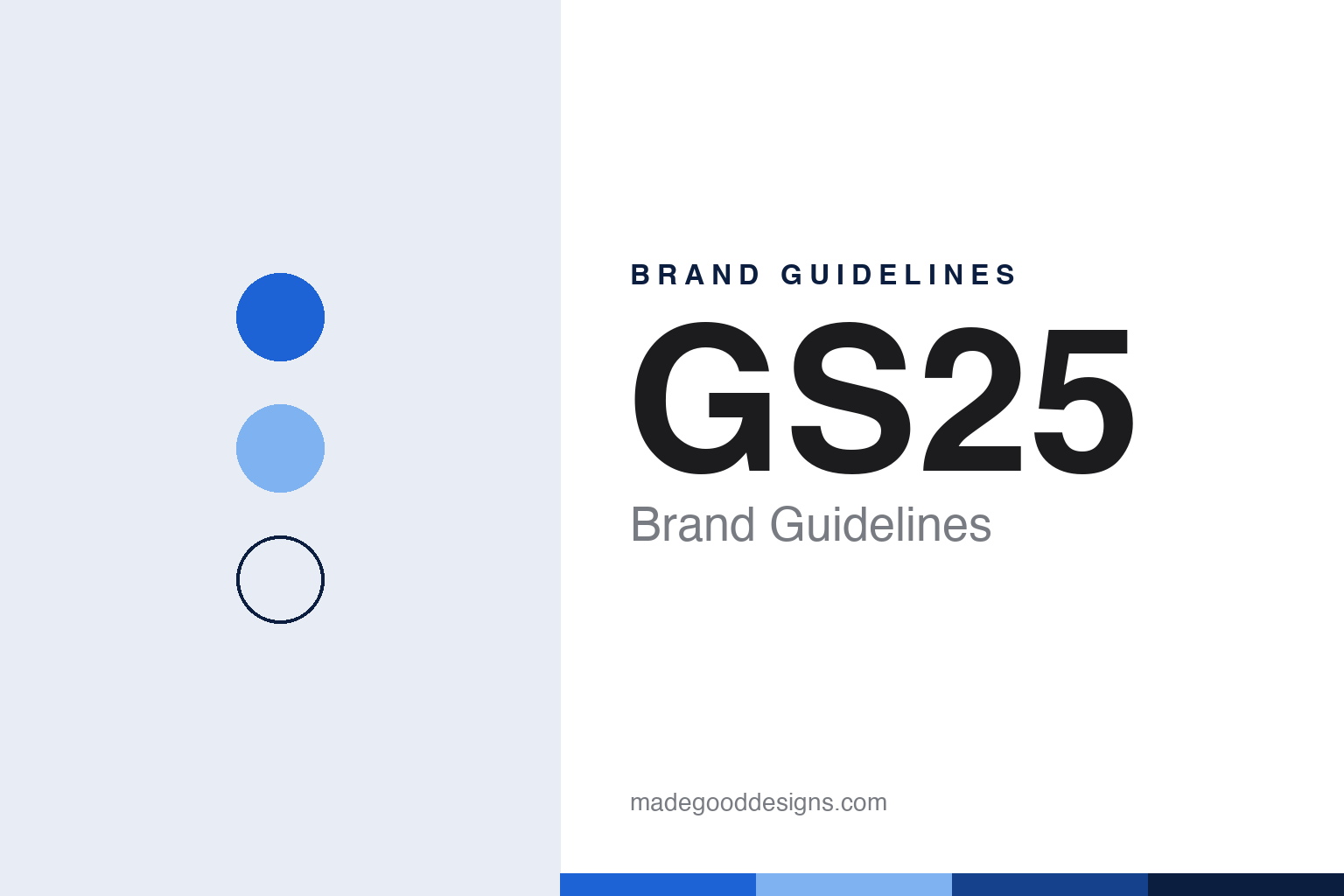
GS25 Brand Guidelines
LG25’s 1990 Kyunghee store, renamed in 2005 and redrawn in blue.
Aa
Two constants: a two-blue palette and a bold grotesque register. Abstract homage — not a GS25 product or mark; no logo, fascia or pack is reproduced.
LG25
A store by a university gate, then a change of group.
GS25 began as LG25. Its first store, the LG25 Kyunghee branch, opened in December 1990 in front of Kyung Hee University in Dongdaemun-gu, Seoul, The Asia Business Daily reported in January 2020, as the chain marked its 30th year. The operator was part of the LG group: Korean Wikipedia traces GS Retail to Lucky Supermarket, whose first store opened in 1974, and says the company took the name LG Distribution in 1991, later running LG department stores, LG Mart hypermarkets and LG supermarkets alongside the convenience stores.
The present name came with a split in the group. In 2004 the business was divided from the LG group and placed under GS Holdings, and in March 2005, with the launch of the GS Group, the company became GS Retail, according to Korean Wikipedia. Its store brands were renamed at the same time: LG Mart became GS Mart, the LG supermarkets became GS Supermarket and LG25 became GS25. English Wikipedia describes the change in the same way, as a rename that followed GS Group’s separation from LG.
GS Retail has kept growing beyond convenience stores. Korean Wikipedia says it listed its shares on the Korean securities market in December 2011, absorbed Watsons Korea in 2017 and merged with GS Home Shopping in July 2021. English Wikipedia gives GS25’s head office as the GS Tower in Seoul’s Gangnam district. Korean Wikipedia lists the company’s present brands as including GS25, the GS THE FRESH supermarkets, the GS SHOP home-shopping channel and the pet store aboutPet, so the convenience chain is one part of a wider retail business.
At the end of 2024 GS25 had 18,112 stores nationwide, Chosun Biz reported in August 2025, against 18,458 for its rival CU; the same report described the two chains as close competitors in convenience retailing.
Colour
Own labels at home, franchise partners abroad.
A GS25 shop is a place for drinks, snacks and quick meals. English Wikipedia mentions flavoured milks, iced drinks, Korean snacks, ramen, fish cakes and kimbap, as well as products the chain develops itself. The Korea Herald reported in March 2025 that GS25’s own-label range is sold under the name YouUs, and that GS Retail exported its products to 30 countries. Coffee is sold under the Cafe25 name, according to The Asia Business Daily, which reported in January 2020 that the chain had begun exporting its own-label products in August 2017 and that its Vietnamese business had reached 57 stores in 2019.
GS25 left South Korea in January 2018, when its first Vietnamese store, GS25 Emprise Tower, opened in Ho Chi Minh City, The Asia Business Daily reported in August 2023. The Vietnamese business works with a local partner, Son Kim Retail, and began taking franchisees in 2021; it had 211 stores at the end of July 2023, the same report said. By January 2025 GS25 had 355 stores in Vietnam, The Korea Herald reported.
Mongolia followed. English Wikipedia says GS25 opened there on 18 May 2021 with three stores in Ulaanbaatar, run by Digital Concept, a company set up by the local Shunkhlai Group with GS Retail that holds the master franchise. The Korea Herald counted 270 Mongolian stores as of January 2025. In November 2026 Money Today visited a new GS25 fresh-food factory on the outskirts of Ulaanbaatar, on a site of 8,960 square metres, which it said had been fully running since July 2026, cooking rice shipped from Dangjin in South Korea for kimbap, triangle kimbap and lunch boxes.
Typography
Design and documentation.
South Korea’s large retailers tend to present themselves through formats before slogans. A single group may run hypermarkets, warehouse stores, supermarkets, convenience stores and online malls side by side, each with its own name on the fascia, and corporate pages usually open with a timeline: the first branch, the district it stood in, the year it opened, and then each new format as it was added.
The big-box stores carry much of their identity on the shelf. Hypermarkets sell groceries alongside clothing, household goods and electronics under one roof, and own labels give them names to point to in the aisle, from value ranges to premium ready meals. Warehouse formats lean on large packs and goods shown in boxes or on pallets, so that the display itself signals the way the store sells.
Department stores and convenience chains work at opposite scales. Department-store groups put their weight into the building, the façade and the flagship in a city centre, while convenience chains rely on a short name and a bright fascia that has to read from a street corner and repeat across a large network of small shops. Beauty and lifestyle chains, and the apps that sit alongside all of these stores, carry the same names into a much smaller frame.
Behind the shop fronts sit corporate structures that the companies set out in plain terms: founding groups, spin-offs, joint ventures with foreign retailers, private-equity owners and listings on the Korea Exchange. Names have changed as partners arrived or left, and some chains have gone through court-supervised rehabilitation. For a designer, that history explains why a fascia, a logotype or an own-label pack looks the way it does today.
Aa
A bold grotesque, compact and square-shouldered. (Specimen set in Archivo, a sans STAND-IN; NOT the GS25 logo or wordmark.)
GS25
Twenty-four hours, plus one.
The GS25 sign was redrawn in March 2019, the first new brand image for the chain since the 2005 rename, the Korean business daily Etoday reported that month. GS Retail kept the GS25 name and gave it new meaning: the company said the number 25 stands for a convenience store open 24 hours plus one extra hour of service, and to show that “plus one,” the new design adds a point at the one o’clock position. According to the same report, the main colour was set in the blue family after customer research, with “GS” and “25” in blues of different saturation, and new shop signs carry the words “LIFESTYLE PLATFORM”. The new signs went first onto newly opened and refurbished stores from April 2019.
A 2021 report in The Asia Business Daily added the company’s explanation of the rest of the mark: the point sits on the numeral 5, and the right-angled frames on either side of the logo stand for a welcome awning over a shop door. English Wikipedia notes that most stores still carried the older identity in August 2019.
The 2019 change also covered GS Retail’s supermarkets, which became GS THE FRESH, a name chosen to link the shops with the GS Fresh online store, set in a dark green with a plain typeface, Etoday reported.
For a design guide, GS25 shows how a number can carry a brand story and how a chain can rename and redraw its fascia while keeping thousands of shops trading. Compare CU, the chain whose store count Chosun Biz set beside GS25’s, and Emart24, another Korean convenience chain. For this guide we use a clear blue, a sky tint and an ink blue with a sans, an unofficial interpretation; no product or logo is reproduced.
Explore & save
Keep GS25’s identity on hand — save it to a board in the Made Good inspiration library.
GS25 identity set
Pin the GS25 two-blue palette and the bold grotesque register to your own board.