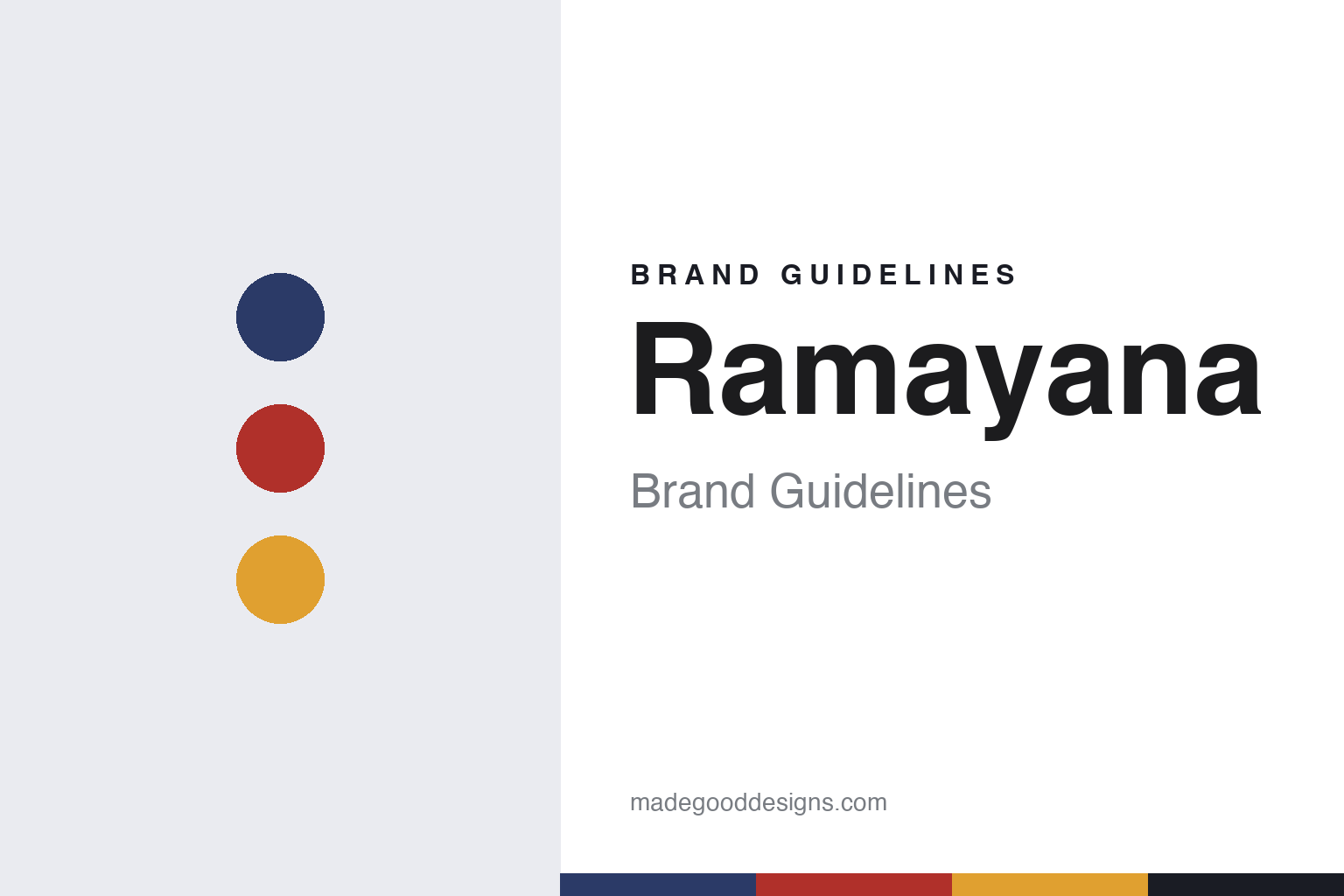
Ramayana Brand Guidelines
A Jalan Sabang clothes shop that became a chain across the archipelago.
Aa
Two constants: an indigo, red and saffron palette and a geometric sans register. Abstract homage — not a Ramayana product or mark; no logo, fascia or label is reproduced.
Jalan Sabang
A Central Jakarta clothes shop, then Blok M.
Ramayana started as a clothing shop on Jalan Sabang in Central Jakarta. Indonesian Wikipedia names three founders, Paulus Tumewu, Tan Lee Chuan and Agus Makmur, and dates the opening of the Ramayana Fashion Store to 1974, with about 40 staff and a self-service, general-store approach that was then becoming familiar to shoppers. English Wikipedia places the shop’s origins in the early 1970s and the move to self-service in 1974. Both editions say that a second store opened at Blok M in Jakarta in 1978, when the range widened to accessories, bags and shoes.
The company came later. PT Ramayana Lestari Sentosa was established on 14 December 1983 to run the business as a department-store company, both Wikipedia editions say. In 1985 Ramayana opened its first store outside Jakarta, in Bandung, according to Indonesian Wikipedia.
Growth picked up in the late 1980s. In 1989 the company started a second department-store name, Robinson, aimed at lower- and middle-income shoppers, and began selling household goods, stationery and toys. Indonesian Wikipedia says the two chains had 20 stores in eight cities by 1992, 16 of them Ramayana, and 45 stores in 15 cities by 1995, with a combined floor area of about 193,000 square metres. From 1993 the stores were developed around a one-stop-shopping idea, with a broad range under one roof at affordable prices, the same source says.
Ramayana Lestari Sentosa became a public company on 24 July 1996, offering 80 million shares; Paulus Tumewu kept about 63.2 per cent after the offering, according to both editions. The shares trade on the Indonesia Stock Exchange under the code RALS. After the listing, Indonesian Wikipedia says, Robinson was aimed at upper-middle-income shoppers, with stores at Plaza Depok and Plaza Tangerang.
Colour
Cahaya, new islands and SPAR.
On 1 November 1997 the company bought two chains from the Pembangunan Jaya Group: Cahaya Department Store, with ten stores, and the Jayasera chain, with six, giving it about 76 stores, Indonesian Wikipedia says. The same year it opened a store in Bali. The Asian financial crisis that began late in 1997 forced store closures and a rescheduling of expansion plans; afterwards the company concentrated its outlets in shopping centres rather than building its own stores, according to both Wikipedia editions. By 2002 the group had 81 outlets, 18 of them in its own buildings.
The chain then spread across the archipelago. Indonesian Wikipedia records the first Ramayana store on Sumatra at Bandar Lampung in 1999, on Kalimantan at Banjarmasin in 2000, on Sulawesi at Makassar in 2002 and in Papua at Abepura in 2010, by which time the company had 115 stores in 42 cities. From 2005 it added electronics and restaurants inside some stores.
In September 2014 the company joined the Dutch-based supermarket group SPAR International. The Jakarta Post reported on 11 September 2014 that Ramayana, which it described as a mid- to low-segment retailer, had made its membership of the SPAR chain official, so that it could build purchasing, warehousing, distribution, marketing and sales systems to SPAR’s standards for its supermarket business. At the time Ramayana operated 118 outlets across its Ramayana department stores and Robinson supermarkets, the paper said. Several Ramayana and Robinson supermarkets were converted to SPAR, but the agreement ended in 2017 and was not renewed, with the company citing consolidation, according to both Wikipedia editions.
Typography
Department stores and hypermarkets in Southeast Asia.
Department stores and hypermarkets in Thailand, Malaysia and Indonesia are usually met inside a larger building. Many sit as anchor tenants in shopping malls, so the store name appears twice: on the fascia above the entrance and again on the mall directory, the car-park signs and the shopping bags carried through the concourse. Some groups also run the malls themselves, which lets one family of names cover both the centre and the store inside it.
The calendar shapes much of what customers see. Retailers in the region publish their own campaigns around Chinese New Year, Hari Raya, Songkran, Deepavali, Christmas and year-end sales, and the store name is often paired with a seasonal theme for a few weeks before returning to its everyday colours. Shopping bags, price tags and in-store signs carry the same palette, so a chain’s colours can be read from across a mall.
Own-label ranges and loyalty programmes extend the name beyond the fascia. Several groups publish house brands for groceries, clothing or homeware, and many describe member cards and apps that collect points across the group’s stores. Store naming is usually plain: a chain name followed by the mall or district, so that a branch is known by its location as much as by its owner.
Corporate pages fill in the rest. Most of these companies set out their founders, founding dates, parent groups and stock-exchange listings on their own investor or corporate sites, and the national business press records acquisitions, renamings and closures as they happen. The guides in this set draw on those dated records and describe each name as its owner and the press present it.
Aa
A geometric sans for a chain of mall department stores. (Specimen set in Outfit, a sans STAND-IN; NOT the Ramayana logo.)
Ramayana
Ramayana Prime and a listed, family-held group.
In August 2017 the company announced that it would close eight stores, in places including Surabaya, Banjarmasin, Bogor and Pontianak, the business site Indonesia Investments reported in a column in late January 2018. The company said the closures were part of a shift to a one-stop-shopping concept, including cinemas run with a partner, and it had 116 stores as of 1 January 2018, the column said. It also described Ramayana Prime, a format introduced in late 2017 with its first store at City Plaza in East Jakarta, combining fashion shopping with a cinema and a food court; Wikipedia places that store in Jatinegara and records a second Ramayana Prime at Cibubur in April 2018. Since 2016 Ramayana has also sold through online marketplaces such as Tokopedia and Shopee, English Wikipedia says.
Store numbers have moved with the market. Indonesian Wikipedia says the company closed 16 supermarkets in 2017 and 19 stores in 2020–21, and that its Ramayana, Robinson and Cahaya department stores fell from 119 in 2017 to 102 in 2021, before new openings such as one in Semarang in 2022. English Wikipedia gives a 2021 count of 86 Ramayana department stores, 82 Robinson supermarkets and two Cahaya department stores. The company runs department stores under the Ramayana, Robinson and Cahaya names and supermarkets as Robinson Mart, Indonesian Wikipedia says. Its head office is in Jakarta, according to the company website.
The business combines goods the company buys outright with goods sold on consignment, on which it earns a sales commission; Liputan6 reported both revenue lines from the company’s first-quarter 2026 accounts on 14 May 2026. The same report said shareholders at the annual meeting on 11 May 2026 approved a dividend for 2025, and named PT Ramayana Makmursentosa, a property company, as the main shareholder.
For a design guide, Ramayana shows how one department-store name can carry several formats, from mall anchors to Ramayana Prime, with sister names alongside it. Compare Matahari, another department-store chain that began in Central Jakarta, and Alfamart, an Indonesian convenience-store chain. For this guide we use an indigo, a market red and a saffron with a sans, an unofficial interpretation; no product or logo is reproduced.
Explore & save
Keep Ramayana’s identity on hand — save it to a board in the Made Good inspiration library.
Ramayana identity set
Pin the Ramayana indigo, red and saffron palette and the geometric sans register to your own board.
Source & notes
Frequently Asked Questions
What font can I use to match the Ramayana look?
This guide describes Ramayana’s type as “A geometric sans for a chain of mall department stores”. Its type specimen is set in Outfit from Google Fonts as a stand-in; Outfit is not Ramayana’s own lettering.
What colours are in the Ramayana palette?
This guide’s Ramayana palette is Indigo #2B3A67, Market red #B0302A, Saffron #E0A030, Ink #1A1C24 and Paper #F7F4EF. The tones are the guide’s own unofficial interpretation, not official Ramayana hex codes.
When was Ramayana founded?
Ramayana was founded in 1974 (Ramayana Fashion Store), in Jalan Sabang, Central Jakarta.
Who founded Ramayana?
Ramayana was founded by Paulus Tumewu, Tan Lee Chuan and Agus Makmur in 1974 (Ramayana Fashion Store).