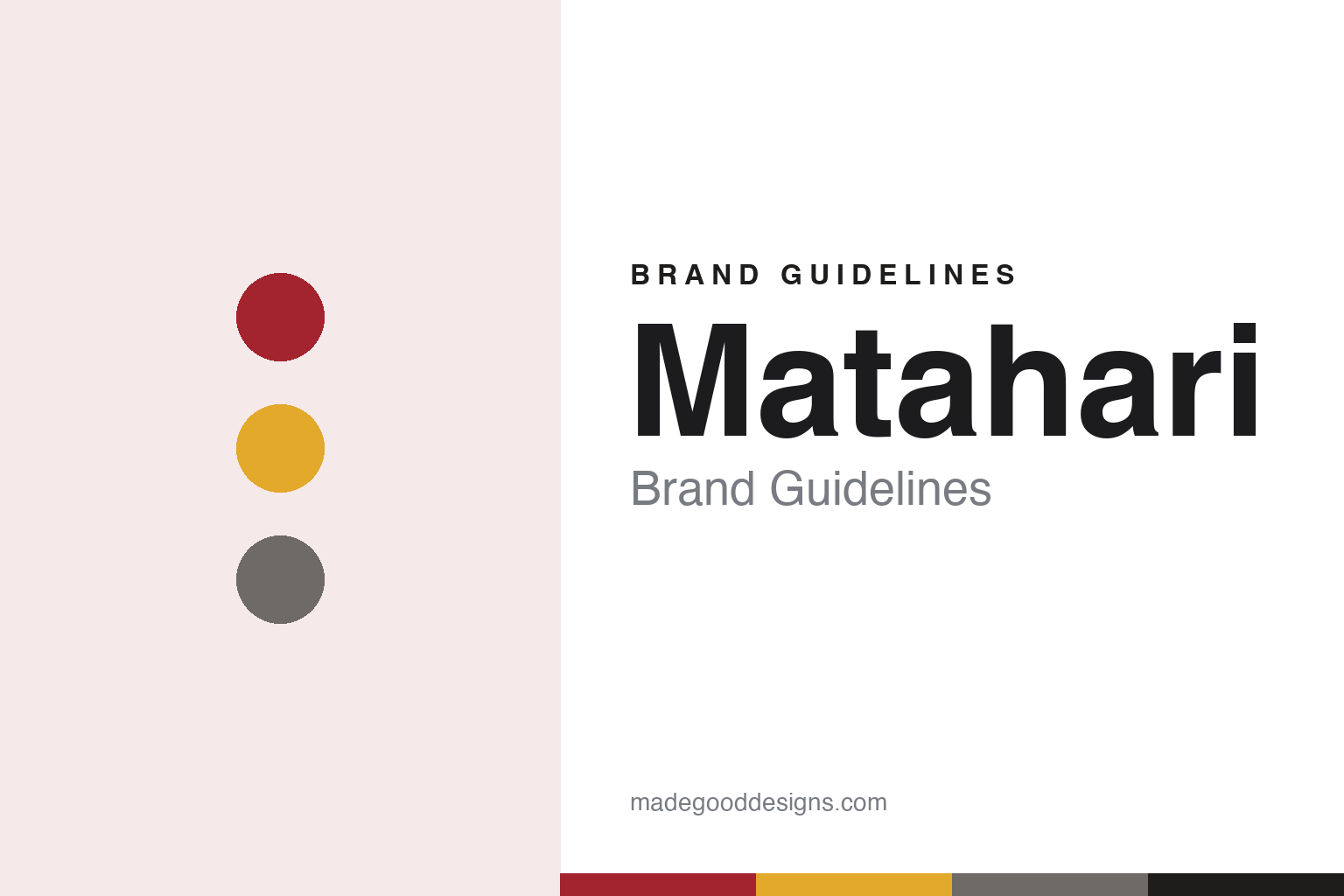
Matahari Brand Guidelines
A Pasar Baru shop, a Dutch store name and the same Matahari sign since 1973.
Aa
Two constants: a crimson, gold and warm grey palette and a modern sans register. Abstract homage — not a Matahari product or mark; no logo, fascia or label is reproduced.
From Mickey Mouse to Matahari
A Pasar Baru children’s shop and a Dutch store name.
Matahari’s story begins in Pasar Baru, a shopping district in Central Jakarta. Indonesian Wikipedia says that from 24 October 1958 Hari Darmawan, who had moved to Jakarta from Makassar, ran a family clothing shop of about 158 square metres called Mickey Mouse, selling children’s clothes, some imported and some sewn on the floor above. English Wikipedia gives the same date, 24 October 1958, as the founding of the business, and the company still counts its history from it.
The shop grew. Indonesian Wikipedia says Hari opened a business called Mamina in 1970 and a second Mickey Mouse branch in 1971, and that the Mickey Mouse name was later changed to MM Fashion, which was kept until 1987. In 1972, with a bank loan, he bought De Zon, a much larger general store nearby in Pasar Baru that had run into financial difficulty. De zon is Dutch for “the sun,” and its Indonesian word, Matahari, became the store’s new name on 15 December 1973, according to the same source. Hari later attached a second reading to the name: split as “mata-Hari,” it points to his own vision for the store, Indonesian Wikipedia says.
For several years there was a single Matahari store. Expansion beyond Jakarta began on 28 March 1980 with a store called Sinar Matahari in Bogor, Indonesian Wikipedia says, and during the 1980s Matahari opened stores in many cities. To bring them under one company, PT Matahari Putra Prima was set up on 11 March 1986, with Hari as president director, and it listed its shares on the Jakarta and Surabaya exchanges on 21 December 1992. At that point Matahari had 36 stores in 16 cities, according to the same source.
The 1990s brought new formats: the upscale Galeria, the Mega M hypermarket and the Super Ekonomi supermarket, along with ventures with the furniture retailer Courts in 1994 and with Marks & Spencer in 1996. Many stores added supermarkets, children’s play areas and Timezone game centres. By January 1997 the group had 84 outlets of various kinds in 30 cities, Indonesian Wikipedia says.
Colour
Lippo, Hypermart and a 2009 spin-off.
Control passed to the Lippo Group in March 1997, when Lippo’s listed company PT Multipolar Tbk bought 48.2 per cent of Matahari Putra Prima from Hari Darmawan and later raised its holding to 60 per cent, according to Indonesian Wikipedia; Hari took a stake in Multipolar in return. During the economic crisis of 1997–98 Matahari closed stores and restructured, folding its many formats into two: Matahari Department Store and Matahari Supermarket. English Wikipedia notes that Galeria had been run in partnership with Japan’s Keio department store.
New formats followed under Lippo. Indonesian Wikipedia says the group opened its own Hypermart hypermarket on 15 January 2004 and a Cut Price store on 1 February 2004, later closed, and that Matahari Supermarket became Foodmart in 2007. English Wikipedia records Parisian, a higher-end offshoot opened in 2007 at Taman Anggrek Mall in Jakarta and closed in 2009.
The listed company that trades as Matahari today has a different origin. Indonesian Wikipedia says it was founded on 1 April 1982 as PT Stephens Utama International Leasing Corporation, a Lippo finance venture. Renamed PT Lippo Pacific Finance in 1989, it listed on the Jakarta and Surabaya exchanges on 16 October 1989 under the code LPPF, which it still uses, and became PT Pacific Utama in 1999. In September 2009 Matahari Putra Prima announced that it would move its department-store business into Pacific Utama; the transfer, covering 87 Matahari department stores, was completed on 25 November 2009, and Pacific Utama then took the name PT Matahari Department Store Tbk. Matahari Putra Prima kept the corporate side and the grocery business, the same source says.
In 2010 the private-equity firm CVC Capital Partners, through its Meadow Asia vehicle, bought 98 per cent of the department-store company, a deal Indonesian Wikipedia says was completed on 1 April 2010. CVC sold down in stages from 2013, with Multipolar taking 24.9 per cent in March of that year, and had left the shareholder register by 2015, according to the same source.
Typography
Department stores and hypermarkets in Southeast Asia.
Department stores and hypermarkets in Thailand, Malaysia and Indonesia are usually met inside a larger building. Many sit as anchor tenants in shopping malls, so the store name appears twice: on the fascia above the entrance and again on the mall directory, the car-park signs and the shopping bags carried through the concourse. Some groups also run the malls themselves, which lets one family of names cover both the centre and the store inside it.
The calendar shapes much of what customers see. Retailers in the region publish their own campaigns around Chinese New Year, Hari Raya, Songkran, Deepavali, Christmas and year-end sales, and the store name is often paired with a seasonal theme for a few weeks before returning to its everyday colours. Shopping bags, price tags and in-store signs carry the same palette, so a chain’s colours can be read from across a mall.
Own-label ranges and loyalty programmes extend the name beyond the fascia. Several groups publish house brands for groceries, clothing or homeware, and many describe member cards and apps that collect points across the group’s stores. Store naming is usually plain: a chain name followed by the mall or district, so that a branch is known by its location as much as by its owner.
Corporate pages fill in the rest. Most of these companies set out their founders, founding dates, parent groups and stock-exchange listings on their own investor or corporate sites, and the national business press records acquisitions, renamings and closures as they happen. The guides in this set draw on those dated records and describe each name as its owner and the press present it.
Aa
A modern sans for a store name unchanged since 1973. (Specimen set in Plus Jakarta Sans, a sans STAND-IN; NOT the Matahari logo.)
Matahari
A corporate rename in 2026, and the same store name.
Since 14 July 2021 the majority and controlling shareholder has been Auric Digital Retail Pte. Ltd., with Multipolar remaining one of the main shareholders, according to English and Indonesian Wikipedia. The head office is at Lippo Village in Tangerang, Banten, Indonesian Wikipedia says.
In April 2026 the company formally changed its corporate name to PT MDS Retailing Tbk. Marketing-Interactive reported on 28 April 2026 that the change applied at corporate level only, and that the stores, formats and brand names, Matahari among them, would stay as they were. The publication described a portfolio with Matahari Department Store as its mass-market anchor for family fashion and lifestyle goods; SUKO, focused on minimalist, functional essentials; ZES, aimed at urban shoppers with a contemporary look; and MU+KU, a curated multibrand format. Own labels named in the same report include Nevada, COLE, Connexion and Little M. It gave the network as more than 140 stores in nearly 80 cities; Indonesian Wikipedia, citing 2025 figures, says Matahari is present in 30 of Indonesia’s 38 provinces. English Wikipedia adds that the chain also sells online through Matahari.com.
The visual identity has changed more than once. Indonesian Wikipedia says the store image and logo were redone in 2000 around a dominant blue, at the same time as the launch of the Matahari Club Card, and that since May 2009 Matahari has used a refreshed logo in grey and red, aimed at a more upmarket image. The store name itself has stayed the same since 1973.
For a design guide, Matahari shows how a store name can stay fixed while the companies behind it change: a family shop, a Lippo-controlled group, a spin-off into a former finance company, private-equity ownership and a 2026 corporate rename. Compare Ramayana, another department-store chain that began in Central Jakarta, and Indomaret, an Indonesian convenience-store chain. For this guide we use a deep crimson, a sun gold and a warm grey with a sans, an unofficial interpretation; no product or logo is reproduced.
Explore & save
Keep Matahari’s identity on hand — save it to a board in the Made Good inspiration library.
Matahari identity set
Pin the Matahari crimson, gold and warm grey palette and the modern sans register to your own board.