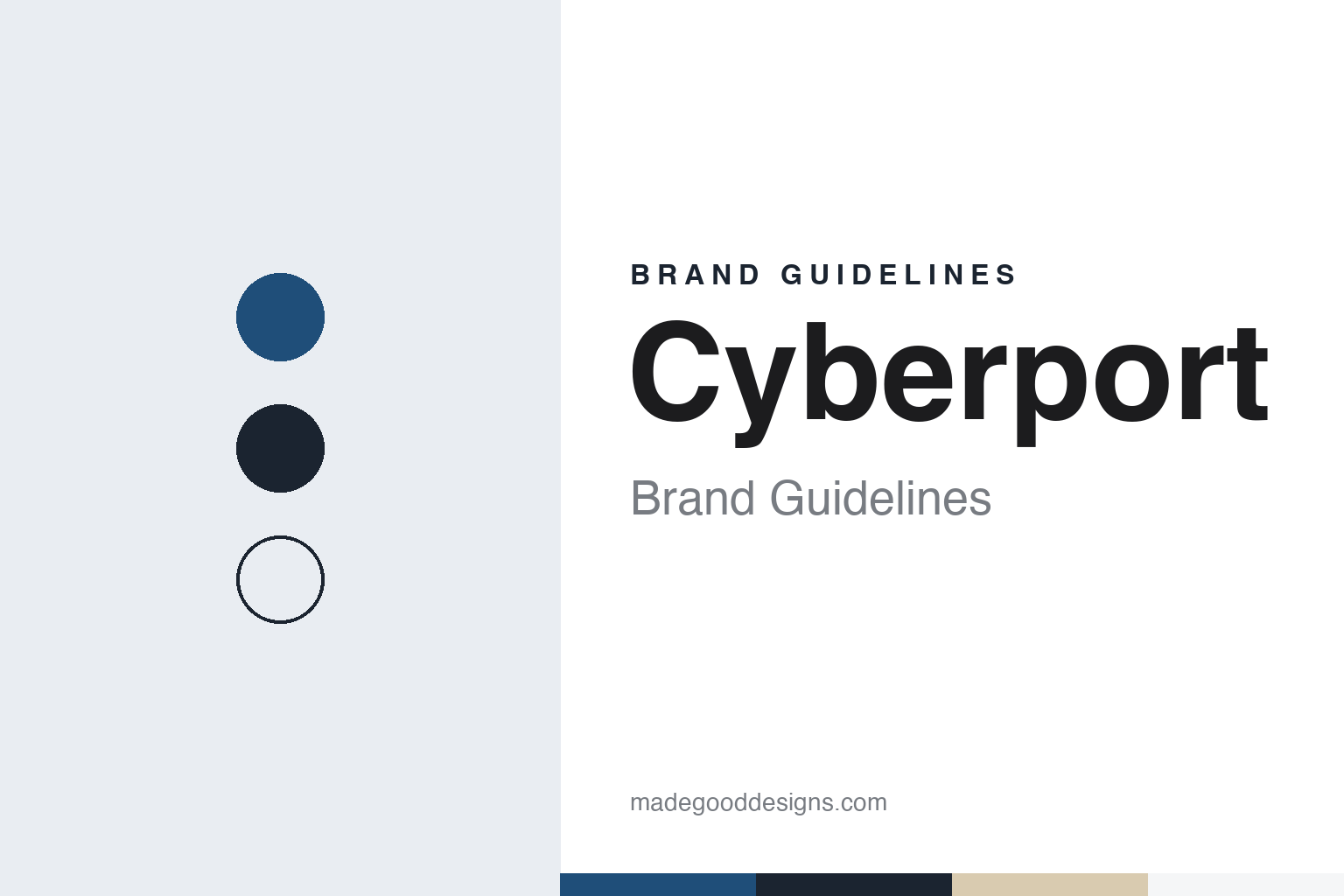
Cyberport Brand Guidelines
The Dresden Apple web shop that became a Burda business.
Aa
Two constants: a Cyberport deep blue and sandstone palette and a Geometric sans register. Abstract homage — not a Cyberport product or mark; no logo or shop sign is reproduced.
A Dresden Start-Up
Apple computers, sold online from Saxony.
Cyberport is an electronics retailer based in Dresden, the Saxon capital. German Wikipedia says Cyberport GmbH was founded there in September 1998 by the brothers Jörg and Olaf Siegel together with Jörg Holzmüller, and that it began by selling Apple computers over the internet. As sales grew it added other brands. The name is not to be confused with Cyberport in Hong Kong, a business park with no link to the German company.
In its early years Cyberport also built computers. German Wikipedia, citing Saxon newspapers of 1999, says the company moved into PC production that year and presented a computer made entirely in Saxony, while pushing sales of PCs configured to each customer’s order; besides Windows, the software company Red Hat certified its Linux distribution for the Dresden firm’s computers, a step reported in the trade weekly Computerwoche in November 1999.
Money from a publisher followed. German Wikipedia says Hubert Burda Media, the Munich-based media group, bought 15 percent of Cyberport in 1999. On 20 September 2000 the marketing weekly Horizont reported that the Burda Beteiligungs-Holding had taken a majority of the “Dresden start-up Cyberport.de,” which Burda had backed since 1999 as a venture investor. A stock-market listing had also been discussed before Burda’s arrival, German Wikipedia says, but it did not happen after the dot-com bubble burst. One of the founders left in 2001; Olaf Siegel stayed, and Burda later said he ran the company for almost fifteen years before moving to its advisory board.
Colour
From web shop to Cyberport Stores.
Cyberport opened its first shop at its own head office in Dresden in 2003, at the Waldschlösschen site, the local news site Oiger reported in October 2012. German Wikipedia says it expanded to Berlin and other cities, and that a Leipzig store, bigger than any it had opened before, followed in 2009. Its shops are called Cyberport Stores.
By November 2011 there were four shops, in Dresden, Leipzig and two in Berlin, heise online reported, when Cyberport opened its first store outside Germany: about 700 square metres in the station shopping centre at Wien Westbahnhof, Vienna’s western railway station. At the same time it began a cooperation with the Austrian electronics chain Niedermeyer, under which customers could order from the Austrian web shop and collect their goods at Niedermeyer branches, starting with nine branches around Vienna and Graz.
Dresden got a second store in October 2012, with about 750 square metres in the Elbepark shopping centre, Oiger reported. German Wikipedia says the network reached 14 locations in Germany and Austria in 2016. Burda’s page on the brand, read in November 2026, lists nine Cyberport Stores in the two countries, alongside sales through the web shop and by telephone, to private and business customers.
Behind the shops sits a logistics business. German Wikipedia says Cyberport built a new logistics centre at Siebenlehn, in central Saxony, after adding household appliances such as fridges and washing machines to its range. Burda says a second hall, opened in July 2023, doubled the area of that central warehouse. Cyberport also widened its range of consumables: German Wikipedia says that in 2017 it bought HQ Patronen, an online seller of toner, ink and office supplies.
Typography
Design and documentation.
Consumer-electronics retailers present themselves first through the store. Many trade from large units on the edge of towns, with long aisles divided into product areas such as computing, television, sound, phones and kitchen appliances. Trade reports describe how these floors are laid out for trying things: in 2017 Tweakers described Coolblue’s first XXL store in Amsterdam as six product areas, and in 2026 Républik Retail described a Boulanger store near Lille with a playable gaming area and a seated space for watching projectors.
Delivery is part of the public face. Some chains run their own vans for large appliances and installation, and Coolblue says it added its own bicycle delivery service in cities in 2018. Online shops, click-and-collect counters and services for repair, trade-in, rental and refurbished goods are presented beside the shelves, often under names of their own that sit next to the shop name on signs and websites.
Naming follows a similar pattern. A chain usually keeps one short shop name and adds own-label ranges with separate names, so a single store can carry the retailer’s brand, its house labels and many outside makers side by side. French Wikipedia, for example, dates Boulanger’s Listo and Essentiel B labels to 2005. When a chain buys a rival abroad, it may keep the local name, as Boulanger did with Krëfel in Belgium after 2019.
Behind the shop fronts sit corporate pages. These usually give a founding story, the current owner and any stock-market listing or plan for one, and some owners publish their own announcements of changing stakes. This guide sets out what dated sources say about each company’s founders, owners and listings, and treats the companies’ own descriptions as their claims.
Aa
A geometric sans — a web-era name from 1998. (Specimen set in Manrope, a sans STAND-IN; NOT the Cyberport logo.)
Cyberport
A Burda business with two brands.
Burda completed its ownership in 2017. In a company announcement that year, Hubert Burda Media said it had bought the remaining two percent of Cyberport from the co-founder Olaf Siegel, making Burda the sole owner; it repeated that it had held a stake since 1999 and a majority since 2000.
The legal form changed in 2023. Burda says the conversion of Cyberport GmbH into a European company, Cyberport SE, was completed on 23 May 2023, with Burda remaining its sole shareholder. Under that holding company sit three subsidiaries, Burda says: a retail company running the stores in Germany and Austria, a logistics and shipping company, and an IT-services company for business customers.
The same year Cyberport gained a sister brand under the same roof. Burda announced that Computeruniverse, another consumer-electronics retailer in its BurdaCommerce division, would be run within one company with Cyberport, while both continued as separate brands; Computeruniverse’s logistics moved to Siebenlehn from the autumn of 2023, and its site at Friedberg, in Hesse, and Cyberport’s in Dresden were both kept. German Wikipedia says Computeruniverse was integrated into Cyberport SE in September 2023.
In its home city the name is now on a sports hall. In October 2026 t-online reported that Dresden’s multi-purpose hall on Bodenbacher Straße, home of the Dresdner SC volleyball team, had been renamed the Cyberport Arena, with the retailer replacing a mineral-water maker that had held the naming rights since 2007. The report described Cyberport as founded in Dresden in 1998, based there, and part of the Burda group.
No colour or typeface for the brand is documented in the sources used here, so the palette is our own: a deep blue for the Elbe and a sandstone for Dresden’s old town.
For a design guide, Cyberport shows how a web-era name can move into shop fronts, a logistics hub and a sports hall. Compare Notebooksbilliger, another German online electronics retailer that opened stores, and MediaMarkt, the German store chain. For this guide we use a deep blue and a sandstone with a sans, an unofficial interpretation; no product or logo is reproduced.
Explore & save
Keep Cyberport’s identity on hand — save it to a board in the Made Good inspiration library.
Cyberport identity set
Pin the Cyberport deep blue and sandstone palette and the Geometric sans register to your own board.