Empik Brand Guidelines
A 1948 press and book club that grew into a Polish culture chain.
Aa
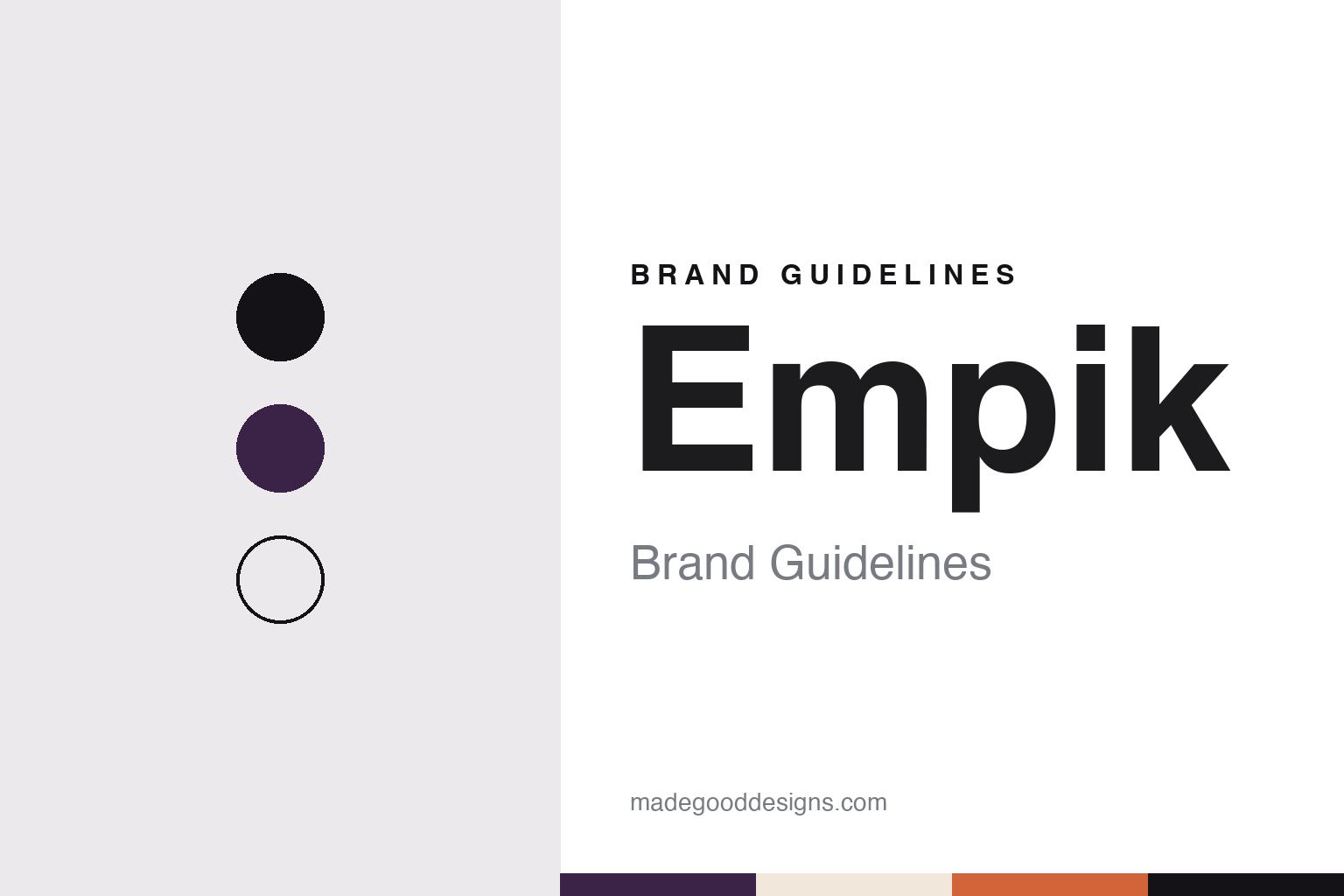
Two constants: an Empik plum, oat and brick orange palette and a Clean sans register. Abstract homage — not an Empik product or mark; no logo, sign or shop image is reproduced.
KMPiK, 1948
Clubs of the International Press and Book.
Empik’s name is an abbreviation spoken aloud. In 1948, Polish Wikipedia says, the main board of the workers’ publishing cooperative “Prasa” set up a nationwide network of culture houses and bookshops called the Klub Międzynarodowej Prasy i Książki, the International Press and Book Club, or KMPiK. Polish Wikipedia derives the name Empik from KMPiK; English Wikipedia gives the shorter form MPiK. Either way, the letters “em-pik” became the brand.
The clubs became a company in 1991. Polish Wikipedia says the company Empik was set up in 1991 by a representative of the press concern RSW “Prasa-Książka-Ruch”, the businessman Janusz Romanowski and Ronny Bruckner, and that RSW brought 74 KMPiK outlets into it. In 1994 the Dutch-registered group Eastbridge N.V. bought Empik from the State Treasury, the same source says. Polish Wikipedia also recalls two features of the 1990s shops: perfume departments, which later became separate stores in the same shopping centres, and multimedia departments that, at the end of the decade, included internet cafés with paid access to computer games.
Polish Wikipedia describes Empik today as carrying on the tradition of the press and book clubs as places for popular culture, literature and music, with author meetings, premieres and other events held in its shops and online. Since 1999 the chain has also given annual awards based on its own sales of books, music, films and audio productions; they were originally called Asy Empiku and took their present name in 2008, Polish Wikipedia says.
Colour
From the Warsaw bourse to a management buy-out.
For two decades Empik sat inside a listed holding company. Puls Biznesu reported in October 2025 that Empik Media & Fashion was listed on the Warsaw Stock Exchange from 1997 to 2016. Polish Wikipedia says that in 2011 the chain was run within NFI Empik Media & Fashion, formerly NFI Hetman and controlled by Eastbridge, a group that also managed international fashion and beauty franchises in Poland and the Smyk toy chain.
Ownership then moved to a Central European investment firm. Puls Biznesu reported that Penta Investments took control of Empik in 2012, and the media-trade site Wirtualnemedia reported in August 2022 that Penta, present in the company since 2012, bought the remaining shares four years later and took the group off the Warsaw exchange. Wirtualnemedia also listed what changed under the chief executive who took over in 2015: the group sold the Smyk chain and the Empik School language schools, bought the ticketing platform Going., and, some years earlier, entered publishing by buying the Wilga, Buchmann and W.A.B. imprints, combined as Grupa Wydawnicza Foksal.
In August 2022 the chief executive, Ewa Szmidt-Belcarz, agreed to buy 51% of the Empik Group from Penta in a management buy-out, Wirtualnemedia reported, with Penta keeping 49% and the deal then awaiting clearance from the Polish competition authority. Puls Biznesu confirmed in October 2025 that she has held the majority stake since 2022 and that Penta holds the other 49%. The company did not change its management structure or strategy with the deal, Wirtualnemedia reported.
The loyalty scheme changed too. Wirtualnemedia reported in 2022 that a free version of the subscription service Empik Premium, mainly offering free delivery from the online shop, had replaced the earlier Mój Empik loyalty programme, and that the group had launched the subscription services Empik Go, for audiobooks and podcasts, and Empik Music.
Typography
Design and documentation.
Bookshop chains in Europe and Asia tend to present themselves through places before products. Many keep one older or larger shop at the centre of their story, a flagship on a named street that appears in their histories, their photographs and often their anniversaries. In Lisbon, Bertrand’s Chiado shop on Rua Garrett plays that part; in Madrid, Casa del Libro’s building on the Gran Vía does the same. For a design reader, the flagship is where a chain’s colours, signs and lettering are seen at their largest.
Inside the shops, the companies describe spaces for reading and meeting as much as shelves. Chains publish details of rooms for book launches and talks, children’s sections and floors given over to single subjects, and some describe places where visitors can sit with a book. These spaces are part of how a bookseller explains what it is for, and they usually carry the same signs and colours as the shop floor.
Most large chains now run loyalty or members’ programmes and an online shop alongside the physical stores. Membership cards, members’ areas on a website and online marketplaces are described by the companies themselves, and the scale of such programmes is checked in these guides against dated press reports rather than marketing pages. Store and imprint naming is usually plain: many chains carry a founder’s surname, a city, or a simple description of a house of books, and a publishing imprint may sit under the same group as the shops.
Corporate pages fill in the rest: founders, owners, listings and the publishing groups that sit behind many chains. Ownership often changes more often than the shop signs do, so the guides in this series date each change of owner to an independent source, describe each name and colour as documented, and treat the palettes shown here as unofficial interpretations.
Aa
A clean sans for a chain that sells books, music and tickets. (Specimen set in Inter Tight, a sans STAND-IN; NOT the Empik logo.)
Empik
Shops, a marketplace and a modernist pavilion.
Empik also trades online. Polish and English Wikipedia say the Empik.com marketplace, where outside sellers list goods alongside Empik’s own range, opened in April 2017, and that Empik Go, for audiobooks, e-books and podcasts, launched the same year. Empik Go’s own e-reader, the GoBook, appeared in 2021, followed in 2023 by the GoBook 2.0, made with PocketBook, according to the same sources.
Its shops have moved into some notable buildings. In 2019, Polish Wikipedia says, Empik opened at Rynek Główny 23 in Kraków’s market square, an address where bookselling goes back to 1610. In December 2024, Polish Wikipedia says, it opened its flagship, Empik Marszałkowska, in the former Cepelia pavilion in central Warsaw. The retail trade site dlahandlu.pl reported on 2 December 2024 that the modernist pavilion had regained its 1960s appearance after several months of renovation, and that the shop would cover about 1,300 square metres on three levels, with a reading room overlooking the city centre and a Klub Empik space for author meetings, signings and concerts; the modernisation was designed by the AMC studio of Andrzej M. Chołdzyński and carried out by Bernatek Architekci. The same report said a second Warsaw shop, on Plac Bankowy, had opened on 6 December 2024 on a corner where a bookshop had traded for decades.
The network has grown in steps. Polish Wikipedia gives 289 shops as of 17 January 2021, and Puls Biznesu put the network at 370 shops in October 2025. The book-trade magazine Rynek Książki reported in October 2026 that Empik had opened its 400th shop in Poland, a 213-square-metre store in the Stara Papiernia centre in Konstancin-Jeziorna that also serves as a pick-up point for online orders.
For a design guide, Empik shows how an acronym can become a retail brand: a name taken from 1948 club initials, carried through a state network, a listed holding company and a management buy-out, and now placed in a restored modernist pavilion. Compare Fnac, another chain that sells books next to music and tickets, and Casa del Libro, a national bookshop chain from Spain. For this guide we use a deep plum, an oat and a brick orange with a sans, an unofficial interpretation; no product or logo is reproduced.
Explore & save
Keep Empik’s identity on hand — save it to a board in the Made Good inspiration library.
Empik identity set
Pin the Empik plum, oat and brick orange palette and the Clean sans register to your own board.