Coolblue Brand Guidelines
The Rotterdam webshop that delivers its own parcels.
Aa
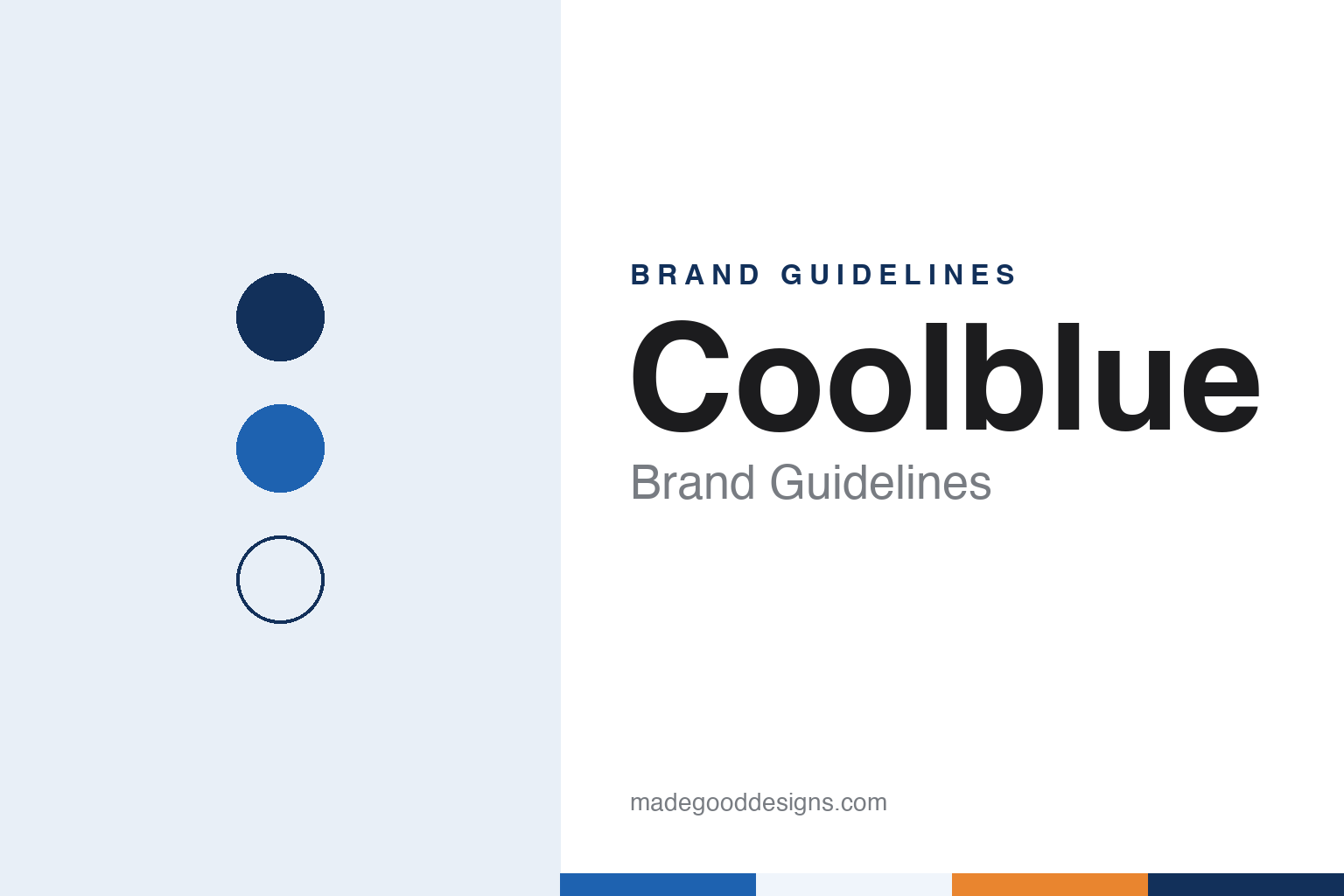
Two constants: a clear blue, deep blue and tangerine palette and a friendly sans register. Abstract homage — not a Coolblue product or mark; no logo, van livery or packaging is reproduced.
MP3man.nl, 1999
Three students, several webshops and one name.
Coolblue was founded in 1999 by Pieter Zwart, Paul de Jong and Bart Kuijpers, according to both English and Dutch Wikipedia, which place the start in Rotterdam. The company’s own history says it began in Zwart’s student room and that the first webshop was MP3man.nl. English Wikipedia says the business grew as a set of separate single-subject shops, among them PDAshop.nl and Laptopshop.nl, and that all the domains were merged into coolblue.nl in 2018.
The name was a reply to another shop. English Wikipedia says Coolblue is meant as the opposite of Hot-Orange, an online department store that outsourced its operations, relied on outside finance and had no customer service; the founders wanted to do the reverse, and chose the name to say so.
The company dates its first step abroad to 2004, with deliveries to Belgium, and says it had opened four physical stores in the Netherlands by 2008. English Wikipedia says all the shares were held by the three founders until 2016. The Dutch trade magazine Twinkle reported on 1 April 2016 that the Rotterdam investment company HAL had taken a minority stake of 20 per cent, becoming the fourth shareholder.
HAL’s stake then rose in steps that its parent, HAL Holding, announced itself. On 6 July 2017 it went to 30.1 per cent, bought from two of the three founders; on 14 June 2019 Zwart and HAL bought all the remaining shares of the two other founders, taking HAL to 49 per cent, with the rest held by Zwart and management. On 1 October 2021 Coolblue announced a plan to list its shares on Euronext Amsterdam; on 13 October 2021 it postponed the listing until further notice, citing market conditions for e-commerce listings, HAL Holding said. RetailDetail reported on 30 August 2024 that Zwart had sold a further 7.5 per cent to HAL to fund growth in Germany, giving HAL a majority of 56.4 per cent.
Colour
A warehouse, vans, bikes and larger stores.
Coolblue built much of its own delivery chain. English Wikipedia says it began with a distribution centre in Capelle aan den IJssel and moved to a new one in Tilburg, dated to 2013 by Wikipedia and to 2015 by the company, which says the building grew from 13,000 square metres to more than 88,000 by 2017. In 2016 the company launched CoolblueDelivers (CoolblueBezorgt in Dutch), its own van network for large appliances, with installation. In 2018 came CoolblueBikes, a bicycle delivery service in cities, and the company has since bought the route-planning software firm Plotwise, in 2022, and added more than 200 robots to its warehouse in 2025.
The stores grew larger over time. Tweakers reported on 24 November 2017 that Coolblue had opened its first XXL store in Amsterdam, an extension of an existing shop on the Gustav Mahlerlaan with 1,700 square metres of floor, five times its earlier size. It was divided into six areas: laptops, computers and networking; televisions; sound; phones, tablets and wearables; coffee machines; and white goods. Coolblue then had eight stores, in Rotterdam, Eindhoven, Groningen, Utrecht, Amsterdam, Wilrijk, Lochristi and Zaventem. RetailDetail reported in February 2025 that it opened eight more stores in 2024, including its first in Wallonia, and Dutch Wikipedia counted 40 stores in the Netherlands, Belgium and Germany in June 2026.
The range has spread beyond electronics. English Wikipedia says the company sells and installs solar panels and charging points, and that it announced its own energy supply, Coolblue Energie, in January 2021; the company says it bought the energy firm ServiceHouse to support that launch. In February 2025, RetailDetail reported, the energy business was reshaping itself as a full installation service, fitting heat pumps and air-conditioning as well.
Typography
How consumer-electronics retailers present themselves.
Consumer-electronics retailers present themselves first through the store. Many trade from large units on the edge of towns, with long aisles divided into product areas such as computing, television, sound, phones and kitchen appliances. Trade reports describe how these floors are laid out for trying things: in 2017 Tweakers described Coolblue’s first XXL store in Amsterdam as six product areas, and in 2026 Républik Retail described a Boulanger store near Lille with a playable gaming area and a seated space for watching projectors.
Delivery is part of the public face. Some chains run their own vans for large appliances and installation, and Coolblue says it added its own bicycle delivery service in cities in 2018. Online shops, click-and-collect counters and services for repair, trade-in, rental and refurbished goods are presented beside the shelves, often under names of their own that sit next to the shop name on signs and websites.
Naming follows a similar pattern. A chain usually keeps one short shop name and adds own-label ranges with separate names, so a single store can carry the retailer’s brand, its house labels and many outside makers side by side. French Wikipedia, for example, dates Boulanger’s Listo and Essentiel B labels to 2005. When a chain buys a rival abroad, it may keep the local name, as Boulanger did with Krëfel in Belgium after 2019.
Behind the shop fronts sit corporate pages. These usually give a founding story, the current owner and any stock-market listing or plan for one, and some owners publish their own announcements of changing stakes. This guide sets out what dated sources say about each company’s founders, owners and listings, and treats the companies’ own descriptions as their claims.
Aa
A friendly sans with round shapes and firm weight. (Specimen set in Rubik, a sans STAND-IN; NOT the Coolblue logo.)
Coolblue
A name chosen as an answer, and a logo set in 2011.
The identity is tied to the name. Beyond the reply to Hot-Orange that English Wikipedia describes, the company’s history page says that in 2011 it set out four brand values and, in the same year, developed the Coolblue logo and colour scheme that it still uses. Those values are the company’s own words; what can be checked is how the name has travelled across the business, onto the delivery and energy services named CoolblueDelivers, CoolblueBikes and Coolblue Energie.
Germany was the next market. The company says it began delivering there at the end of 2020, starting in North Rhine-Westphalia with its own van service for large appliances and bike deliveries around Düsseldorf, and using DHL for parcels elsewhere. RetailDetail reported on 12 July 2021 that the first German store would open in the Kö-Bogen II building in central Düsseldorf, with 2,600 square metres of floor. By 30 August 2024, Tweakers reported, Coolblue had two German stores, in Düsseldorf and Essen.
The stores carry the same idea as the vans: the company handles the last part of the sale itself. In July 2021 RetailDetail quoted Zwart as saying that customers often already knew which product they wanted but liked to try it first, and the XXL stores are laid out by product area for that reason, according to Tweakers.
For a design guide, Coolblue shows how a webshop can build an identity from a single coined name and repeat it across vans, bikes, stores and services. Compare MediaMarkt, which Tweakers named as the rival Coolblue’s larger stores were set against, and Boulanger, whose group owns Krëfel in Belgium, another of Coolblue’s markets. For this guide we use a clear blue, a deep harbour blue and a bright tangerine with a friendly sans, an unofficial interpretation; no product or logo is reproduced.
Explore & save
Keep Coolblue’s identity on hand — save it to a board in the Made Good inspiration library.
Coolblue identity set
Save the clear blue, deep blue and tangerine palette and the friendly sans register to your own board.