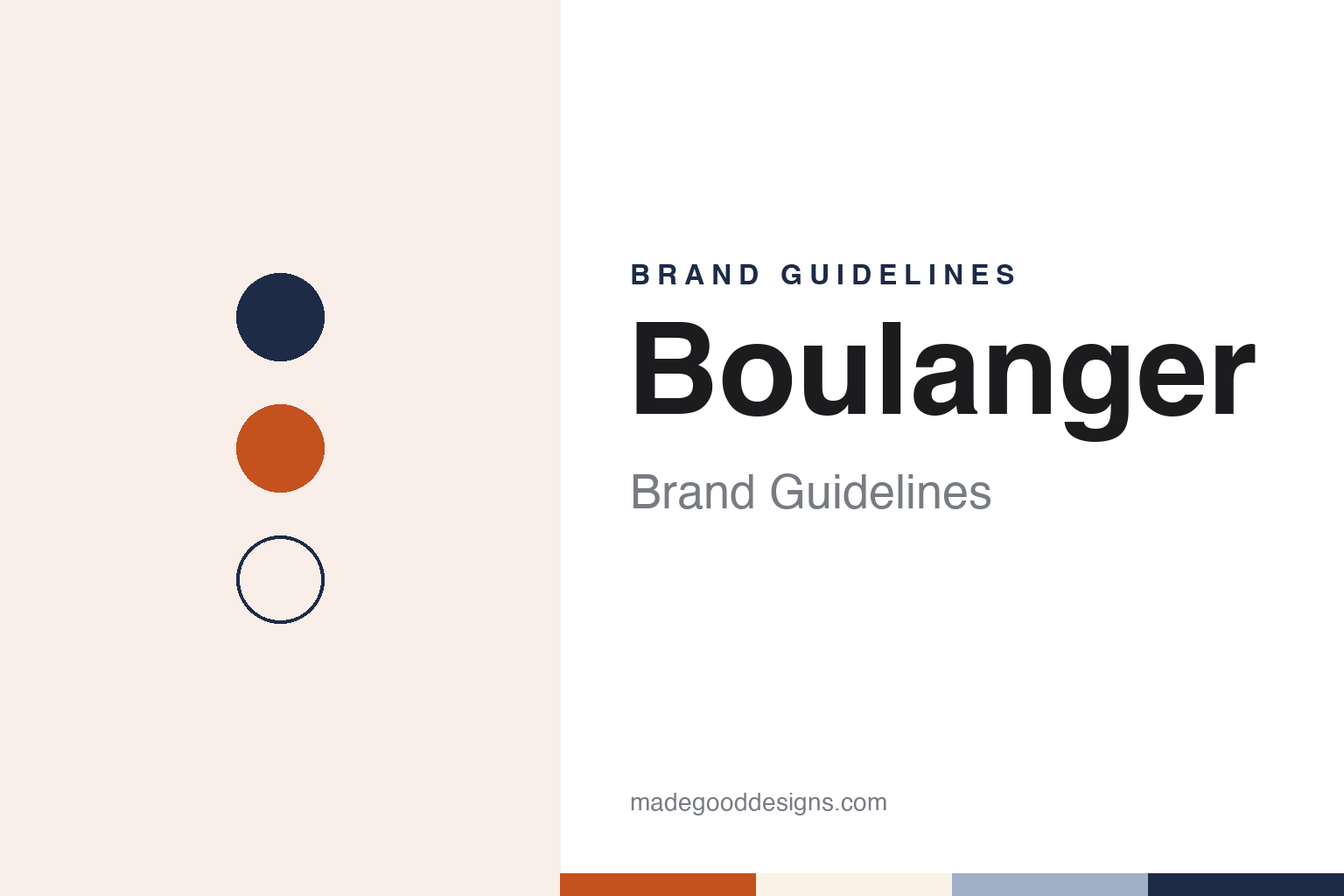
Boulanger Brand Guidelines
The Lille radio shop that became a French appliance chain.
Aa
Two constants: a warm orange, deep blue and cream palette and a rounded sans register. Abstract homage — not a Boulanger product or mark; no logo, sign or packaging is reproduced.
Lille, 1954
Two brothers, radio sets and an after-sales counter.
Boulanger began in Lille in 1954. The trade magazine Ecommerce Magazine, reporting in July 2023, dates the company to that year and names its founders as the brothers Bernard and Gustave Boulanger. The franchise portal Toute la Franchise, in a profile updated in July 2026, describes their first shop as one that repaired and built radio sets. French Wikipedia adds that the brothers set themselves apart with a real after-sales service in the shop, and that between 1954 and 1963 they opened three more stores and a warehouse in Lille.
The move to the town that is still its base came in 1974, when, French Wikipedia says, Boulanger built a warehouse of 6,000 square metres at Lesquin, south-east of Lille, opened a 1,000-square-metre store in Douai and tried a self-service area for small appliances in one of its Lille shops. The company then had 224 employees.
Ownership changed in the 1980s. French Wikipedia says the Association familiale Mulliez, the family group behind Auchan, bought into the company in 1983 and took control in 1986; Toute la Franchise also gives 1986 as the year the Mulliez group became majority shareholder. From then, French Wikipedia says, Boulanger grew nationally, with larger stores of 1,000 to 2,000 square metres on the edge of towns, and closed a number of its older shops.
The chain tried other markets and formats along the way. French Wikipedia records stores in Spain from 1998 and a withdrawal in 2009, when the Spanish shops were sold to the Portuguese chain Worten; online selling from March 2007; and, in 2011, the purchase of the French Saturn stores from the German group Metro, which French Wikipedia’s articles count as 34 in one place and 36 in another. Its first store in Paris opened on 1 September 2015, in the Opéra district.
Colour
Superstores, own labels and services under one name.
The store is still the main stage. Actu.fr reported on 28 October 2026 that Boulanger had 220 stores in France when it opened a new one at Basse-Goulaine, outside Nantes, with 2,271 square metres of selling space. The paper listed the services that store offers, as the others do: collection within 30 minutes, next-day delivery, unlimited repair through the Infinity club, trade-in of old appliances, refurbished products and rental.
Many of those services have their own names. French Wikipedia dates B’Dom’, a home computer-help service, to 2006; click and collect and the rental site Lokéo to 2010, renamed Boulanger Location in 2019; and the repair and installation business Solvaréa to 2013. Own-label goods sit beside the international brands. French Wikipedia says Listo, the entry-level label, and Essentiel B, which covers small and large appliances, sound, vision and computing, both date from 2005, and that the gaming label Skillkorp was created in 2017 with Asus ROG; in 2025 the company cut its portfolio from six labels to those three.
The way the chain grows has also changed. Toute la Franchise reports that Boulanger ran only company-owned stores until 2018, when it opened its network to franchisees. The trade magazine Républik Retail counted 223 stores in France in November 2025, about fifty of them franchised, when it reported a new Boulanger Outdoor format in Toulon: a store of nearly 500 square metres for garden, terrace and outdoor-kitchen equipment. In 2020, French Wikipedia says, Boulanger also bought the Ex&Co group, which ran 82 stores under the Expert and Connexion names, so that they could move over to the Boulanger name as franchises.
Typography
How consumer-electronics retailers present themselves.
Consumer-electronics retailers present themselves first through the store. Many trade from large units on the edge of towns, with long aisles divided into product areas such as computing, television, sound, phones and kitchen appliances. Trade reports describe how these floors are laid out for trying things: in 2017 Tweakers described Coolblue’s first XXL store in Amsterdam as six product areas, and in 2026 Républik Retail described a Boulanger store near Lille with a playable gaming area and a seated space for watching projectors.
Delivery is part of the public face. Some chains run their own vans for large appliances and installation, and Coolblue says it added its own bicycle delivery service in cities in 2018. Online shops, click-and-collect counters and services for repair, trade-in, rental and refurbished goods are presented beside the shelves, often under names of their own that sit next to the shop name on signs and websites.
Naming follows a similar pattern. A chain usually keeps one short shop name and adds own-label ranges with separate names, so a single store can carry the retailer’s brand, its house labels and many outside makers side by side. French Wikipedia, for example, dates Boulanger’s Listo and Essentiel B labels to 2005. When a chain buys a rival abroad, it may keep the local name, as Boulanger did with Krëfel in Belgium after 2019.
Behind the shop fronts sit corporate pages. These usually give a founding story, the current owner and any stock-market listing or plan for one, and some owners publish their own announcements of changing stakes. This guide sets out what dated sources say about each company’s founders, owners and listings, and treats the companies’ own descriptions as their claims.
Aa
A rounded sans for a friendly, softened register. (Specimen set in Nunito, a sans STAND-IN; NOT the Boulanger logo.)
Villeneuve-d’Ascq
A family-owned group, a Belgian purchase and a refitted store.
Boulanger sits inside a larger Mulliez group. A decision of the Belgian Competition Authority dated 12 November 2019 describes High Tech Multicanal Group, or HTM, based at Lesquin, as the holding company over both the Boulanger group and the discount chain Electro Dépôt. That decision cleared the purchase by HTM and Boulanger of the Belgian chain Krëfel, with its Luxembourg arm Hifi International. The deal had been announced in June: RetailDetail reported on 12 June 2019 that it brought 74 Krëfel stores in Belgium and 11 Hifi International stores in Luxembourg together with Boulanger’s 154 French stores. French Wikipedia says HTM was renamed United.b in 2021. In July 2023, Ecommerce Magazine reported, Emilie Soleri, previously at Auchan Retail, was named chief executive of Boulanger.
The visual identity has been adjusted rather than replaced. French Wikipedia says the logo introduced in 2004 was redrawn in 2018 with rounder forms. In September 2026 the chain showed a refitted store at Villeneuve-d’Ascq, near Lille. Républik Retail reported on 15 September 2026 that the 3,000-square-metre store was the first to carry the whole of the new concept, and the first to bring into a building the brand platform “Plaisir partagé” (shared pleasure), launched a year earlier on the website and app. The magazine quoted the marketing director describing a livelier orange and a darker, more elegant blue.
The layout changed too. The magazine described two routes through the store, a short one for collecting orders and services and a longer one for browsing; around fifteen product categories rearranged, with less room for clock radios, hi-fi systems and satnavs; a gaming area of more than 50 square metres with playable computers and a racing simulator; and the chain’s first seated space for watching projectors.
For a design guide, Boulanger shows how an appliance chain can keep one family name over seven decades while its shop fronts, own labels and services multiply around it. Compare Darty, another French electrical retailer, and MediaMarkt, whose sister chain Saturn’s French stores passed to Boulanger in 2011. For this guide we use a warm orange, a deep evening blue and a soft cream with a rounded sans, an unofficial interpretation; no product or logo is reproduced.
Explore & save
Keep Boulanger’s identity on hand — save it to a board in the Made Good inspiration library.
Boulanger identity set
Save the warm orange, deep blue and cream palette and the rounded sans register to your own board.