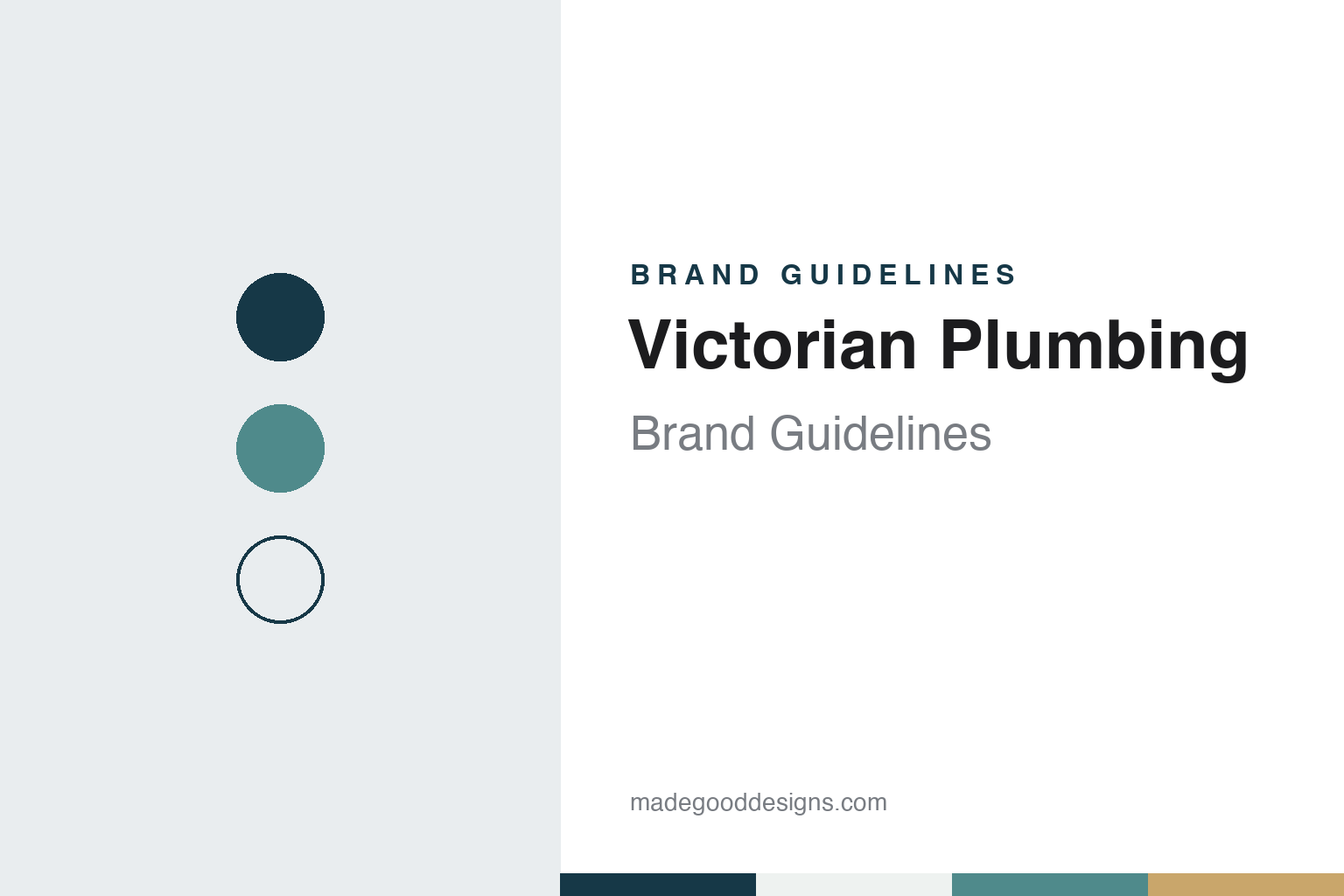
Victorian Plumbing Brand Guidelines
An online bathroom retailer that started in a garden shed.
Aa
Two constants: a deep teal, sea glass and brass palette and a plain retail sans register. Abstract homage — not a Victorian Plumbing product or mark; no bathroom product, logo or advert is reproduced.
From a shed
A Merseyside start in 2000.
Victorian Plumbing began in 2000. English Wikipedia dates the start to September 2000 and says the company was founded by Mark Radcliffe from his parents’ shed in Merseyside; the Liverpool Echo, reporting on the day of the company’s stock market debut in June 2021, gave the same year and the same shed. The company’s own history agrees on 2000 and says Radcliffe already had experience of selling online when he started it.
The idea was simple: sell bathroom products over the internet rather than from a showroom on a retail park. In its own account of its history, the company says it launched an own range under the Victorian Plumbing name in the mid-2000s, moved into a head office in Formby, Merseyside, in 2004, and opened a single showroom next to that office in 2009, so that customers could see products in person.
Growth then moved the business inland into Lancashire. The company says its first warehouse in Skelmersdale opened in 2013, that it ran its first television advert in 2014, and that it opened a new headquarters in Skelmersdale in 2020. The Liverpool Echo reported in June 2021 that the business had moved from the shed to Formby and then to its Skelmersdale base, and that it employed more than 500 people across seven locations, including Manchester and Birmingham.
Colour
Own ranges, a court case and a listing.
Much of what the company sells is its own. On its investor website it says it stocks more than 36,000 products from more than 150 brands, including over 25 own brands sold only on its website, among them Arezzo, Chatsworth, Milan and Keswick, alongside third-party names such as Grohe, Roca and Hansgrohe. It describes Chatsworth as a range of Victorian-inspired designs and Keswick as a collection that includes column radiators; the Victorian Plumbing range itself covers baths, pottery and brassware, the company says.
Its closest rival for years had a confusingly similar name. Victoria Plum, a separate online bathroom retailer founded in 2001 according to English Wikipedia, took Victorian Plumbing to court over search advertising. The trade magazine kbbreview reported in December 2018 that on 18 November 2016 the High Court ruled that Victorian Plumbing had paid to advertise infringing text in search results when people searched for Victoria Plum, and granted an injunction; in the same ruling, Victorian Plumbing succeeded in a counterclaim against Victoria Plum for buying Victorian Plumbing’s name as a search keyword.
On 22 June 2021 the company was admitted to AIM, the London Stock Exchange’s growth market, according to the company, English Wikipedia and the Liverpool Echo, which reported the debut on the day. The founder and members of his family sold part of their holdings in the listing but kept large stakes, the paper reported.
The listing also made the company’s shirt and stadium marketing more visible. English Wikipedia says it became principal shirt sponsor of Bolton Wanderers in June 2023, a deal extended in December 2025, and title sponsor of snooker’s UK Championship from 2024.
Typography
Design and documentation.
DIY chains, home-improvement retailers and builders’ merchants present themselves through the places where customers meet them. A home-improvement store is usually a large warehouse-style building with long aisles, high racking and a garden or timber area, and the chains describe those stores in their own words on their websites. A builders’ merchant is more often a yard and a branch, where tradespeople buy timber, bricks and fixings across a counter. For a design reader, the shed, the yard and the counter are where the colours, signs and lettering of these companies are seen at full size.
Many trade suppliers also sell from a catalogue and a website, with orders collected from a counter or delivered to site. Printed catalogues, product codes and click-and-collect services appear in the companies’ own descriptions, and in the trade press that covers them. Liveried vans and lorries carry the same names and colours from the branch to the building site, so a merchant’s identity often travels further on the road than it does on the high street.
Store and own-label naming is usually plain. Chains carry a founder’s surname, two merged surnames, or a literal compound of a product and a place, and many sell house ranges under their own names alongside the branded tools and materials they stock. Groups often run several trading names side by side, one for each trade or customer type, rather than folding them into one.
Corporate pages fill in the rest: founders, owners, listings, demergers and the investment groups that sit behind many chains. Ownership in this sector changes more often than the shop signs do, so the guides in this series date each change of owner to an independent source, describe each name and colour as documented, and treat the palettes shown here as unofficial interpretations.
Aa
A plain, sturdy retail sans for a bathroom brand sold online. (Specimen set in Libre Franklin, a sans STAND-IN; NOT the Victorian Plumbing logo.)
Victorian Plumbing
A rival bought, and MFI back online.
The two rivals ended up under one owner. The BBC reported in May 2024 that Victorian Plumbing had bought Victoria Plum, of Doncaster, just over six months after Victoria Plum went into administration and was sold in a pre-pack deal; at the time Victorian Plumbing employed about 600 people across nine sites in Lancashire, Manchester and Birmingham, the BBC said. In October 2024 Retail Gazette reported that Victorian Plumbing would close Victoria Plum after a consultation with its staff, and English Wikipedia says the Victoria Plum website was closed that month. The same Retail Gazette report said a new semi-automated distribution centre in Lancashire was by then in operation.
The Victoria Plum purchase brought an older name with it. Retail Gazette reported in May 2025 that the MFI brand and web domain had come to Victorian Plumbing with Victoria Plum. MFI was the flat-pack furniture retailer founded in the 1960s that went into administration during the 2008 financial crisis, the magazine noted. In May 2026 Retail Gazette reported, from the company’s half-year results, that MFI had been relaunched in July 2025 with an initial range of about 600 products, and had grown to more than 5,500 product lines across homeware categories by the end of March 2026. The company’s investor site describes MFI as an online-only retailer of homewares and furniture.
The same May 2026 report described other changes: tiles and flooring had become a growing category, trade customers were a larger share of the business, and the group had bought a Merseyside transport company in January 2026 to bring more of its deliveries in-house. The report also quoted Stephnie Judge presenting her first set of interim results as chief executive. The company now gives its address as Leyland, Lancashire, and remains listed on AIM.
For a design guide, Victorian Plumbing shows how a period-sounding name can carry a modern, online business, and how a retailer can collect other names, from Arezzo to MFI, under one roof. Compare Wren Kitchens, another English home-improvement retailer, and B&Q. For this guide we use a deep teal, sea glass and a brass tone with a sans, an unofficial interpretation; no product or logo is reproduced.
Explore & save
Keep Victorian Plumbing’s identity on hand — save it to a board in the Made Good inspiration library.
Victorian Plumbing identity set
Pin the Victorian Plumbing deep teal, sea glass and brass palette and the plain retail sans register to your own board.