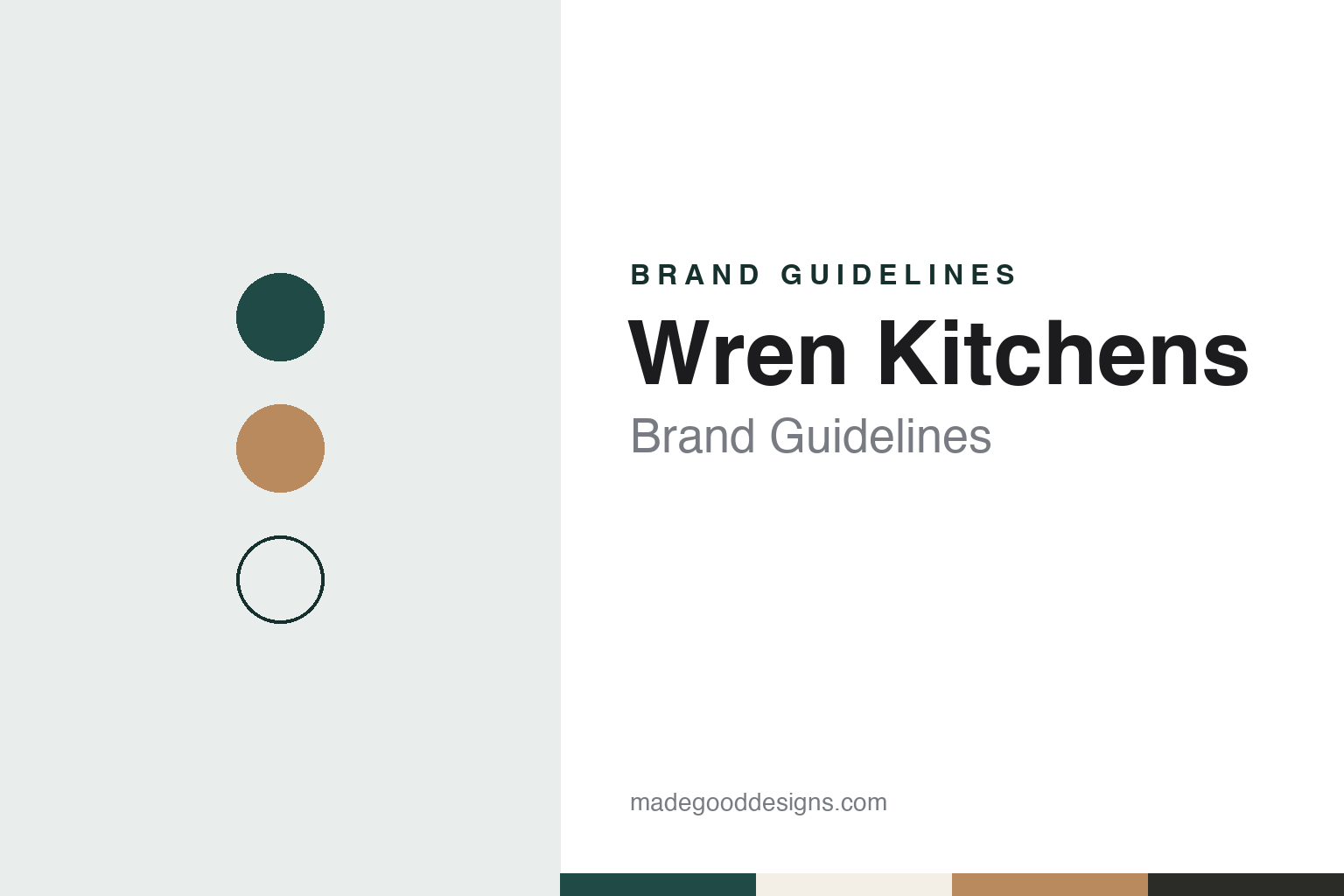
Wren Kitchens Brand Guidelines
A 2009 Humber kitchen maker that builds, sells and fits its own units.
Aa
Two constants: an estuary green, oak and plaster cream palette and a rounded geometric sans register. Abstract homage — not a Wren Kitchens product or mark; no kitchen, logo or showroom is reproduced.
Howden, 2009
A Humber kitchen maker.
Wren Kitchens is a British company that designs, makes and sells fitted kitchens and fitted bedrooms through its own showrooms. The company registered at Companies House as Wren Kitchens Limited was incorporated on 22 January 2009. The register shows that it changed its name to Wren Living Limited in November 2013 and went back to Wren Kitchens Limited in July 2017, so the business has traded under both names in its short history.
English Wikipedia says the company was founded in Howden, the market town in the East Riding of Yorkshire, and that its head office stayed there until December 2013, when it moved across the Humber to Barton-upon-Humber in North Lincolnshire. Companies House still gives Barton as the registered office. The trade magazine kbbreview reported in June 2019 that Wren was “currently celebrating its 10th anniversary,” which fits the 2009 incorporation date.
The founder is Malcolm Healey, a businessman born in Hull. English Wikipedia says he began his career in his family’s paint business, and that in 1982 his company, Humber Kitchens, joined the furniture retailer MFI in buying Hygena, the kitchen and furniture brand, from Norcros. MFI took full control of Hygena in 1987 and bought Healey out. He then moved to the United States, where he set up the kitchen-cabinet maker Mill’s Pride, which he later sold before coming back to Britain. English Wikipedia’s article on Wren tells the same story in brief: the management team behind Wren traded for ten years in the United States before that business was sold and the team returned to the UK.
English Wikipedia describes Wren as a privately held company, with Healey as its owner and Mark Pullan as managing director, and lists its products as kitchens and bedrooms.
Colour
Factories on the Humber.
Wren makes its own furniture. English Wikipedia says it manufactures all of its kitchen units in its own plants at Scunthorpe, Howden and Barton-upon-Humber, and that the 180-acre Barton site was bought in August 2013 from Kimberly-Clark, the paper and hygiene-products group. Companies House lists the company’s activities as the manufacture of kitchen furniture, joinery installation, the retail of furniture in specialised stores, and the cutting, shaping and finishing of stone.
The Barton site has been the focus of its growth. In June 2019 kbbreview reported that Wren was submitting a planning application for a new 910,000 sq ft manufacturing plant behind its existing buildings there. The plan, the magazine said, would create 1,200 jobs on top of the 1,500 people already employed on the site, and the plant would be the company’s fourth factory in the Humber region. At the time Wren had 78 showrooms across the country and employed about 1,000 people at its production sites in Scunthorpe, Howden and Hull.
The model is vertical. Wren designs the kitchens, builds the units in its own factories, sells them in its own showrooms and installs them, selling to homeowners. That differs from trade suppliers such as Howdens, which say they sell only to trade professionals. The Humber link is strong: Howden, the town where Wren began, is also where Howdens has one of its factories, though the two are separate companies with separate owners.
The showroom estate grew quickly. English Wikipedia gives a count of 106 stores in 2021, citing the Cumbrian newspaper News and Star, which reported in June 2021 on a new showroom in Carlisle. By April 2026, the American trade publication Business of Home reported, Wren operated more than 100 showrooms in the UK.
Typography
Design and documentation.
DIY chains, home-improvement retailers and builders’ merchants present themselves through the places where customers meet them. A home-improvement store is usually a large warehouse-style building with long aisles, high racking and a garden or timber area, and the chains describe those stores in their own words on their websites. A builders’ merchant is more often a yard and a branch, where tradespeople buy timber, bricks and fixings across a counter. For a design reader, the shed, the yard and the counter are where the colours, signs and lettering of these companies are seen at full size.
Many trade suppliers also sell from a catalogue and a website, with orders collected from a counter or delivered to site. Printed catalogues, product codes and click-and-collect services appear in the companies’ own descriptions, and in the trade press that covers them. Liveried vans and lorries carry the same names and colours from the branch to the building site, so a merchant’s identity often travels further on the road than it does on the high street.
Store and own-label naming is usually plain. Chains carry a founder’s surname, two merged surnames, or a literal compound of a product and a place, and many sell house ranges under their own names alongside the branded tools and materials they stock. Groups often run several trading names side by side, one for each trade or customer type, rather than folding them into one.
Corporate pages fill in the rest: founders, owners, listings, demergers and the investment groups that sit behind many chains. Ownership in this sector changes more often than the shop signs do, so the guides in this series date each change of owner to an independent source, describe each name and colour as documented, and treat the palettes shown here as unofficial interpretations.
Aa
A rounded geometric sans — a short, single-syllable name. (Specimen set in Outfit, a sans STAND-IN; NOT the Wren Kitchens logo.)
Wren Kitchens
A UK business and a closed US chapter.
Wren tried to repeat the formula in the United States. Business of Home reported on 28 April 2026 that Wren launched there in February 2020, opening a 252,000 sq ft factory in Wilkes-Barre, Pennsylvania, and a showroom in Milford, Connecticut, later that year. By 2024, the publication said, it had 14 independent showrooms on the East Coast and had signed a deal to put Wren Kitchens studios inside selected stores of The Home Depot.
That venture has closed. According to the same report, the American operation filed for Chapter 7 bankruptcy on 24 April 2026 and shut all 15 of its US showrooms; Chapter 7 is the liquidation procedure of the US bankruptcy code. Former employees told the publication that they had been informed on 23 April that operations would stop immediately. Business of Home also reported that Wren’s UK business was continuing unaffected. The US business no longer trades.
In Britain the company remains a manufacturer-retailer based on the Humber, with factories at Scunthorpe, Howden and Barton and showrooms across the country. Its founder’s history also ties it to the wider British kitchen industry: Hygena passed to MFI in 1987, and MFI’s old listed company, renamed Galiform in 2006 and Howden Joinery Group in 2010, is now the parent of Howdens, according to Companies House.
For a design guide, Wren Kitchens shows how a company that controls every step from factory to fitting can present itself as one brand rather than a chain of suppliers. Compare Howdens, the trade-only kitchen supplier with its own Howden factory, and Wickes, a home-improvement chain that also sells kitchens. For this guide we use an estuary green, oak and a plaster cream with a sans, an unofficial interpretation; no product or logo is reproduced.
Explore & save
Keep Wren Kitchens’s identity on hand — save it to a board in the Made Good inspiration library.
Wren Kitchens identity set
Pin the Wren Kitchens estuary green, oak and plaster cream palette and the rounded geometric sans register to your own board.