Half Price Books Brand Guidelines
A 1972 Dallas laundromat, used books and Texas Bookman.
Aa
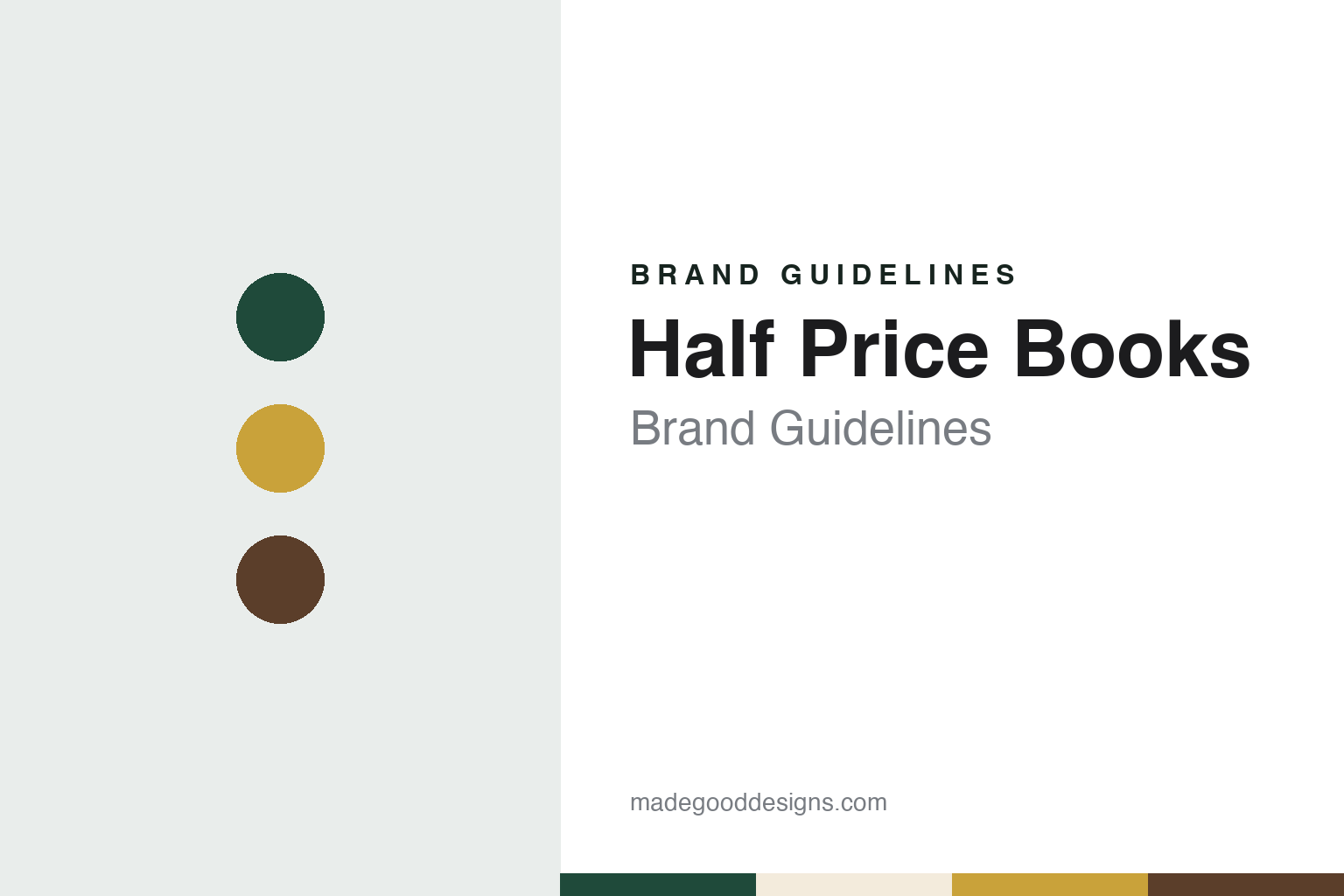
Two constants: an ink green, mustard and warm paper palette and a bookish serif register. Abstract homage — not a Half Price Books product or mark; no sign, logo or bag is reproduced.
A Dallas laundromat
Two founders and 2,002 books.
Half Price Books opened on 27 July 1972 in a converted laundromat in Dallas, Texas. Its founders were Ken Gjemre, a former buyer for the Zale retail chain, and Pat Anderson. Gale’s International Directory of Company Histories says they stocked the first shop with 2,002 books from their own libraries; Shelf Awareness reported in 2022 that they ran advertisements in the local paper announcing “We Buy Books” and soon had a few thousand books and plenty of customers. Gale says Anderson first lent money to the venture and, within six months, became Gjemre’s full partner.
The shop was frugal from the start. Gale says the cash register was second-hand and the shelves were homemade. The idea also differed from most second-hand bookshops of the time, which, Gale says, specialised in rare and collectable editions. Half Price Books aimed at general readers: it made a rule not to charge more than half the cover price for any book, and it would buy almost anything printed, except newspapers, from customers if it was in good condition. Most staff, not only a manager, were trained to price books brought in over the counter, so people could sell their books whenever the shop was open.
The first shop had about 1,000 square feet, and within three months the founders opened a second store with five times the space, Gale says. Growth was paid for out of profits, and the flagship moved four times in its first fourteen years. By the end of the 1980s about a third of the company was owned by its employees, who also shared in its profits, according to Gale.
Colour
Records, remainders and a 1999 flagship.
The range soon grew from books into recorded media. Gale says a friend selling his library asked Gjemre to take his record collection too; the records sold out over a weekend, and records became a permanent line. In 1986 the company opened Half Price Software as a separate shop for computer programs; Gale says it was kept apart from the bookstores because its customers were seen as a different crowd. It also started buying remainders, publishers’ overstock, and created Books By The Yard, selling surplus volumes by the linear yard to restaurants and decorators who wanted filled shelves for atmosphere. By 2022, Shelf Awareness reported, the stores sold new and used books, DVDs, CDs, magazines and video games.
Expansion beyond Texas began in 1983. Gale dates the first Seattle store to that year, while a 2022 report in the Advocate, a Dallas neighbourhood paper, says the first store outside Texas, also opened in 1983, was in Wisconsin. By 1986 there were 23 stores, nine of them in Dallas–Fort Worth. In November 1991 Gjemre gave up day-to-day management while remaining chairman, and Anderson, previously secretary and treasurer, became chief executive. In 1995 leadership passed to her daughter Sharon Anderson Wright, who had started at the company shelving books as a teenager, Gale says; by February 1999 the chain had 61 stores in ten states.
New branches were stocked collectively: existing stores sent every fiftieth book on their shelves to the new location. In early 1999 the company opened a 55,000-square-foot flagship on Northwest Highway in Dallas, its biggest store, with rooms for readings and art exhibitions, a rare-book section, large windows and a planted strip of trees along the front. The same year it set up its first presence on the internet, Gale says.
Typography
Design and documentation.
Bookshop chains and online booksellers present themselves in different places. A chain’s identity is seen first on the street: the name over the shop front, the table displays inside, and the bookmarks, bags and seasonal catalogues handed over at the counter. An online bookseller has no shop front, so its name, its website and the catalogue pages it publishes carry the same work, along with the parcels that arrive at the door.
Store and imprint names are usually plain. Many chains carry a founder’s surname, as Dymocks does with William Dymock, who opened his first Sydney shop in 1879, according to English Wikipedia. Others are coined for the web, such as Booktopia, founded in Sydney in 2004. Older names often survive inside newer businesses: Angus & Robertson became an online brand within Booktopia after a 2015 purchase, SmartCompany reported, and the last Dymocks shop in New Zealand passed to Paper Plus franchisees in 2012, according to Stuff.
Ownership shapes the presentation. Some chains are franchise networks, in which local operators run shops under one name; others are family companies, listed companies or units of larger retail groups. The corporate pages that booksellers publish, and the trade and business press that covers them, set out founders, owners, acquisitions and, where they happened, administrations and changes of owner.
This guide describes each bookseller from dated sources: who founded it, who owns it, and what happened when the business changed hands. Where a chain closed or passed through administration, it says so with the date. The palettes and typefaces shown are our own unofficial interpretations, not the companies’ marks.
Aa
A bookish serif for shelf cards and price stickers. (Specimen set in Libre Baskerville, a serif STAND-IN; NOT the Half Price Books logo.)
Half Price Books
Hackberry Press, Texas Bookman and a family firm.
The company has added sidelines in publishing and wholesale. English Wikipedia says its publishing division, Hackberry Press, reprints public-domain titles or acquires US or English-language rights from other publishers. Its wholesale division, Texas Bookman, founded in 1983 and also based in Dallas, sells trade and scholarly remainders to wholesale buyers; it began selling directly to businesses through its website in April 2020 and in May 2022 hosted its first Texas Remainder Expo, a trade show where exhibitors from the US and UK showed remainder stock.
Half Price Books marked its 50th anniversary on 27 July 2022, a date the mayor of Dallas declared Half Price Books Day, Shelf Awareness reported. English Wikipedia names Sharon Anderson Wright as chief executive and Kathy Doyle Thomas as president, with the corporate office in the Northwest Highway flagship, and counts more than 120 stores, including outlet stores, in 19 states. For the anniversary the company posted a timeline with photographs on its website, the Advocate reported. In April 2024 CultureMap Dallas described the chain as still family-owned, with about 120 stores in 19 states, about 40 of them in Texas. The same report said the store in Mesquite, open since 1994, would close on 5 May 2024 at the end of its lease, which a company spokesperson put down to a decline in customer traffic, and that the chain had recently begun stocking current chart titles from the New York Times lists alongside its used stock.
For a design guide, Half Price Books shows how a plain, descriptive name can carry a whole buying-and-selling model. Compare Powell’s Books, another American bookseller founded in the early 1970s, and Books-A-Million, whose 2nd & Charles shops also trade in used media. For this guide we use an ink green, mustard and warm paper with a serif, an unofficial interpretation; no product or logo is reproduced.
Explore & save
Keep Half Price Books’s identity on hand — save it to a board in the Made Good inspiration library.
Half Price Books identity set
Pin the Half Price Books ink green, mustard and warm paper palette and the bookish serif register to your own board.