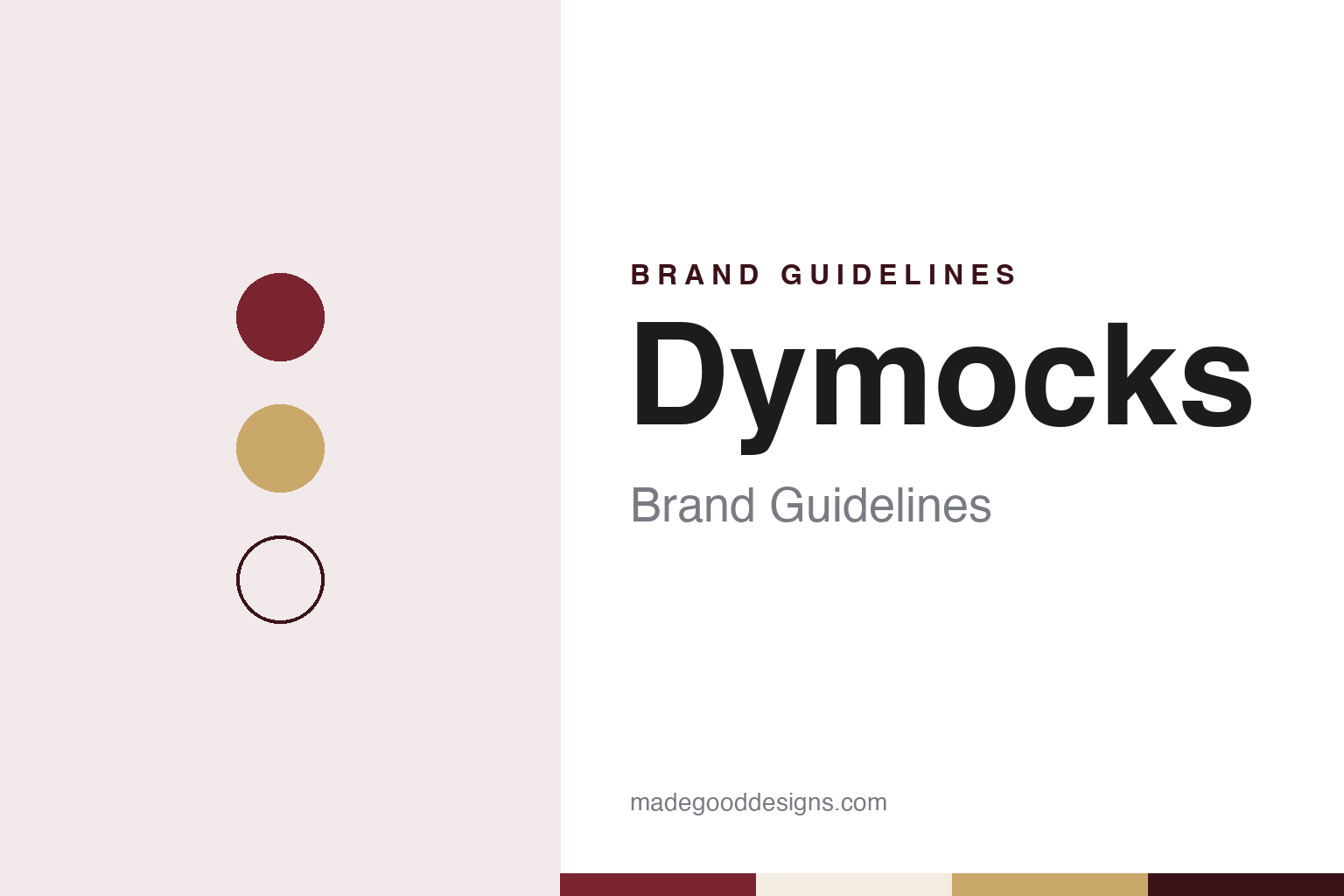
Dymocks Brand Guidelines
A George Street book arcade, a family owner and a franchise chain.
Aa
Two constants: a Dymocks claret and sandstone palette and a Bookshop serif register. Abstract homage — not a Dymocks product or mark; no shop front, logo or bag is reproduced.
Dymock’s Book Arcade
A Sydney bookseller from 1879.
Dymocks began in Sydney in 1879, when William Dymock opened a bookshop in Market Street, English Wikipedia says. As the business grew it moved to larger premises at 428 George Street, where it traded as Dymock’s Book Arcade. The Sydney Morning Herald reported in October 2022 that Dymock advertised the arcade as holding more than a million books, and that the company had occupied the George Street site for more than 130 years, which the paper called one of the longest runs of retail and office use by one company in New South Wales.
The business stayed in the family. Dymock was unmarried, and his estate passed to his sister Marjory, the wife of John Forsyth; the Herald wrote in 2022 that the Forsyths have run the company since then. In July 2013 the paper reported that a later John Forsyth, the founder’s great-nephew, took over the bookseller in 1981. In 2016 it described the Dymocks Group as owned by Forsyth, and in November 2020 Inside Retail quoted him as the group’s chairman.
The address became a building. English Wikipedia says the company bought the site of the old Royal Hotel on George Street in 1922 and built the Dymocks Building, completed in 1930. The Herald described it in 2022 as an interwar Commercial Palazzo-style building by the architect F.H.B. Wilton, with shops on 11 floors, promoted on completion as “The Block” and now heritage-listed. It still holds about 120 specialty shops, the paper said, alongside the bookshop and the company’s head office on the sixth floor, restored by the architects Gray Puksand with the original corridor and partitions kept.
Colour
From one arcade to a franchise chain.
For most of its history Dymocks was a single Sydney shop. That changed in 1986, when the business began franchising, English Wikipedia says; the Sydney Morning Herald reported in July 2013 that the company still owned the George Street flagship while local stores ran as franchises, which it described as businesses owned by local operators. The chain spread to every mainland Australian state, English Wikipedia says, and for a time to New Zealand and Hong Kong.
Store counts are given here only with their dates. The Herald put the chain at about 70 stores across Australia in January 2012, and at 72 bookshops in Australia and 12 in Hong Kong in July 2013, when it noted that newer shops, such as one at Indooroopilly in Queensland, had been designed around their lighting, colours and visual merchandising. English Wikipedia gives about 50 Australian stores as of June 2022.
The overseas branches did not last. In Hong Kong, English Wikipedia says, Dymocks formed a joint venture with the South China Morning Post group in 1999 and opened its first store at the Star Ferry concourse in Central; it closed its flagship in the IFC Mall and its Hong Kong office in January 2015, and the remaining shops were later renamed by their operators. In New Zealand, Stuff reported in September 2012 that Dymocks was closing its last shop, on Broadway in Newmarket, Auckland, on 21 September, with franchisees of the local Paper Plus chain taking it over; Dymocks had left Wellington in 2009 after its franchisee there went into liquidation.
The chain has tried several formats beyond the printed book. English Wikipedia dates its online store to late 2006 and its loyalty programme, Booklover Rewards, to 2001, relaunched in 2006. The Herald reported in July 2013 that Dymocks began selling e-books in November 2007, and that its self-publishing service, D Publishing, was closed after about 15 months; English Wikipedia gives the closure as March 2013.
Typography
How booksellers present themselves.
Bookshop chains and online booksellers present themselves in different places. A chain’s identity is seen first on the street: the name over the shop front, the table displays inside, and the bookmarks, bags and seasonal catalogues handed over at the counter. An online bookseller has no shop front, so its name, its website and the catalogue pages it publishes carry the same work, along with the parcels that arrive at the door.
Store and imprint names are usually plain. Many chains carry a founder’s surname, as Dymocks does with William Dymock, who opened his first Sydney shop in 1879, according to English Wikipedia. Others are coined for the web, such as Booktopia, founded in Sydney in 2004. Older names often survive inside newer businesses: Angus & Robertson became an online brand within Booktopia after a 2015 purchase, SmartCompany reported, and the last Dymocks shop in New Zealand passed to Paper Plus franchisees in 2012, according to Stuff.
Ownership shapes the presentation. Some chains are franchise networks, in which local operators run shops under one name; others are family companies, listed companies or units of larger retail groups. The corporate pages that booksellers publish, and the trade and business press that covers them, set out founders, owners, acquisitions and, where they happened, administrations and changes of owner.
This guide describes each bookseller from dated sources: who founded it, who owns it, and what happened when the business changed hands. Where a chain closed or passed through administration, it says so with the date. The palettes and typefaces shown are our own unofficial interpretations, not the companies’ marks.
Aa
A bookshop serif — a George Street arcade name. (Specimen set in Libre Caslon Text, a serif STAND-IN; NOT the Dymocks logo.)
Dymocks
A bookseller inside a family group.
The bookshops sit inside a wider family business. The Sydney Morning Herald reported in January 2012 that more than half of the company’s assets were in property, including the George Street building, and that it owned a macadamia plantation on the New South Wales mid-north coast. Over the following decade the group bought and sold several businesses: the Healthy Habits sandwich-bar chain, bought in 2009 and sold to Franchised Food Co in 2016, the Herald reported in June 2016; and the Victorian confectioner Patons Macadamia, bought in 2010 and sold to its managing director in November 2020, according to Inside Retail.
Stationery stayed. In November 2015, the Herald reported, Dymocks bought the Telegram Group, a supplier of stationery and gifts that included the online shop Notemaker.com.au; English Wikipedia says Notemaker became the Milligram stationery shop. Inside Retail listed the group in November 2020 as the Dymocks bookshops, Dymocks Properties, the Telegram stationery business, Arapala Macadamia Farms and Dymocks Tutoring, the education business English Wikipedia says began as Potentia in 2018 and took the Dymocks name in 2020.
That shape explains much of the brand. The name is a founder’s surname, used for a building, a property company, a tutoring service and a franchise network at once. The George Street building, heritage-listed and still trading, gives the bookseller a physical anchor that most chains do not own, and the franchise model means the name appears over shops run by local operators across the country.
For a design guide, Dymocks shows how a bookseller’s name can stretch from one arcade to a building, a family group and a franchise network while keeping the founder’s surname. Compare Booktopia, the Sydney online bookseller, and Foyles, another family-founded bookshop with a flagship building. For this guide we use a claret, a sandstone and a cream with a serif, an unofficial interpretation; no product or logo is reproduced.
Explore & save
Keep Dymocks’s identity on hand — save it to a board in the Made Good inspiration library.
Dymocks identity set
Pin the Dymocks claret and sandstone palette and the Bookshop serif register to your own board.