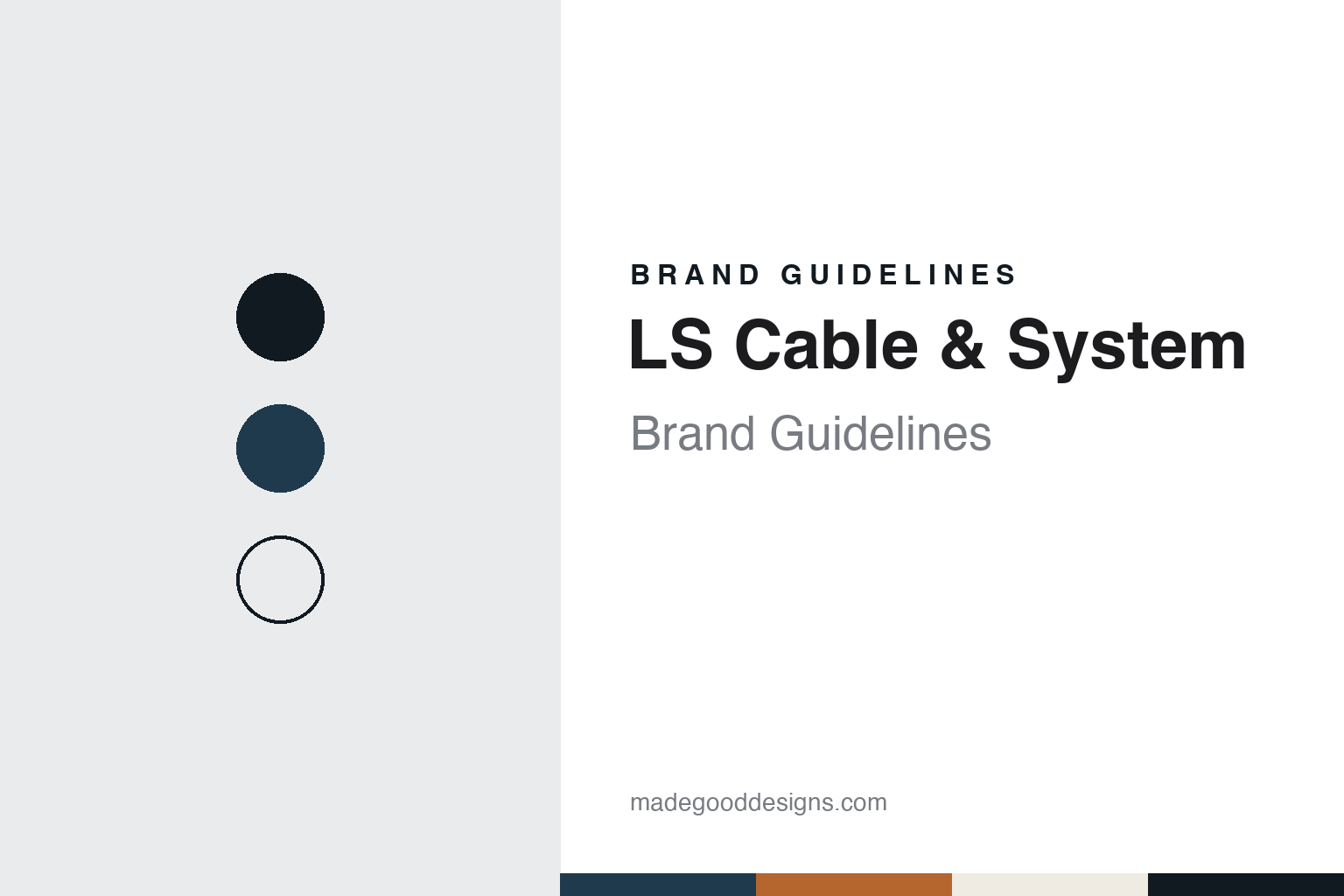
LS Cable & System Brand Guidelines
Korea Cable Industry of 1962, LG roots and the LS name.
Aa
Two constants: a slate, copper and cream palette and an engineering sans register. Abstract homage — not an LS Cable & System product or mark; no cable, logo or nameplate is reproduced.
Korea Cable Industry
From a 1962 cable works to the LS Group.
LS Cable & System traces its start to May 1962, when Korea Cable Industry was established. The history page of its parent, LS Corp., lists that company as “currently LS Cable & System,” and English Wikipedia gives the same founding month. In 1969 the business became Goldstar Cable, English Wikipedia says, and it later traded as LG Cable, the cable arm of the LG Group; LG stands for Lucky Goldstar, English Wikipedia notes.
The break with LG came in November 2003. LS Corp.’s timeline records that month as the point at which the group “spun off from LG Group.” The Korea Herald explained the background in May 2016: the LS Group was founded in 2003 by three brothers of the LG founding family, Koo Tai-hwoi, Koo Pyong-hwoi and Koo Doo-hwoi, and its founding affiliates included LG Cable & System, now LS Cable & System, along with the gas suppliers E1 and Yesco. The paper described the group’s model of passing the chairmanship between cousins of the founding families.
A new name followed. English Wikipedia says the company became LS Cable in March 2005, and the LS Corp. history lists March 2005 as the month the group announced its new corporate identity. The next change was structural. LS Corp.’s timeline notes that the group transformed into a holding company in July 2008, and Korean Wikipedia explains what that meant for the cable business: the present company was established on 1 July 2008 as a new entity, separated from the machinery maker LS Mtron, while the former LS Cable became the holding company LS Corp. In March 2011 the English name changed again, to LS Cable & System, English Wikipedia says. Korean Wikipedia lists LS Corp. and related parties as holding most of the shares.
Colour
Grid cable, subsea work and a family of plants.
The product range is broad. English Wikipedia groups it into power cable from low to extra-high voltage, submarine cable with engineering and installation, telecom cable including optical fibre and LAN cable, and industrial materials such as copper wire rod. It also lists bus ducts, the enclosed power rails used to carry electricity through buildings. The company’s head office is in the LS Tower in Anyang, south of Seoul, which LS Corp. says was completed in May 2008, and English Wikipedia names domestic factories in Gumi, Donghae and Anyang. The Korea Times illustrated its March 2026 report with a company photograph of the Donghae production plants on the east coast.
Much of the recent growth is offshore. LS Corp. records a launch ceremony for a submarine cable-laying vessel in April 2022, and The Korea Times reported in March 2026 that LS Marine Solution, the group’s submarine cable installation subsidiary, had a record year on the back of offshore wind work. The same report said LS Cable & System was building a submarine cable factory in the United States and a bus duct plant in Mexico, and named LS Eco Energy as its Vietnam-based cable subsidiary. On 2 November 2026, Money Today reported that LS Cable & System and LS Marine Solution had signed a contract for resource allocation with Taean Wind Power for the 504 MW Taean Offshore Wind Farm, reserving factory time and vessel schedules; the definitive contract was planned for the end of the year and was not signed at the time of writing. The paper said the laying vessel GL2030 had been expanded to the 7,000-ton class.
The group reaches beyond Korea in other ways. LS Corp. lists a plant in Poland completed in May 2019, and an initial public offering for LS C&S Asia in September 2016. The Korea Herald reported in October 2026 that Gaon Cable, an LS Cable & System subsidiary, had won a United States order for medium-voltage cable for data centres; LS Corp. traces Gaon Cable to Kukje Cable of 1947, which it calls the first cable company in Korea. English Wikipedia says LS Cable agreed in June 2008 to buy the Atlanta magnet-wire and data-cable maker Superior Essex, which English Wikipedia also lists as acquired by the LS Group that year.
Typography
How cable makers present themselves.
Cable makers sell products that most people never see once they are installed. Power lines run under streets and seabeds, data cable sits inside walls, and magnet wire is wound into motors. Their public image therefore leans on what can be photographed before installation: the cable itself, the plant that makes it and the ships that lay it.
The most common picture is the cut end. Company pages and catalogues show a cable in cross-section, with copper or aluminium conductor, insulation, screens and outer sheath set out in rings, often against a plain background. Wide shots of full reels and drums stacked in a yard do the same job at a larger scale, turning a long product into a single object that a camera can frame.
Submarine work has added another set of images. Press releases about offshore wind and grid links are often illustrated with cable-laying vessels, carousels of coiled cable and tall factory towers where high-voltage cable is made. These photographs carry the story of size and reach without needing a consumer product, and they are usually credited to the company that issued them.
Words matter as much as pictures. Makers organise their ranges into product families with short trade names, voltage classes and standard codes, and their corporate pages spend a lot of space on plants, subsidiaries and owners: where a factory stands, when it opened and which group holds the shares. For a designer, the category offers a practical vocabulary of rings, coils, ships and site maps, and a reminder that an industrial identity is often built from documentation rather than from packaging.
Aa
An engineering sans for a grid-cable maker. (Specimen set in IBM Plex Sans, a sans STAND-IN; NOT the LS Cable & System logo.)
LS Cable & System
A group name shared with its sister companies.
The LS name is a group name. LS Corp.’s timeline puts the announcement of the new corporate identity in March 2005, two years after the split from LG, and the cable maker carries it alongside sister companies such as LS ELECTRIC and LS MnM, both listed on LS Corp.’s pages. Korean Wikipedia lists LS Corp. as the parent.
Competition at home has also reached the courts. Chosun Biz reported on 13 March 2025 that the Patent Court, in a second-instance ruling, had partly accepted LS Cable & System’s claims in a patent case over a bus-duct joint kit made by Taihan Cable & Solution, a case LS filed in August 2019; a first-instance court had also ruled partly in LS’s favour in September 2022. Taihan said it would decide whether to appeal after reviewing the judgment.
For a design guide, LS Cable & System shows how a cable maker’s public image rests on names, plants and ships rather than on a consumer product: a 1962 company that has carried four names, a group identity shared with its sister firms, and press photographs of plants and laying vessels. Compare it with Prysmian, which grew out of Pirelli’s cable business, and with Nexans, another maker of land and subsea power cable. For this guide we use a subsea slate, drawn copper, insulation cream and ink with a sans, an unofficial interpretation; no product or logo is reproduced.
Explore & save
Keep LS Cable & System’s identity on hand — save it to a board in the Made Good inspiration library.
LS Cable & System identity set
Pin the LS Cable & System slate, copper and cream palette and the engineering sans register to your own board.