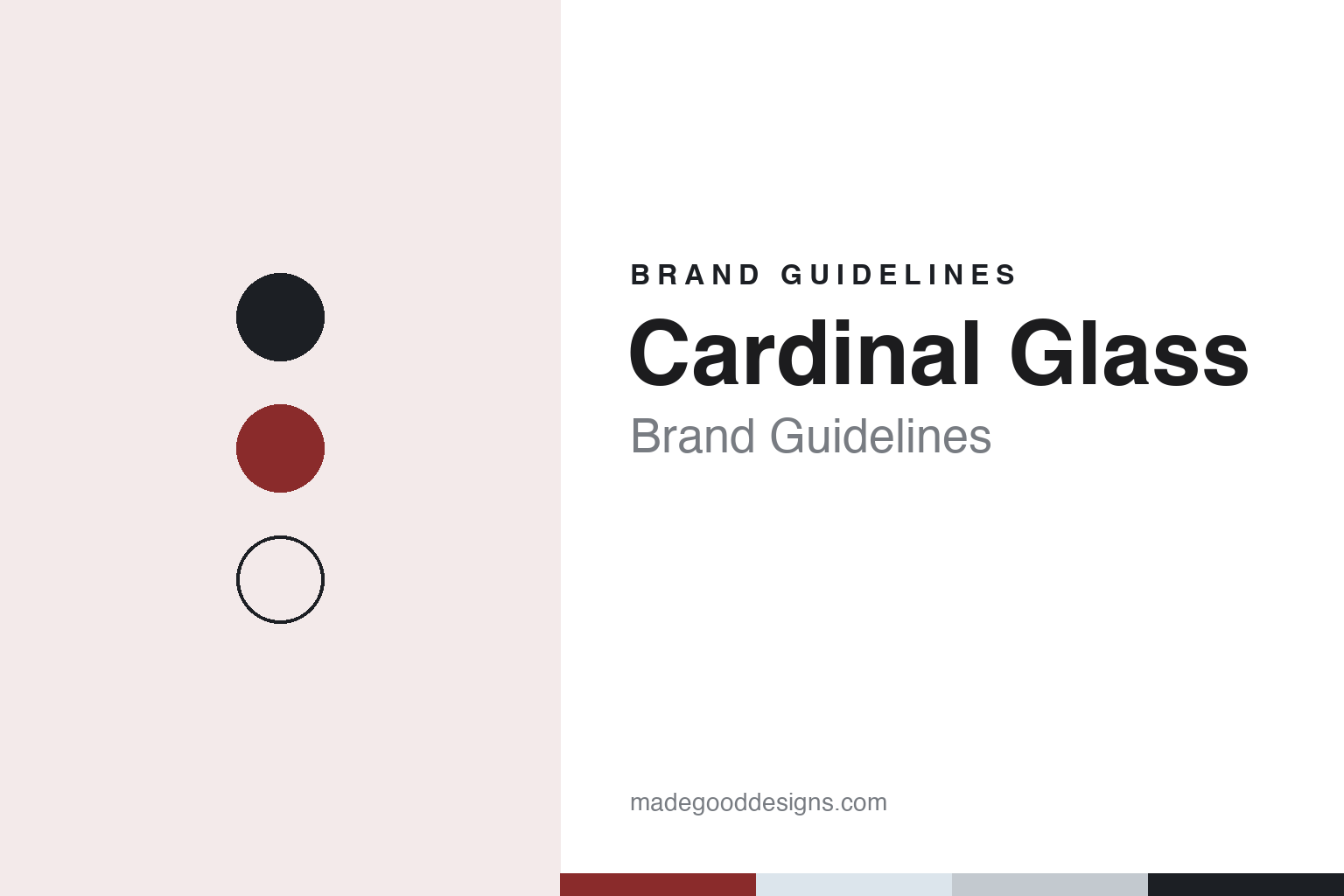
Cardinal Glass Brand Guidelines
A 1962 sash-maker spin-off that put a number on every coating.
Aa
Two constants: a cardinal red, ink and coated silver palette and a technical serif register. Abstract homage — not a Cardinal Glass product or mark; no glass product, logo or nameplate is reproduced.
A sash maker’s subsidiary
Insulating glass in St. Louis Park, 1962.
Cardinal Glass Industries began in 1962 as a subsidiary of a Minnesota window-sash maker. The company’s own history says that in the early 1960s window manufacturers wanted insulating glass instead of storm windows, and that the established suppliers, PPG and Libbey-Owens-Ford, were quoting lead times of about a year. The ML Gordon Sash and Door Company therefore decided to make its own units and created Cardinal Insulated Glass Co., in a small plant in St. Louis Park, Minnesota.
Roger O’Shaughnessy joined in 1963, when the company had 12 employees, and became president in 1967, the company says. In September 2025 USGlass Magazine, citing a 2007 interview, reported that he had held various jobs at the company before being asked to become president in the late 1960s, and that he saw Cardinal as a supplier to major branded window companies whose names should come first. The company describes its role in the same terms today: a turnkey supplier to window manufacturers, from insulating glass to coated, laminated, tempered and plain float glass.
The company dates a long run of product steps to the following decades. It says it introduced triple-pane insulating glass in 1977, silicone dual-seal units in 1978, and in 1983 its LoĒ coatings, building a dedicated factory to supply coated glass for residential windows. Argon gas filling followed in 1987 and the LoĒ² coatings in 1991. In 1992 Cardinal built its first float glass plant, to steady the glass supply for its insulating and coating plants, and in 1993 it launched the XL Edge spacer system. Later entries in its timeline include LoĒ² Plus glass and the Preserve film in 2002, the LoĒ-i81 coating in 2010, which the company says can be used on exposed surfaces, and two coatings in 2020, LoĒ-180ESC and LoĒ-Di89, aimed at the Canadian ENERGY STAR requirements of that year.
Colour
Coatings with a superscript.
Cardinal’s product names follow one system. The coated glass family carries the LoĒ name with a superscript and a number: the company lists LoĒ³-366, which it introduced in 2006 as a triple-silver coating, LoĒ-180 for passive solar designs from 2011, LoĒ-i89 for the room-side surface from 2012, and LoĒ²-272. Its insulating-glass names include XL Edge and Endur, launched in 2014, with add-ons such as the Preserve film, which is removed after construction, and the Neat coating of 2006, which the company describes as easier to clean, followed by Neat+ in 2020. The float side offers PureVision low-iron glass and HydroClear.
The newest line is CLiC, a switchable privacy glass that the company publicly launched in 2023. In October 2026 Cardinal opened a dedicated CLiC plant in Tomah, Wisconsin, with robotic production lines, USGlass Magazine reported; the Tomah site began in 1988 as a 60,000-square-foot plant making stock insulating units and now covers more than 800,000 square feet. Company officials said the expansion followed 18 months of development and construction, and the site includes a demonstration space, the CLiC “Tiny House,” where visitors see the glass in home settings before touring production.
The company is organised by process into five wholly owned subsidiaries: Cardinal FG for float and high-volume tempered glass, Cardinal CT for custom tempered glass, Cardinal LG for laminated glass, Cardinal CG for coated glass and Cardinal IG for insulating glass. It says it has nearly 10,000 employees at 49 locations in the United States, and research centres in Minnesota, Wisconsin and Florida.
Typography
Design and documentation.
Glass makers sell mainly to builders, carmakers and bottlers rather than to shoppers, and their brand pages are written for those buyers. The material does much of the visual work. Many of the large producers fill their websites and annual reports with photographs of their own float lines, furnaces and forming machines, shot and published the way each company chooses, next to close-ups of finished sheets, windscreens and bottles.
Product pages tend to follow the three big markets. Architectural ranges cover clear and tinted float glass, coated glass for solar control and insulation, laminated glass and mirrors, each usually with a range name and a technical data sheet. Automotive pages describe windscreens, side and roof glass, and glass with heating, acoustic layers or head-up-display areas. Container makers show bottles and jars by capacity, colour and finish, often with catalogue pages of standard shapes for wine, beer, spirits and food.
Colour belongs to the catalogue as much as to the logo. Flat-glass makers publish swatches for body tints and reflective coatings, and packaging makers name their glass colours, such as flint, amber and green, and show the same bottle shape in each. Corporate pages carry a second kind of identity: maps of plants, lists of countries, ownership histories and stock-market listings, which matter in an industry where many groups have grown by buying or merging with other glassworks.
The guides in this group read those public materials: founding records, owners, plants and product families, as the companies and independent sources describe them. The colours and type samples shown here are our own interpretation, not official brand assets, and no product or mark is reproduced.
Aa
A sturdy technical serif for a maker of numbered coatings. (Specimen set in Source Serif 4, a serif STAND-IN; NOT the Cardinal Glass logo.)
Cardinal Glass
Privately held in Eden Prairie.
The largest change in recent years came from Japan’s AGC. In June 2021 USGlass Magazine reported that Cardinal, based in Eden Prairie, Minnesota, had signed a contract to buy the assets of AGC Glass in Church Hill, Tennessee, Abingdon, Virginia, and Spring Hill, Kansas, subject to regulatory review; AGC said the sale was part of its medium-term plan for its architectural glass business, and Cardinal said the plants would expand its float, coating and tempering capacity. “Our capital investment plan for these operations will allow us to sustain even higher volumes in a very tight North American glass market,” O’Shaughnessy said at the time. On 2 August 2021 Cardinal announced that the transaction had closed, the magazine reported.
Other moves followed. In 2021 Cardinal bought an architectural glass plant in Statesboro, Georgia, from Apogee Enterprises, which had planned to close it. In October 2026 it filed a notice that Cardinal LG would close the Statesboro laminated glass plant from 6 December 2026, affecting about 115 jobs, and cited changing conditions in the laminated glass market, USGlass Magazine reported. In August 2026 the same magazine reported plans for a carbon capture system at the Cardinal FG float plant in Winlock, Washington, developed with K2-CO2 of Padova, Italy, with operation planned for 2029.
In September 2025 Bowie Neumayer, with 22 years at Cardinal and 19 as vice president of sales and marketing, became president, while O’Shaughnessy stayed on as chairman and chief executive, USGlass Magazine reported. The company calls itself a management-owned S corporation and lists remaining privately owned among its guiding principles, alongside a culture of independence for each production plant.
For a design guide, Cardinal Glass shows how a supplier that works behind other makers’ brands can build a naming system of its own around coatings and numbers. Compare AGC, whose US architectural glass plants it bought in 2021, and Guardian Glass, another American flat glass maker. For this guide we use a deep cardinal red, ink and a coated-glass silver with a serif, an unofficial interpretation; no product or logo is reproduced.
Explore & save
Keep Cardinal Glass’s identity on hand — save it to a board in the Made Good inspiration library.
Cardinal Glass identity set
Pin the Cardinal Glass red, ink and coated silver palette and the technical serif register to your own board.