Rusta Brand Guidelines
An Uppsala idea, a Gävle store and a Nordic discount chain.
Aa
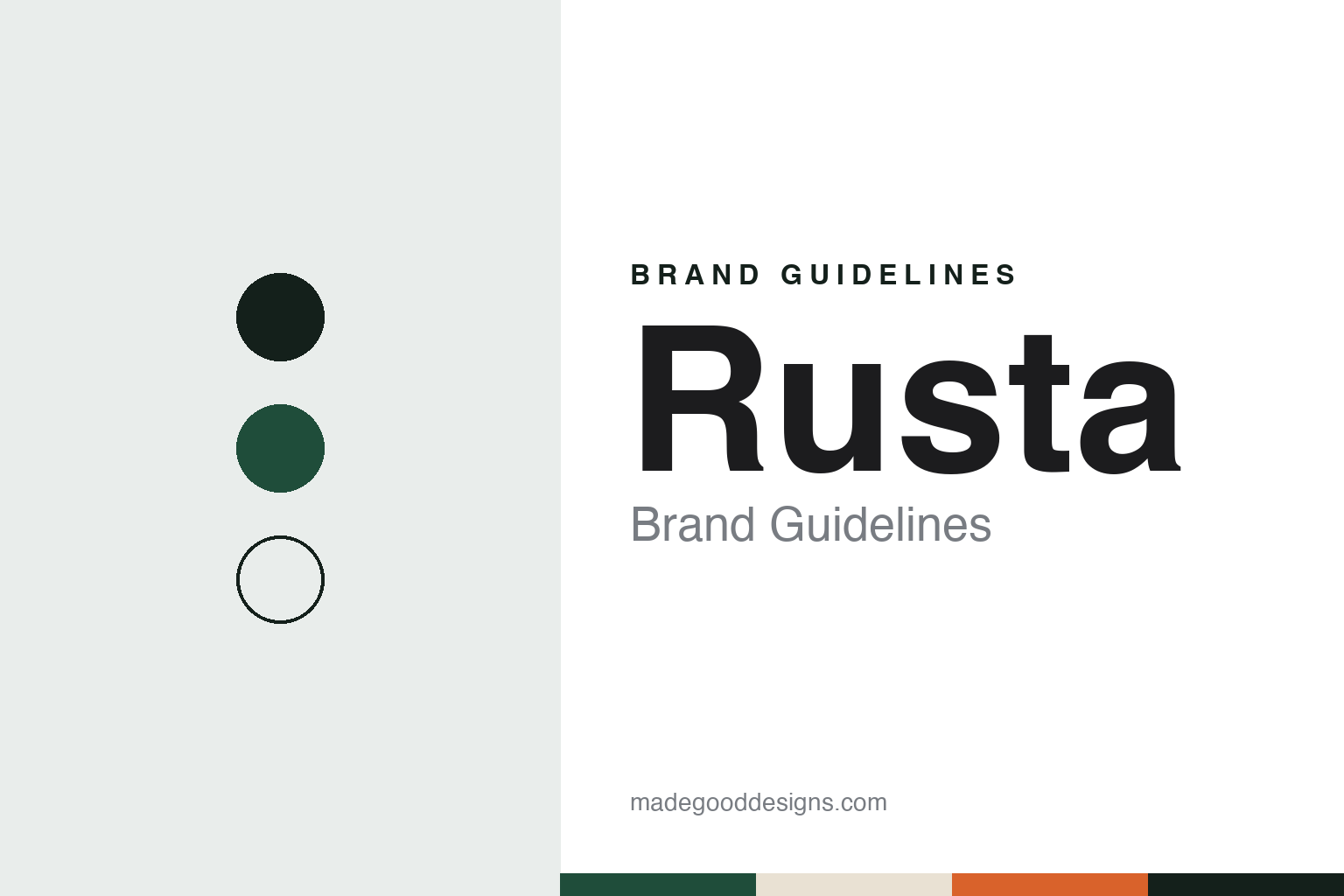
Two constants: a Rusta spruce green, sand and orange palette and a Sturdy grotesque register. Abstract homage — not a Rusta product or mark; no logo, store sign or packaging is reproduced.
Uppsala and Gävle
A research-studies idea that became a store.
Rusta is a Swedish discount retailer that sells products for the home and for leisure time. The company says it was founded in 1986 by Anders Forsgren and Bengt-Olov Forssell, and it dates the idea further back, to 1979, when the two men were doing research studies at Uppsala University. Swedish Wikipedia gives the same founding year and the same two founders, and names the listed company as Rusta AB (publ), with its seat in Upplands Väsby, north of Stockholm.
Although the company places its founding in Uppsala, the first Rusta store opened in Gävle in 1986. The company’s own timeline says that a year later, in 1987, Rusta adopted a direct sourcing model and opened its first central fulfilment centre, also in Gävle. By 1990, the timeline says, the chain had reached ten stores and seventy employees.
The company describes its aim in its own words as a store where Swedish people could buy everyday products at low prices. Swedish Wikipedia describes the concept in plainer terms: simple purchasing processes without middlemen, a broad range and large volumes. Purchasing happens mainly through direct import from Europe and Asia, or directly from manufacturers in Sweden, it says, and the chain sells both its own brands and international ones.
For most of its history Rusta was a purely Swedish chain. Its first store outside Sweden did not open until 2014, twenty-eight years after the first store in Gävle, according to the company’s timeline. In 2010, the company says, it introduced one common store concept, which it now uses in every market.
Colour
Buying offices in Asia and beyond.
The part of Rusta that customers do not see is its buying network. The company’s timeline says it opened its first local sourcing office in Hangzhou, China, in 1996; Swedish Wikipedia gives 1998 for the opening of a purchasing and distribution office in China, so the two sources differ on the year. The company says it added an office in New Delhi in 2013, a third in Ho Chi Minh City in 2016 and a fourth in Istanbul in 2024.
According to Swedish Wikipedia, these offices handle purchasing, order follow-up, quality control and inspection of products. Neither the company’s history page nor the encyclopaedia names the factories that make Rusta’s goods; what can be said is that the chain buys directly from suppliers through offices in China, India, Vietnam and Türkiye, alongside imports from Europe and some direct purchasing from Swedish manufacturers.
The logistics side grew in step. After the first fulfilment centre in Gävle in 1987, the company says, a central fulfilment centre opened in Norrköping in 2015. In 2016 Rusta launched a membership programme, Club Rusta. The company says the club reached about 1.7 million members after roughly two years and more than seven million across its markets by the end of its 2025/26 financial year. Those are its own figures.
In 2020 Rusta added an online store to its physical chain. The company describes the web shop as complementary to the stores, and its investor site says it is available in Sweden and Finland, while another page on the same site says Rusta Online is available in all its markets.
The goods themselves cover the home and leisure time, as Swedish Wikipedia puts it, and the encyclopaedia calls the stores lågprisvaruhus, low-price department stores. The company describes itself as a variety discount retailer with one store concept in every market.
Typography
Design and documentation.
Discount, home and hobby retailers in Europe, Britain, Australia and Malaysia tend to present themselves first through the store itself. The sign over the door, the logo on the bags and the layout of the aisles carry most of the identity, and many of these chains repeat one standard format from town to town, so a shopper meets the same look in a high street, a retail park or a shopping centre.
Own-label ranges are a second layer. Many of these retailers sell established consumer brands alongside goods under their own names, and they publish those range names on their websites, packaging and shelf cards. For a design guide, the useful facts are the ones the companies state themselves: what each range is called, what it covers and how it sits beside branded stock, rather than any claim about quality or price.
Store networks are the third. Chains in this group publish their store counts, the countries they trade in and the mix of company-run and franchise branches, and those figures move quickly as new sites open and others close. Any count is only as good as its date, so the guides in this series give each figure with the year of the source that reports it.
Ownership is the fourth. Some of these businesses began as a single shop run by a founder or a family, and later passed to private-equity firms, listed parent groups or stock-market investors. Their corporate pages usually tell that story, from the first store to the current owner, and the guides here describe family and group ownership plainly, with dates, as the sources set it out.
Aa
A sturdy grotesque for a practical, price-led retailer. (Specimen set in Archivo, a sans STAND-IN; NOT the Rusta logo.)
Rusta
From Sweden to Norway, Germany and Finland.
Expansion abroad began in 2014, when Rusta opened its first store in Norway, according to the company. In 2017 it opened its first store in Germany. The trade journal DIY International reported on 11 May 2018 that Rusta had acquired the Finnish low-cost chain Hong Kong, which ran a similar retail format and had 24 stores in Finland; at that time, the journal said, Rusta had 22 stores in Norway and two in Germany, and the deal took the group to more than 150 stores.
The Finnish stores kept their old name for two more years. Finnish Wikipedia says the Finnish company was renamed Rusta Finland Group Oy in May 2020, and that the first stores to open under the Rusta name in Finland did so in Lappeenranta and Kokkola on 13 May 2020. Swedish Wikipedia says the name on all the Hong Kong stores changed to Rusta from May 2020, and the company says the integration of the Rusta concept was completed that year.
Rusta became a listed company in 2023. Swedish Wikipedia says its shares began trading on Nasdaq Stockholm on 19 October 2023, and the company’s investor site confirms the 2023 listing.
Store counts depend on the date. A table in Swedish Wikipedia, dated 29 January 2026, lists 124 stores in Sweden, 53 in Norway, 44 in Finland and ten in Germany. The company’s investor site, describing its 2025/26 financial year, gives 125 stores in Sweden, 54 in Norway, 50 in Finland and ten in Germany, and says it has more than 240 stores in all.
Rusta has not published any account of the design of its logo or lettering, and no official colour or typeface specification is public. What the brand presents is consistent rather than decorative: one store concept in every country, one name across the Nordic markets since the Finnish stores were renamed in 2020, and a range that runs from the home to the garden.
For a design guide, Rusta shows how a discount chain can keep one name and one store format while it grows from a single town in Sweden into four countries. Compare Clas Ohlson, another Swedish chain with Nordic stores, and Biltema, a Swedish retailer of hardware and home goods. For this guide we use a spruce green, warm sand and a garden orange with a sans, an unofficial interpretation; no product or logo is reproduced.
Explore & save
Keep Rusta’s identity on hand — save it to a board in the Made Good inspiration library.
Rusta identity set
Pin the Rusta spruce green, sand and orange palette and the Sturdy grotesque register to your own board.
Source & notes
Frequently Asked Questions
What font can I use to match the Rusta look?
This guide describes Rusta’s type as “A sturdy grotesque for a practical, price-led retailer”. Its type specimen is set in Archivo from Google Fonts as a stand-in; Archivo is not Rusta’s own lettering.
What colours are in the Rusta palette?
This guide’s Rusta palette is Spruce green #1F4D3A, Ink #14201B, Warm sand #E9E1D3, Garden orange #D9622B and Paper #F7F5F0. The tones are the guide’s own unofficial interpretation, not official Rusta hex codes.
When was Rusta founded?
Rusta was founded in 1986 (Uppsala, Sweden (first store in Gävle)).
Who founded Rusta?
Rusta was founded by Anders Forsgren and Bengt-Olov Forssell in 1986.


