S Group Brand Guidelines
A customer-owned co-operative network, a 1904 central company and white Functionalist shops.
Aa
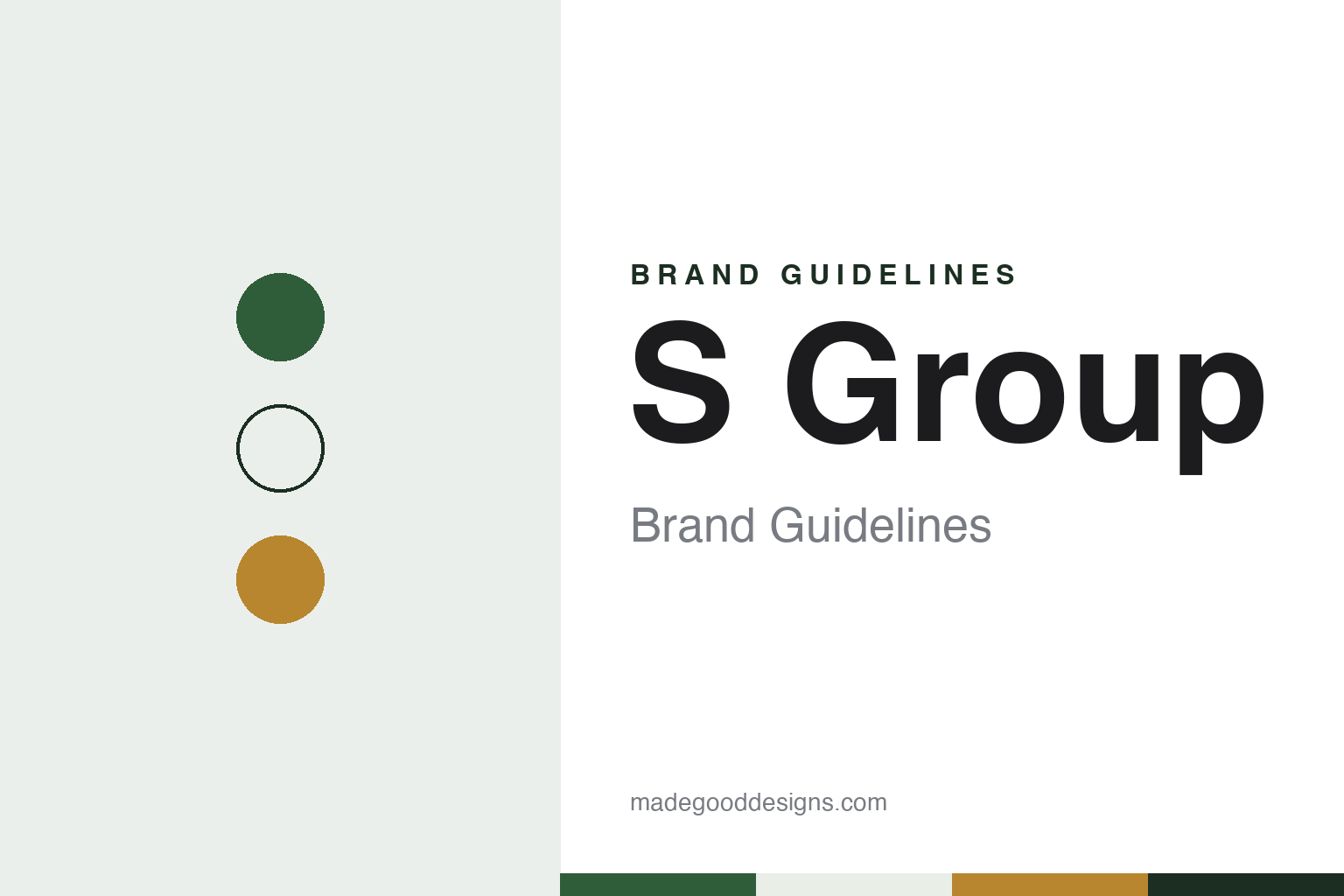
Two constants: a co-op green, white and rye gold palette and a Functionalist sans register. Abstract homage — not an S Group mark; no logo, sign or store banner is reproduced.
SOK
A central company for Finland’s co-operative shops.
S Group is not one company but a network. The company describes itself as a customer-owned Finnish network of retail and service businesses, made up of 19 independent regional co-operatives, five local co-operatives and SOK, the central company that the co-operatives own. Its shoppers can join a co-operative as members, and the members own it. The group says it runs about 2,000 outlets in Finland and employs about 40,000 people, figures it gave on its website in November 2026.
The central company is the oldest part. Finnish Wikipedia says Suomen Osuuskauppojen Keskuskunta — the Central Finnish Cooperative Society, shortened to SOK — was founded in Tampere in 1904 to handle joint purchasing for the co-operative shops and to advise and guide them, and that the co-operative magazine Yhteishyvä has spread the idea since 1905. The group’s own history says SOK set up its first production plants in Helsinki between 1914 and 1916, among them a knitting shop, a brush factory and a coffee roasting plant.
The movement split in 1916. Finnish Wikipedia says the mainly urban, working-class co-operatives left to form their own central bodies, KK and OTK, and for almost eight decades Finnish co-operative retail ran in two separate camps; the co-operatives that stayed with SOK became known as the Pellervo co-operatives, after the Pellervo Society. The group’s own account calls the years from 1920 to 1950 a “golden era and wartime”, when SOK grew into a large wholesale business and built industrial plants of its own to supply the shops.
Membership works through the shops themselves. English Wikipedia says a customer pays a small sum into a local co-operative to become a client-owner and receives the S-Etukortti card, and that purchases earn a Bonus paid back into an account at S-Bank, the group’s bank, which the group says it set up at the end of 2007. The Bonus system began in a few co-operatives in the late 1980s and became national in 1994, according to the group.
Colour
White walls, big windows and “Huttunen’s box”.
Before it had chain logos, SOK had an architecture. Docomomo Finland, the modern-architecture heritage organisation, says SOK founded a building department in 1920 to design its plants and co-operative shops across the country, and that the architect Erkki Huttunen, who joined it in 1928, soon became its most significant designer. Through him, Docomomo says, the forms of Functionalism spread into the design of SOK’s co-operative shops.
The change was quick. Huttunen’s first scheme for the Aitta co-operative shop in Sauvo, drawn in May 1929, still used historical stylistic elements; after new influences from co-operative shop design in Sweden, he drew a completely new design at the end of 1931, and the shop was built in 1933. Docomomo Finland says this “Functionalist shop” was the first of a modern shop type at the SOK building department and served as the basis for tens of similar village shops in the 1930s: oblong two-storey brick buildings with large shop windows and white-rendered facades, under a roof that reads as flat. The Finnish Architecture website, run by Archinfo, adds that in 1930 Huttunen and the architect Paavo Riihimäki designed a small flat-roofed countryside store that became one of the commonest SOK buildings of the decade, nicknamed “Huttunen’s box”.
The style reached industry and offices too. Docomomo Finland says SOK’s mill at Toppila in Oulu, completed in 1929, still followed the classical tradition, but that the need for new building types — rural shops, combined office and warehouse buildings, large grain silos — pushed Huttunen towards modernism, until each new building became a manifesto and the idea of “co-operative shop Functionalism” emerged. Its purest form, Docomomo says, is the SOK office and warehouse in Oulu of 1938, built entirely of reinforced concrete with strip windows and long cantilevered canopies; SOK stopped using it in 1988 but still owns it, and it has been protected in the town plan since 1986.
The same architect shaped the group’s flagship. According to Archinfo, planning of the Sokos department store in Helsinki began in 1938, construction started in 1939 and the building was completed in 1952. The group says it opened on Mannerheimintie that year with the Vaakuna Hotel in the same building, and that the Sokos name later spread to smaller stores, other businesses and the Sokos Hotels chain.
Typography
Signs, own labels and group pages.
Europe’s supermarket, discount and variety chains show themselves first through the shop sign. A short name, a monogram or a block of colour has to work on a high-street fascia, a carrier bag, a trolley and a staff uniform at once. When Rewe renamed its Austrian Merkur stores Billa Plus in April 2021, the Austrian broadcaster ORF listed exactly those items — logos, shop fronts, bags and work clothing — as the things to be changed over. Albert Heijn’s lower-case “ah” monogram has been used since 1966.
Own-label packaging carries the identity onto the shelf. Chains name their ranges in their own words, from organic lines to entry labels and delicatessen ranges, and heritage archives such as the Stichting Albert Heijn Erfgoed foundation keep older packs that show how those labels looked decades ago. A change of colour or logo usually reaches packs, shelves, store interiors and campaigns in stages, as Billa’s yellow-and-white scheme did in the Czech Republic from 2024.
Formats and networks are part of the picture too. Many chains run several store types under one name — a neighbourhood supermarket, a larger flagship, a convenience shop at a station or filling station, and home delivery — and publish their store and country counts on their own corporate pages. Those counts change often, so this guide gives each one with the date of its source.
Ownership varies widely. Some chains still carry a founder’s name; others belong to listed retail groups, to family holdings or to co-operatives owned by their members or retailers, and several have been bought, merged or renamed over the decades. Corporate pages on founders, owners and retail groups set out those structures, and each guide here states them as dated facts, separating what independent sources record from what the companies say about themselves.
Aa
A plain Functionalist sans, in the spirit of the white co-operative shops. (Specimen set in Archivo, a sans STAND-IN; NOT the S Group logo or any store sign.)
S Group
Regional co-operatives and national chains.
The modern group was assembled in a crisis. Finnish Wikipedia says SOK and its co-operatives ran into financial trouble in the 1970s, and that at the co-operatives’ annual meeting on 3 June 1982 the members voted to make the reform of SOK conditional and urgent. Of 183 co-operatives in 1982, only about half remained two years later, as shops were folded into larger regional co-operatives. SOK gave up its industrial plants, and the network of regional co-operatives and the SOK group took the name S Group (S-ryhmä) in 1984, according to Finnish Wikipedia; the group’s own history describes the same reform and the network of regional co-operatives that still operates.
The store banners grew out of that structure. The group says the Keskimaa co-operative opened a Prisma hypermarket at Seppälä, in Jyväskylä, in 1972, and that the S-market chain was set up at the end of the 1970s. English Wikipedia lists the grocery chains as Sale, Alepa, S-market, Prisma and Food Market Herkku, alongside ABC service stations, Sokos department stores and Sokos Hotels; the group says the first ABC station store opened at Utti in December 1998. Own labels named by English Wikipedia include Rainbow and Kotimaista, and the X-tra range made with the Nordic co-operative buyer Coop Trading.
Abroad, the group has moved in and out. It says it opened a Citysokos store in Tallinn in 1995 and that the city’s Hotel Viru joined Sokos Hotels in 2003; English Wikipedia says the group announced its withdrawal from Latvia and Lithuania in May 2017. In April 2026 SOK agreed to sell Prisma Peremarket, its Estonian Prisma business, to Coop Estonia, ERR News reported; ESM Magazine reported on 3 September 2026 that Coop Estonia had completed the purchase of the 13 stores after the Estonian Competition Authority approved it in May, with the stores keeping the Prisma name until each was rebranded. SOK says it continues to run travel and hospitality business in Estonia.
For a design guide, S Group shows how a co-operative can carry a shared identity through buildings, banners and a membership card rather than one shop name. Compare Kesko, which English Wikipedia names as its close competitor in Finland, and Coop Switzerland, another co-operative retailer. For this guide we use a co-op green, a white and a rye gold with a sans, an unofficial interpretation; no product or logo is reproduced.
Explore & save
Keep S Group’s identity on hand — save it to a board in the Made Good inspiration library.
S Group identity set
Pin the S Group co-op green, white and rye gold palette and the Functionalist sans register to your own board.
Source & notes
Frequently Asked Questions
What font can I use to match the S Group look?
This guide describes S Group’s type as “A plain Functionalist sans, in the spirit of the white co-operative shops”. Its type specimen is set in Archivo from Google Fonts as a stand-in; Archivo is not S Group’s own lettering.
What colours are in the S Group palette?
This guide’s S Group palette is Co-op green #2F5D3A, Pine ink #1C2E22, Render white #E9EEE6, Rye gold #B8862E and Paper #F7F7F4. The tones are the guide’s own unofficial interpretation, not official S Group hex codes.
When was S Group founded?
S Group was founded in 1904 (SOK), in Tampere, Finland.
Who owns S Group?
S Group today: SOK, Helsinki; owned by the co-operatives. S Group is known for Prisma, S-market, Alepa, Sokos.