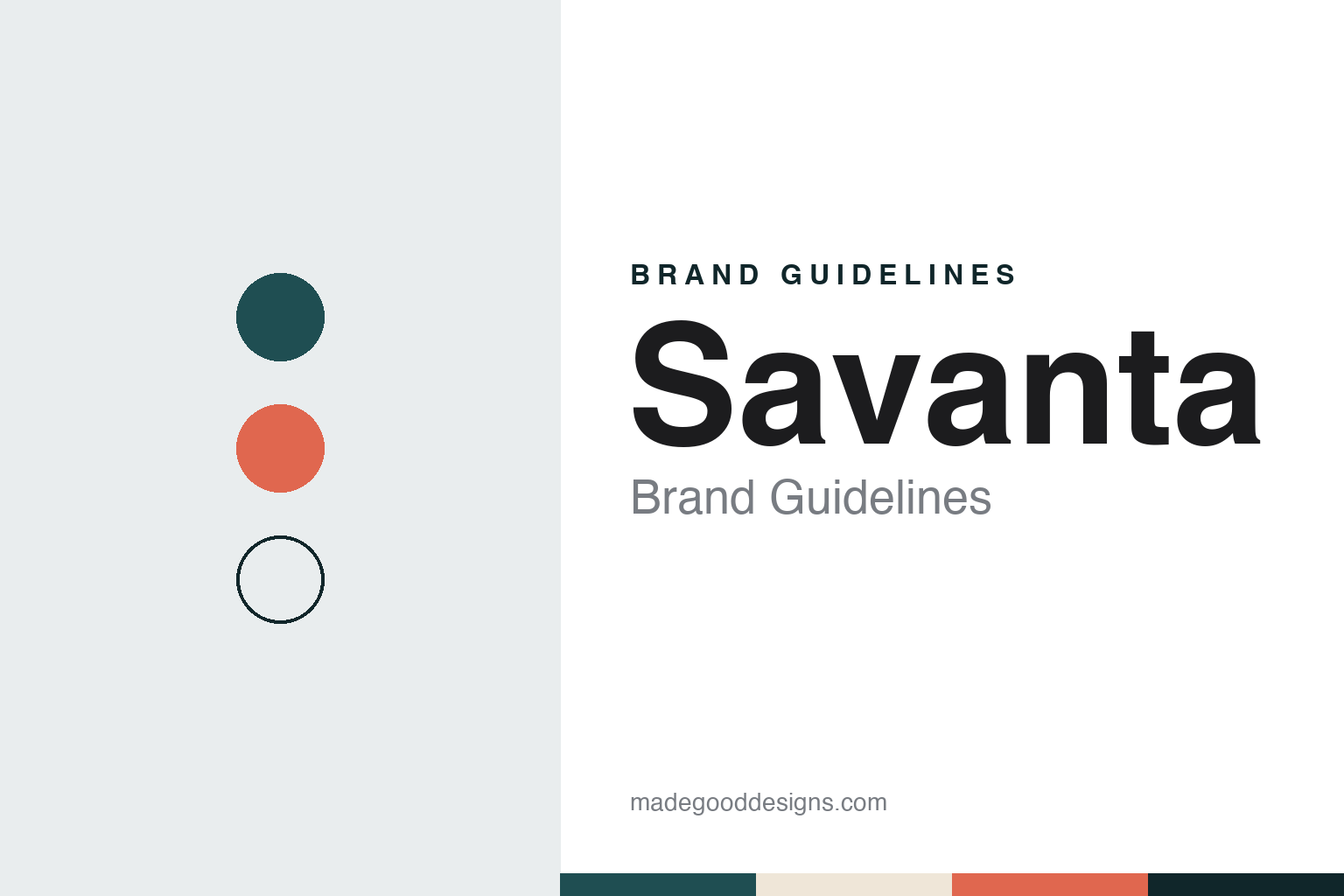
Savanta Brand Guidelines
Four agencies, one coined name and a family of Vues.
Aa
Two constants: a deep teal, sand and coral palette of our own and a rounded geometric sans register. Abstract homage — not a Savanta product or mark; no logo, report or dashboard is reproduced.
Four agencies, one name
A roll-up inside a communications group.
Savanta is a London-based market research and data company, and it is younger than most of its parts. Research Live, the news site of the Market Research Society, reported in February 2019 that MIG Global, part of the communications group Next 15, had that month combined four of its data businesses — Morar HPI, Viga, Charterhouse and Circle Research — into a new company called Savanta. The company’s own history page gives the same four names and dates its start to 2019.
The pieces had been collected over several years. Savanta’s timeline says Morar Consulting joined Next 15 in 2015 and bought HPI Research in 2016, the year Next 15 launched the fieldwork agency VIGA. Circle Research, a business-to-business specialist, and Charterhouse, with a financial-services focus, followed in 2017, and the data-collection business Thinqonline in 2018. Savanta describes Next 15 as an AIM-listed marketing group; in the 2019 interview its chief executive described his boss, Tim Dyson, as the man who set up Next 15.
The name was chosen with care. Chief executive Roger Perowne told Research Live that Savanta is based on the word “savant,” a knowledgeable person, and that he wanted a name that was easy to say, did not mean something rude in another country and could be owned. He described the business as “an intelligence company rather than a data company or a research company,” with about 200 people at the time, and said the combined scale had paid for tools such as BrandVue, its brand-tracking product, which he called an investment that a 30-person firm would have been unable to make.
He also described a change in how people were organised: teams were replaced by practices, pools of expertise inspired by consultancies, so that one researcher could work across several, and line management gave way to what he called career management. The merger, he said, had been prepared over six months with the owners and managers of the four businesses, and the new company was making a major investment in marketing at a time when some larger research brands had held back.
Colour
Buying expertise, then ComRes.
From 2019 Savanta grew mainly by acquisition. Its history page lists the custom research division of Wealth-X and the New Jersey consultancy HSR Associates in 2019, along with a move to a larger office in New York. The most familiar name it added that year was ComRes. English Wikipedia says ComRes was set up in 2003 as Communicate Research Ltd by Andrew Hawkins, later its chairman, and over time widened from public affairs into sectors such as financial services, education, transport and the voluntary sector. It took the name Savanta ComRes in 2019 when it was sold to Savanta, and has been known simply as Savanta since 2022. It also records a Market Research Society award in 2014 for ComRes’s public policy and social research. Savanta’s own page describes ComRes as a specialist in public policy, corporate reputation and communications research.
More businesses followed, each listed on the company’s timeline: the UK division of Future Thinking in 2020, which brought a face-to-face fieldwork network; the youth specialist YouthSight and MSI International in 2021; the user-experience agency MindSpark Research in 2022, the same year Savanta opened a technology hub in Amsterdam; and, in 2023, the North American shopper-research firm Explorer Research and Infosurv, an employee and customer-experience agency. Savanta says YouthSight brought a panel of 150,000 people aged 13 to 30.
English Wikipedia lists offices in London, Oxford, New York, San Francisco, Toronto, Amsterdam and New Delhi, and the company runs separate websites for the United Kingdom, the United States and Europe. Its methods, the same source says, range from telephone, face-to-face and online surveys to focus groups, consultations and social-media monitoring, with analysis such as market segmentation, regression, MaxDiff and conjoint studies.
Typography
Design and documentation.
Market research and data firms sell something that is hard to picture: answers drawn from surveys, panels and statistics. Their public identity is therefore carried less by products than by publications and screens. Euromonitor International, for example, presents an annual Top Global Consumer Trends report as a headline release, issued from London in November 2026 in English, Japanese, Korean, Chinese, Arabic and Portuguese, while its newsroom lists press coverage that quotes its analysts.
The platform has become the main showcase. Euromonitor describes Passport as a single hub for market, industry and consumer data, and in June 2026 the trade news service MrWeb reported a rebuilt version with a conversational, AI-based interface. In the same month Dynata launched Dynata+, which it describes as a self-service platform where users check feasibility, see pricing and launch survey projects themselves. Firms that run panels also publish panel books and quality pages, and some name a standard such as ISO 20252 on their sites.
Numbers carry much of the visual weight. Euromonitor’s 2027 trends release gives each trend a short coined name followed by a few headline survey percentages, and Dynata says its new platform shows feasibility, pricing and project progress in real time. In a category like this, a brand is read through headings, figures and the screens that hold them.
Ownership is often part of the story told on corporate pages. Dynata’s press room keeps its 2017 merger release, its 2019 rename and its 2024 restructuring announcements; Euromonitor’s site describes it as independent and privately owned, and the UK company register shows its holding structure. This guide sets out what can be checked about each firm — who founded it, who owns it, and what it says about its own reach — and marks clearly what rests on the company’s word.
Aa
A rounded geometric sans for a coined, easy-to-say name. (Specimen set in Manrope, a sans STAND-IN; NOT the Savanta logo.)
Savanta today
Still inside Next 15, with a promise and a suffix.
Savanta still sits inside Next 15. In November 2026 the group’s page on its businesses listed Savanta beside agencies such as M Booth, MHP Group and Pretzl, and described it as having 22.9 billion data points, 4,000 tracked brands and a growing suite of AI-powered products, including virtual personas and syndicated data licensing; those figures are Next 15’s own. Savanta’s website calls the company “a data, market research and advisory company” and runs a knowledge centre of free reports with titles such as Consumer Compass, Grocery Eye and a quarterly business-confidence survey for Northern Ireland.
Its products share a naming system built on one suffix, “Vue”: BrandVue, MarketVue and MillionaireVue, the last aimed at wealthy audiences, sit beside Essentials omnibus surveys, SnapMe videos and Virtual Personas by Savanta. Its public face is a short promise, “Make Better Decisions,” repeated on the about page, in the footer and in the company description, and its homepage features a BrandVue study of the UK’s Top 100 Most Loved Brands for 2024. Its audience panels cover business buyers, consumers, high-net-worth individuals, students and young people, and its industry pages run from automotive and luxury to sport and travel.
For a design guide, Savanta shows how a roll-up of specialist agencies can be given one short, coined name and one plain promise, with product names built from a shared suffix. Compare YouGov, another London research firm, and Ipsos. For this guide we use a deep teal, a warm sand and a coral with a sans, an unofficial interpretation; no product or logo is reproduced.
Explore & save
Keep Savanta’s identity on hand — save it to a board in the Made Good inspiration library.
Savanta identity set
Pin the Savanta deep teal, sand and coral palette and the rounded geometric sans register to your own board.