Skuld Brand Guidelines
The Oslo mutual of 1897 that took its name from a norn and its symbol from an anchor.
Aa
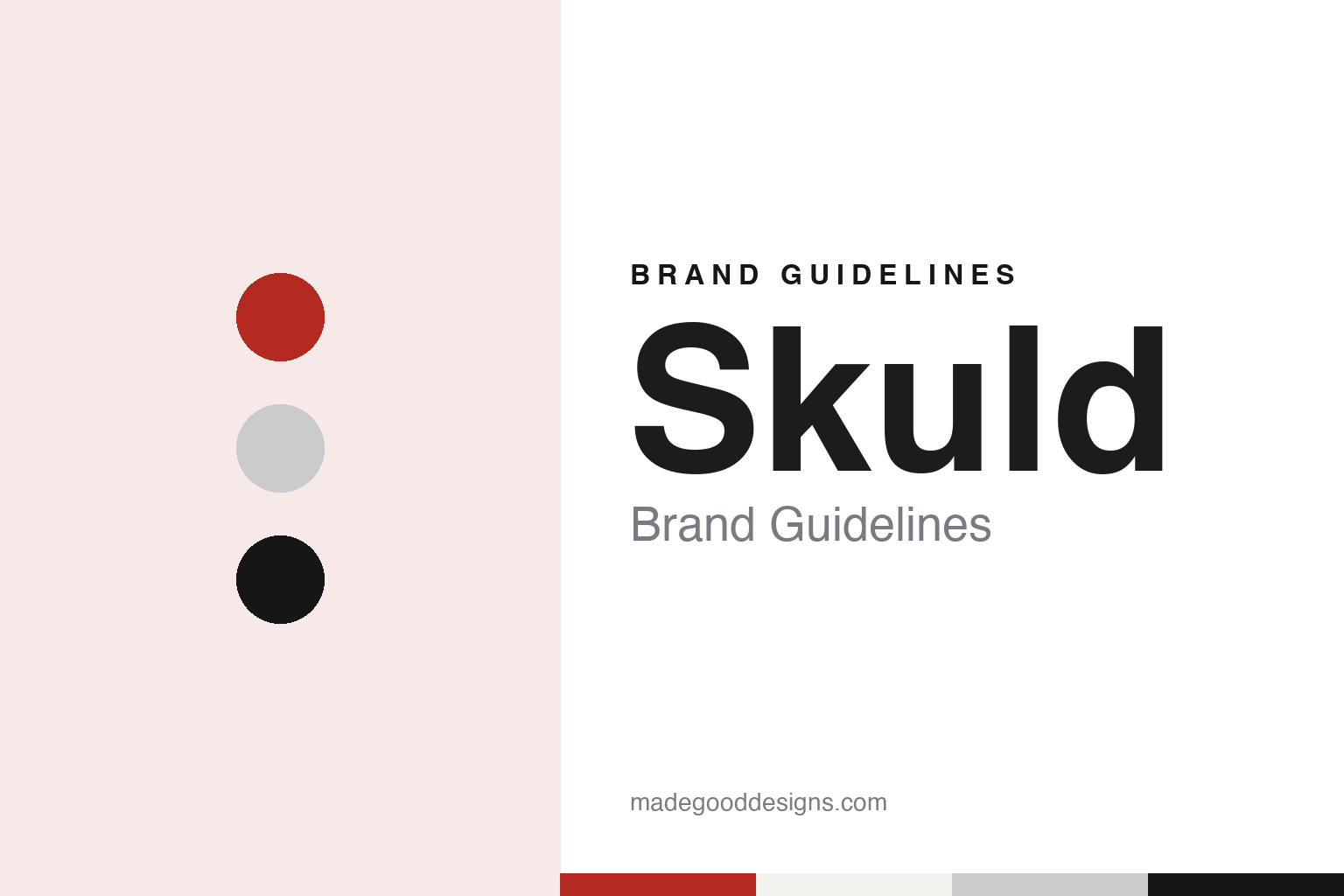
Two constants: a Skuld red, grey and ink palette and a Firm sans register. Abstract homage — not a Skuld product or mark; no anchor, logo or document is reproduced.
A norn’s name
Oslo, 1897.
Skuld was founded in Oslo in 1897. English and Norwegian Wikipedia both describe it as the first P&I club outside the United Kingdom, and Store norske leksikon, the Norwegian encyclopedia, gives the same year and describes it as a mutual owned by its customers, the shipowners. Its full name is Assuranceforeningen Skuld (Gjensidig); “gjensidig” is the Norwegian word for mutual. In a press release of 13 January 2022, Skuld said it had grown over 125 years from “a P&I Club for Scandinavian shipowners” into a global marine insurer.
The name comes from Norse mythology. English Wikipedia explains that Skuld is one of the norns, the powerful goddesses who weave the threads of destiny. The same article quotes the purpose of the association as “mutual insurance against liabilities and losses incurred by members in direct connection with the operation of the entered vessels.”
Store norske leksikon’s article on P&I cover gives the background. British shipowners began forming mutual associations for liabilities beyond their hull cover in the second half of the nineteenth century, the first in 1855, and in Norway P&I cover is written by two mutual associations, Skuld and Gard. The sources used for this guide do not say how Skuld operated during the occupation of 1940–1945. English Wikipedia records a major restructuring between 2000 and 2003, which it says strengthened the club’s finances and led it into other marine insurance, including business written on a non-mutual basis.
Colour
Owned by its members.
As a mutual, Skuld has no shareholders. English Wikipedia says it is owned and controlled by its insured shipowners, the members, who vote at the general meeting according to the gross tonnage of the ships they have entered. The members elect a committee of between 12 and 30 people that meets twice a year, and a board of between five and nine. Skuld’s own about page says it has “no external shareholders” and that its governance is meant to keep decisions in line with the long-term interests of the maritime community. It is a member of the International Group of P&I Clubs, the group of mutuals that work together on reinsurance and on industry matters of common interest, English Wikipedia says.
Its product list reaches beyond P&I. Skuld’s facts and figures page names Owners’ Mutual P&I and Defence; hull and machinery cover, with ancillary products including loss of hire; Charterers’ Liability and Defence; and Skuld Yacht P&I, with fixed-premium and offshore products alongside. By its own account it serves shipowners, charterers and traders, energy and offshore operators, and yacht owners. For the 2025/26 policy year the same page gives 126 million gross tons entered for P&I, and it cites an “A” rating from Standard & Poor’s in a report of August 2025.
Skuld says it works from 11 offices: Oslo, as head office, with Bergen, Bermuda, Copenhagen, Hamburg, Hong Kong, London, New York, Piraeus, Singapore and Tokyo. It gives its staff as around 362 people of more than 30 nationalities. Its president and chief executive is Ståle Hansen, who already held the role in May 2017, when the club marked its 120th anniversary.
Typography
Mutual insurers in public.
P&I clubs are mutual associations: the shipowners and charterers they insure are also their members, and so, in effect, their owners. Store norske leksikon, the Norwegian encyclopedia, dates the first British club to 1855; clubs such as Gard and Skuld are members of the International Group of P&I Clubs, whose members work together on reinsurance and shared industry matters. Their core product is liability cover, written alongside hull cover and freight, demurrage and defence cover.
Because their customers are their members, the clubs present themselves less like retailers and more like institutions. Their websites are built around working documents: rules and statutes, guidance to the rules, member circulars, lists of entered vessels, correspondents and ports, and office maps that show where claims handlers sit, from Oslo and London to Piraeus, Hong Kong and Tokyo. Annual reports and renewal pages carry the financial side of the story, and loss-prevention guides, posters and articles are offered to members as guidance.
Photography in this category tends to show ships, harbours and ports as the clubs publish them, while names and symbols lean on the sea and on long histories. Some clubs explain their marks in public: Skuld, for example, sets out its anchor, its horizon line and its red on its own website. Where a club publishes no such details, and in every case for colour values, the palettes in these guides — navies, teals, greys, reds and golds — are our own interpretations rather than official codes.
This guide sets out what can be checked about each club: when and where it was founded, how it is owned and governed, what it says about its cover and its offices, and which mergers or acquisitions have shaped it, with dates. Claims that rest only on a club’s own pages are marked as the club’s own word.
Aa
A firm sans — an anchor and a horizon line. (Specimen set in Archivo, a sans STAND-IN; NOT the Skuld logo.)
Skuld
“Red is our colour.”
Skuld explains its identity on its own website. For its 125th anniversary it introduced a new visual identity, announced on 13 January 2022, saying it had taken the moment “to modernise our branding and corporate identity”; its chief executive said the club wanted its branding to reflect “more precisely who we are today.” At the time, the release said, Skuld had 10 offices around the world; its website now lists 11. Its visual-identity page sets out the parts. The first is the anchor, which Skuld calls “a symbol of hope, steadfastness, and assurance”: dropped, it stands for security and stability; lifted, for hope and new beginnings. The second is the horizon, used as a visual metaphor for what unites the club and its members — “a continuous line that represents the past, the present, and most importantly the future.”
The third is colour. “Red is our colour,” the page says, describing the red as energetic and powerful, with warmth and confidence. Skuld offers its principal logo in Skuld red, with light grey and black versions, and specifies the red with Pantone, CMYK, RGB, NCS and RAL references. Its stated purpose is “Safeguarding our maritime community today and for generations to come.” Its sponsorships stay close to the sea: Skuld says it sponsors the P&I cover of the tall ships Statsraad Lehmkuhl, first entered with it in 1975, and Christian Radich, entered in 1976, supports the Scandinavian Institute of Maritime Law at the University of Oslo, and sponsors the NorShipping conference held every second year in Oslo.
For a design guide, Skuld shows how a mutual can turn a mythological name, an anchor and a single red into a clear identity. Compare Gard, the other Norwegian P&I club, founded in Arendal in 1907, and DNV, the Norwegian classification society. For this guide we use a red, a horizon grey and an ink with a sans, an unofficial interpretation; no product or logo is reproduced.
Explore & save
Keep Skuld’s identity on hand — save it to a board in the Made Good inspiration library.
Skuld identity set
Pin the Skuld red, grey and ink palette and the Firm sans register to your own board.