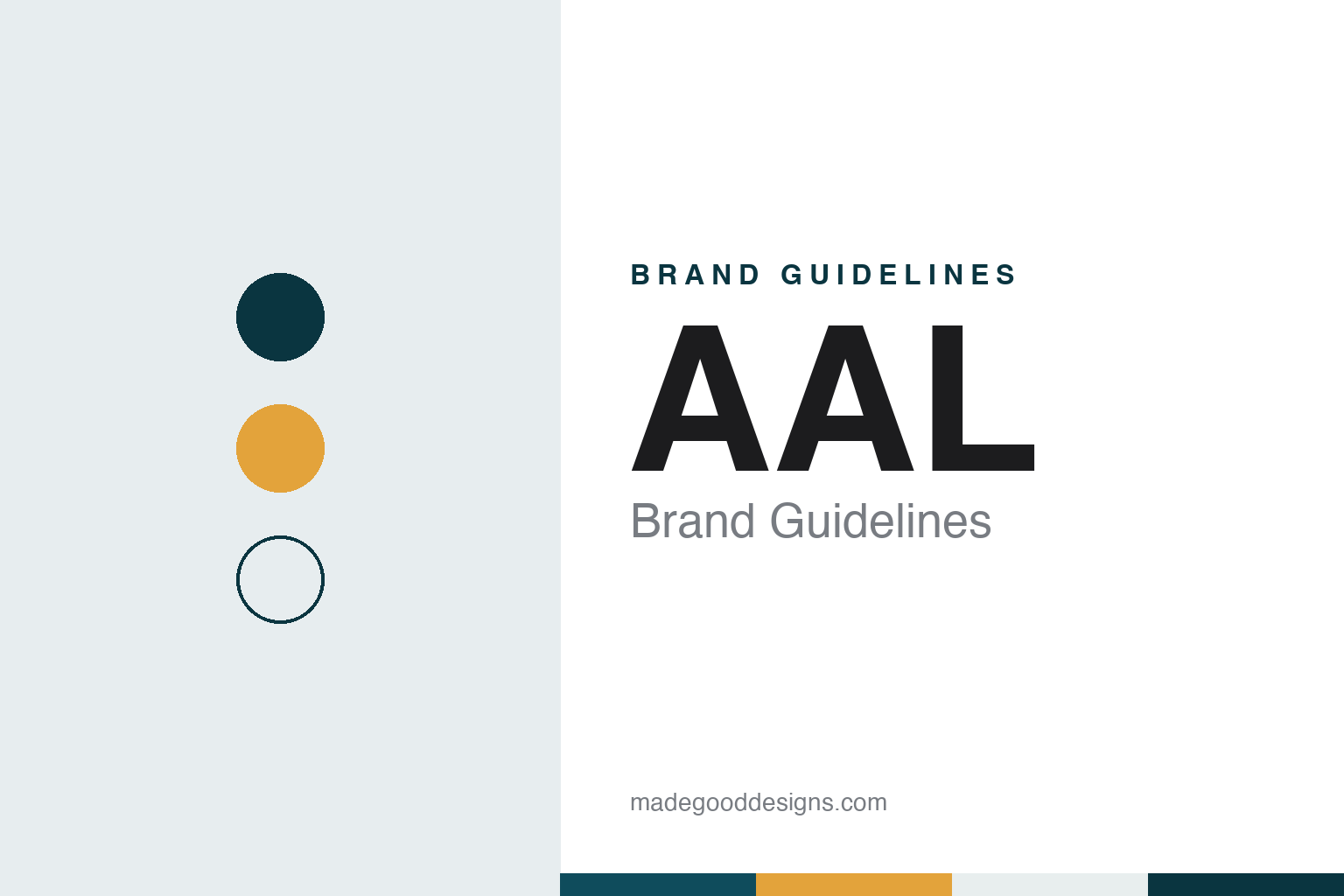
AAL Brand Guidelines
From an Australia–Asia liner to a global heavy-lift carrier, under three letters.
Aa
Two constants: a teal, amber and haze palette and a grotesque sans register. Abstract homage — not an AAL vessel or mark; no ship, logo or livery is reproduced.
Austral Asia Line
A liner service between Asia and Australia.
AAL began as Austral Asia Line. According to the company’s own history, Austral Asia Line BV was incorporated in the Netherlands in 1995, with its commercial head office in Brisbane, to run a breakbulk and multipurpose liner service between South East Asia and Papua New Guinea, Queensland and Australia’s Northern Territory. A sister company, Project Asia Service, followed in 1998 to link North Asia with Papua New Guinea and Australia’s east coast. In 2004 AAL launched a PNG Express service between Asia and Papua New Guinea, since replaced by its New Pacific Line, and set up a dedicated project cargo department.
The business then moved its centre north. AAL says it opened a representative office in Singapore in 1999 and one in Shanghai in 2000, merged Austral Asia Line BV and Project Asia Service in 2006, and in 2008 incorporated Austral Asia Line Pte Ltd in Singapore, moving its headquarters there. Offices followed in Korea in 2006, in Houston and Hamburg in 2012, and in Japan and the United Arab Emirates in 2015. In 2011 it launched a Tramp & Projects division for chartering, and in 2013 that division took AAL into North America with frequent fixed-route sailings; the company says AAL Americas marked ten years in 2024.
AAL describes itself as part of Schoeller Holdings Ltd., a privately owned investment group based in Limassol, Cyprus, whose businesses span shipping — ship owning, ship management, ship operation and chartering — as well as aviation, hospitality, technology and horticulture. On its homepage the carrier calls itself “a member of the prestigious Schoeller Holdings Group.” In June 2026 Breakbulk.News reported that AAL was marking 30 years of operations, and the company says it held anniversary events for customers and partners around the world during 2025.
Colour
Lettered classes, from D to Super B.
AAL’s fleet is organised into lettered classes, and its history can be read through them. The company says its first owned, newly built heavy-lift multipurpose ships, the D-Class of 30,000 dwt, arrived in 2001 and have since been retired, as have the four H-Class ships introduced in 2006. In 2011 the AAL Brisbane was the first delivery of ten A-Class vessels of 31,000 dwt, and in 2012 the AAL Fremantle was the first of four S-Class ships of 19,000 dwt. Its website now lists T-Class, Super B-Class, A-Class, S-Class, G-Class and W-Class ships, ranging from 12,600 to 33,000 dwt, with a fleet list and vessel descriptions for each.
The third generation is the Super B-Class of 32,000 dwt dual-fuel heavy-lift vessels. AAL says the first four of an eight-ship order were delivered in 2024 and two more in 2025. Breakbulk.News described the AAL Houston as a dual-fuel ship fitted with three port-side cranes with a maximum lift of 700 tonnes and space for up to 90,000 freight tons of project and breakbulk cargo. In May 2026 the magazine reported that AAL had named the AAL Mumbai at the CSSC Huangpu Wenchong Shipyard in Guangzhou, taking the Super B-Class to eight ships, with two more due in 2028. On that ship each crane was raised from 350 to 400 tonnes, for combined lifts of up to 800 tonnes, and the name, the magazine said, reflects AAL’s growing focus on India.
The services fall into three models, which AAL calls Chartering Solutions, Liner Services and Fixed Trade Route Services. Its liner network connects Asia with Australia and Oceania and includes a Europe – Middle East – India – Asia service launched in 2020, while the fixed trade routes offer monthly sailings between Asia and the Americas and between Asia and Europe. Its cargo pages are divided into heavy lift and project cargo, breakbulk and unitised cargo, wind energy equipment, floating cargo, earthmoving equipment and rolling stock, and dry bulk, and it lists customers in energy, mining, forestry, agriculture and construction.
Typography
How heavy-lift carriers present themselves.
Heavy-lift and project-cargo carriers sell something that is hard to show before it happens: the movement of a single object too large or too heavy for a container. Their websites lean on photographs of their own ships and cargo instead, heavy-lift vessels with paired cranes, decks loaded with modules, port cranes or offshore structures, published by the companies themselves as records of past voyages.
Colour carries much of the identity. Company names are painted large on hulls and crane booms, and across this sector the wordmarks often appear in strong orange, blue or red against white superstructures and dark hulls, so that they read from a quayside or in an aerial photograph. The same few colours then tend to run through the livery, the website and the printed material.
Fleet pages sit at the centre of these sites. Ships are grouped by class and described by crane capacity, deck area and deadweight: Jumbo lists its vessels as K3000, J1800 and H800 classes, and BigLift divides its fleet into heavy-lift types and heavy transport vessels such as the MC-Class. Engineering and transport services, from stowage planning to ship-motion analysis, are presented beside the fleet as a second product.
The rest of a typical site is evidence and reach: project-reference galleries sorted by market, from mining to offshore energy and port development; customer magazines and news of ships on order; and office maps showing sales and agency networks across several continents. This guide sets out what can be checked about each company, its founding, its ownership and its fleet, and marks clearly what rests on the company’s own word.
Aa
A grotesque sans for three capital letters. (Specimen set in Barlow, a sans STAND-IN; NOT the AAL logo.)
Three letters
Austral Asia Line becomes AAL.
The name AAL is itself a rebrand. The company says Austral Asia Line was formally re-branded globally to “AAL” in 2015, the same year it opened offices in Japan and the United Arab Emirates; the full name remains in the Singapore company incorporated in 2008. Its website today presents the carrier under the three letters, with pages for sailing schedules and route maps, a media section of news, brochures, photographs and videos, and a Chinese-language version alongside the English one. The company says it has grown into one of the largest multipurpose operators in its sector.
Awards are a large part of how AAL presents itself. Its history lists the Ship Operator of the Year title at the Heavy Lift Awards, run by Heavy Lift & Project Forwarding International, in 2022, 2023 and 2024, a shipping line of the year title at the same awards in 2019, and the project-cargo shipping line category at the AFLAS Awards in most years from 2016 to 2025. It also names an Innovation & Digital Award at the EIC’s WESCA APAC event in 2024 and a cargo operator award at the Supply Chain Excellence Awards Asia Pacific in 2025.
AAL publishes yearly sustainability reports, with editions for 2022 to 2025 linked from its website, and says it has aligned its disclosures with the Global Reporting Initiative Standards and parts of the European Sustainability Reporting Standards. Its stated values are accountability, approachability and leadership, and its stated vision is to become a benchmark for the multipurpose sector by 2030.
For a design guide, AAL shows how a regional liner name can be shortened into three capitals as the business spreads from Brisbane and Singapore to the Americas, Europe and India. Compare SAL Heavy Lift, another three-letter heavy-lift name, and BigLift. For this guide we use a deep teal, a cargo amber and a pale sea haze with a sans, an unofficial interpretation; no product or logo is reproduced.
Explore & save
Keep AAL’s identity on hand — save it to a board in the Made Good inspiration library.
AAL identity set
Save the AAL teal, amber and haze palette and the grotesque sans register to your own board.