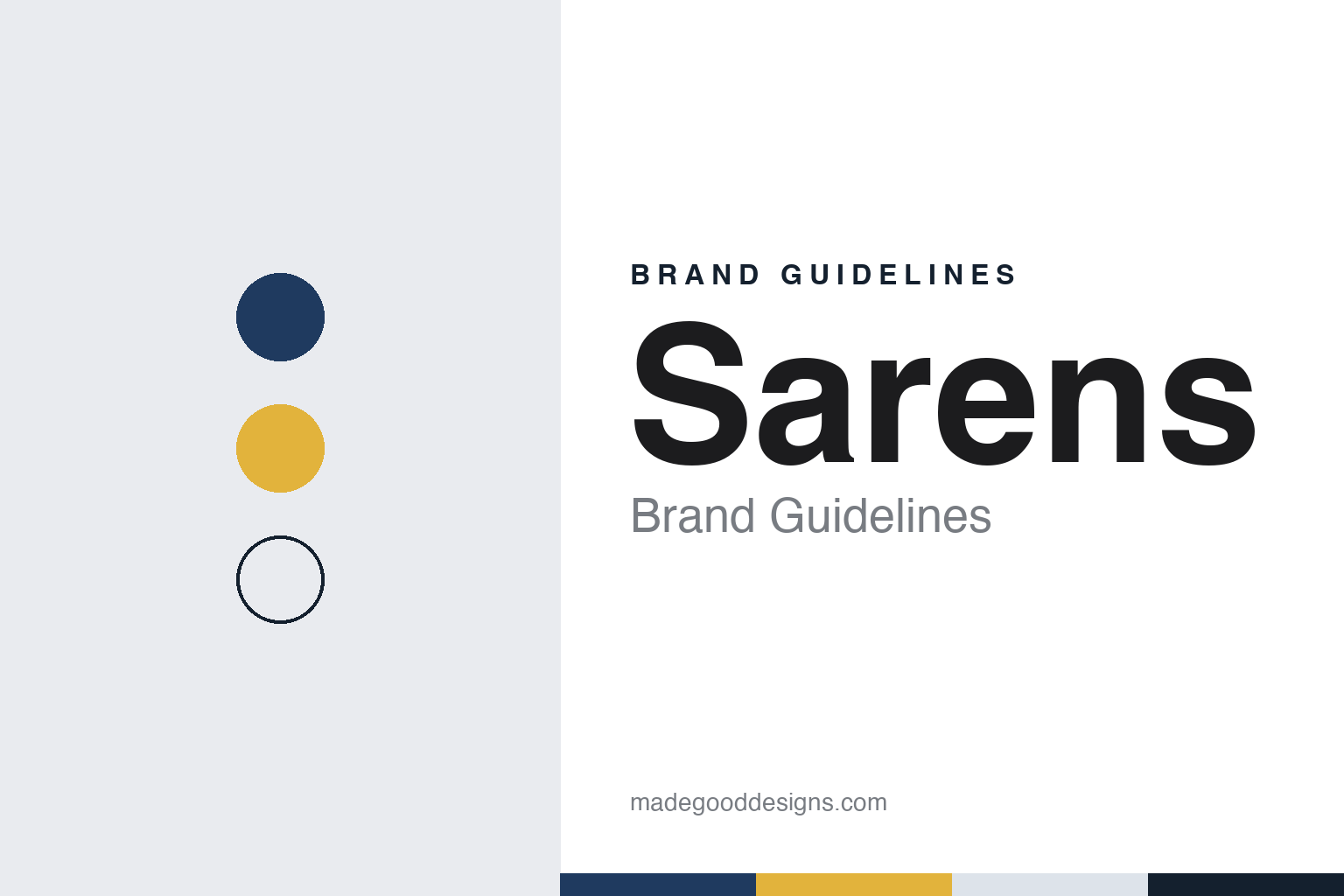
Sarens Brand Guidelines
A horse and cart in Flanders, then cranes named after the family.
Aa
Two constants: a navy, yellow and steel palette of our own and a condensed sans register. Abstract homage — not a Sarens product or mark; no crane, trailer, logo or livery is reproduced.
Frans Sarens
A horse and cart in Flanders.
Sarens began with trees. English Wikipedia says Frans Sarens founded the business in 1921 for forestry works and the transport of trees with horses and carts. The company’s own timeline describes him as a farmer whose horse and cart did that work, and says the business grew in Flanders through the 1930s as his twelve children joined him straight from school. It recalls that the horse and cart soon became a truck, then a cart again for lack of fuel during the war years, before wooden wheels gave way to rubber tyres and horses to engines. The company sums up that early approach as adapting the means to what each client needed.
The sources used for this guide do not say how the Sarens family business operated during the occupation of 1940–1944.
The company dates its own birth to 2 September 1955, when Sarens De Coster was founded, and English Wikipedia gives the same date for its incorporation. In 1958 it took part in the Brussels World Expo, the company says. Through the 1960s it invested step by step in new equipment and grew within Belgium. In the 1970s it added its first barges and self-propelled modular trailers to the fleet and began working in the UK. In the 1980s it entered the Netherlands, which it still counts among its strongest business units, and in the 1990s it completed its first wind-turbine erections and moved into Germany, Poland and Thailand; its Thai page dates the start of work there to 1997.
Growth also came by purchase. English Wikipedia lists the British firm G W Sparrow and Sons in 1997, the crane-rental business of the Dutch firm Riwal in 2007, the American firm Rigging International in 2009, and the Polish firm Zuraw Grohman and Canada Crane Services in 2010. The company’s timeline for the 2000s points to work in New Caledonia with a CC8800 crawler crane, and for the 2010s to moving the Space Shuttle Endeavour in the United States and placing the roof of the Flamanville nuclear plant in France.
Colour
Family ownership, shared and regained.
Sarens stayed wholly in family hands until 2011, the Belgian news agency Belga reported in April 2023, when the Amsterdam investment firm Waterland took a 22 per cent stake to support its international growth. In 2021 that stake passed to Begoos, the holding group of the Belgian entrepreneur Luc Tack. On 3 April 2023 the family announced that it had bought the shares back, and the group was again fully family-owned; KHL reported the next day that Begoos would give up its mandate on the Sarens board, and quoted the company calling the step one of “historic significance.” No financial details were published. The chief executive, Wim Sarens, represents the fourth generation of the family, English Wikipedia says.
The group is based in Wolvertem, part of the municipality of Meise north of Brussels, beside the A12 road, as the regional broadcaster Ring described it in January 2026. It describes its work as crane rental, heavy lifting and engineered transport, for markets that include oil and gas, mining and metals, offshore and modular yards, onshore and offshore wind, civil infrastructure, thermal and nuclear power and solar. Its staff figures vary by page and date: the home page speaks of 100 offices on five continents and more than 5,500 employees, the company story of more than 70 locations and 6,000 employees, and Belga gave about 5,000 people in 2023.
The signature machines are the Sarens Giant Cranes, ring cranes the company designs and builds itself. English Wikipedia dates the first, the SGC-120, to 2011, developed with Rigging International, and the larger SGC-140 to 2017. The SGC-250, nicknamed “Big Carl” after Carl Sarens, the company’s director of technical solutions, projects and engineering, went first to the Hinkley Point C nuclear power station construction site in England. The SGC-90, nicknamed “Little Celeste,” is an electric ring crane, and in 2025 the company launched the SGC-170, which it calls its fifth giant crane and which plugs into the grid, nicknamed “Big Matthias” after Matthias Sarens, the R&D manager behind the in-house design of the series.
The 2020s also brought, in the company’s words, a depot model for reaching clients faster and a growing fleet of material-handling equipment. In January 2026 the employers’ organisation Voka-Kvk Vlaams-Brabant named Sarens its “Gangmaker” for the Noord-Rand region, Ring reported; the regional chair said the prize looks for sustainability, innovation and roots in the region, and the company said the family had been rooted there for 70 years and now counted more than 6,000 colleagues.
Typography
How heavy-lift companies present themselves.
Heavy-lift and project-cargo carriers sell something that is hard to show before it happens: the movement of a single object too large or too heavy for a container. Their websites lean on photographs of their own ships and cargo instead, heavy-lift vessels with paired cranes, decks loaded with modules, port cranes or offshore structures, published by the companies themselves as records of past voyages.
Colour carries much of the identity. Company names are painted large on hulls and crane booms, and across this sector the wordmarks often appear in strong orange, blue or red against white superstructures and dark hulls, so that they read from a quayside or in an aerial photograph. The same few colours then tend to run through the livery, the website and the printed material.
Fleet pages sit at the centre of these sites. Ships are grouped by class and described by crane capacity, deck area and deadweight: Jumbo lists its vessels as K3000, J1800 and H800 classes, and BigLift divides its fleet into heavy-lift types and heavy transport vessels such as the MC-Class. Engineering and transport services, from stowage planning to ship-motion analysis, are presented beside the fleet as a second product.
The rest of a typical site is evidence and reach: project-reference galleries sorted by market, from mining to offshore energy and port development; customer magazines and news of ships on order; and office maps showing sales and agency networks across several continents. This guide sets out what can be checked about each company, its founding, its ownership and its fleet, and marks clearly what rests on the company’s own word.
Aa
A condensed sans for a family name carried on giant cranes. (Specimen set in Barlow Condensed, a sans STAND-IN; NOT the Sarens logo.)
Sarens
A family name on the boom.
The family name is the brand. The group carries the founder’s surname, and its newest giant cranes carry the nicknames of family members: Big Carl and Big Matthias. The website header pairs the name with the line “Nothing too Heavy, Nothing too High.”
The rest of the site is built around the work. News appears under the heading Heavyweight News, alongside press releases, a Picture of the Month, films and project pages, and the company runs Sarens Academy training centres, a Sarens Women+ section and a Creators & Explorers page. The equipment pages are arranged by type, from cranes and transport equipment to hoisting, maritime and material-handling equipment, with a separate section for used machines for sale.
For a design guide, Sarens shows how a family surname, a short slogan and a handful of named machines can carry an industrial identity across many countries. Compare Mammoet, the Dutch heavy lifting and transport company, and Fagioli, the Italian heavy-transport company. For this guide we use a deep navy, a hook yellow and a steel grey with a condensed sans, an unofficial interpretation; no product or logo is reproduced.
Explore & save
Keep Sarens’s identity on hand — save it to a board in the Made Good inspiration library.
Sarens identity set
Save the Sarens navy, yellow and steel palette and the condensed sans register for your own heavy-industry projects.